Photo Credit
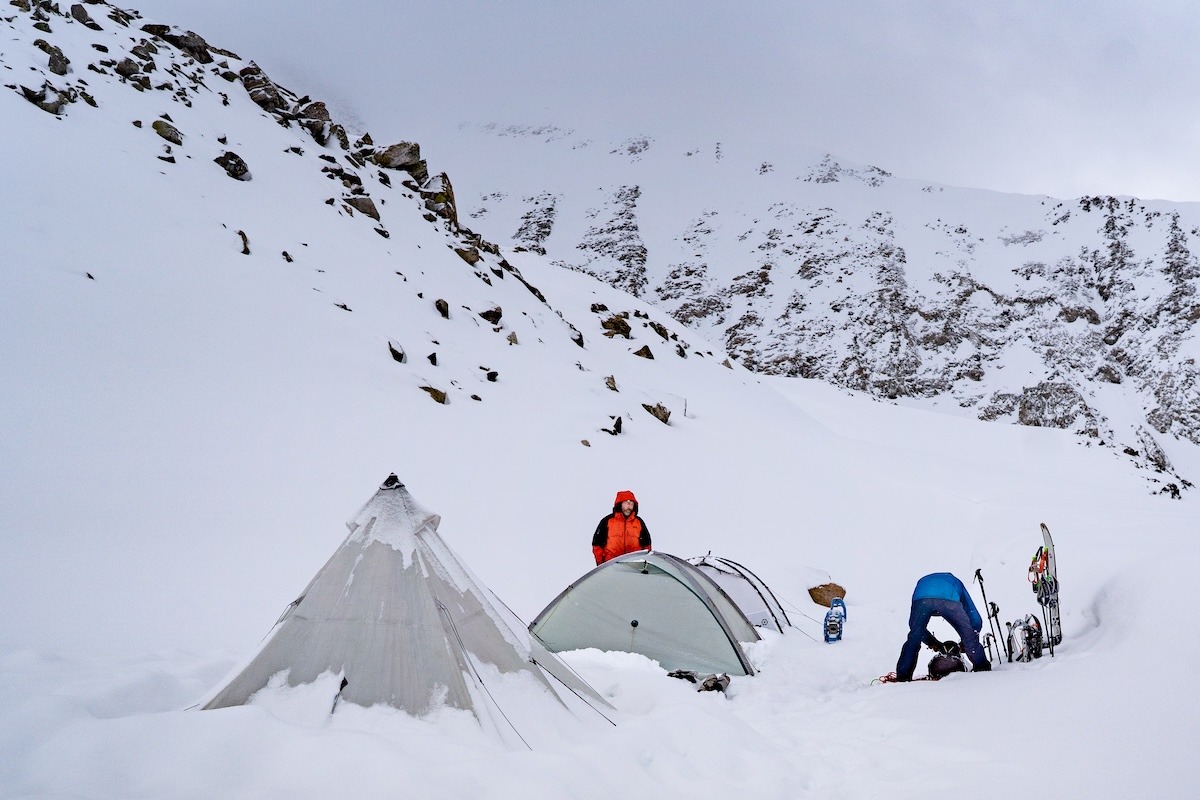
From backcountry ski tours to mountaineering in some of the most brutal weather on Earth, a 4-season tent is the last line of defense between you and the elements. Accordingly, these tents are much stronger than a typical 3-season backpacking tent, with less mesh, more substantial canopies and rainflies, tougher pole structures, and a whole host of features designed for winter use. Below are our picks for the best 4-season tents of the year, with the Mountain Hardwear Trango 2 coming out on top. Given the range of possible uses, we’ve categorized the models into mountaineering, basecamp, and treeline. For more background, see our 4-season tent comparison table and buying advice below the picks, as well as our breakdown on how we approach the testing process.
Editor’s note: We updated this guide on January 23, 2026, to add the SlingFin HotBox and Black Diamond Mega Snow, move the Alps Mountaineering Tasmanian up to our top budget pick, and remove unavailable models from REI and Black Diamond. We also included new photos from recent testing trips, added a tested and dismissed section, and ensured all other information was current at the time of publication.
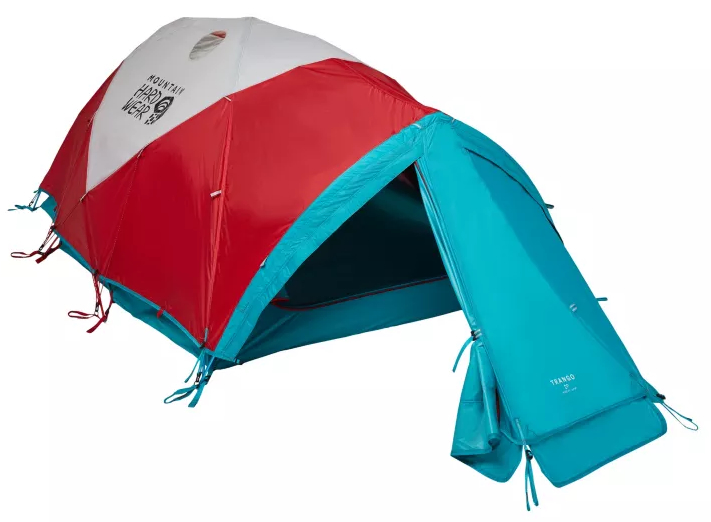 Category: Basecamp
Packaged weight: 9 lb. 7 oz.
Floor area: 40 sq. ft.
Wall(s): Double
What we like: Tough build, great livability, and comes in multiple sizes.
What we don’t: Heavy and expensive.
Mountain Hardwear’s Trango has been trusted for years in the most inhospitable regions of the planet. And although it’s one of the heavier tents on our list, you’ll be thankful for the robust build when you’re waiting out tough conditions at basecamp. Holding back nothing in the name of protection, the Trango 2 features a double-wall design, 40 square feet of living space (considerably more than most two-person tents), and two doors and vestibules for easy access and convenient storage. For added security in high winds, Mountain Hardwear designed the tent fly to connect to both the poles and the tent body, forming a single, solid structure that can withstand some of the world’s worst weather.
At high-altitude basecamps around the world, you’re bound to see two tents more than almost any other: the North Face’s VE 25 (below) and the Mountain Hardwear Trango here. The Trango does fall short of the VE 25 in a few categories: It’s more expensive and forgoes the TNF’s pole sleeves, which provide a very stable structure in high winds (our tester had the opportunity for a side-by-side comparison while guiding on Denali). But the Trango features a more durable fly (70D vs. the VE 25's 40D) and is available in two-, three-, and four-person varieties. All told, whether you’re winter adventuring in the Lower 48 or waiting out weather in the greater ranges, the Trango is one of the most well-built and reliable shelters available.
See the Mountain Hardwear Trango 2
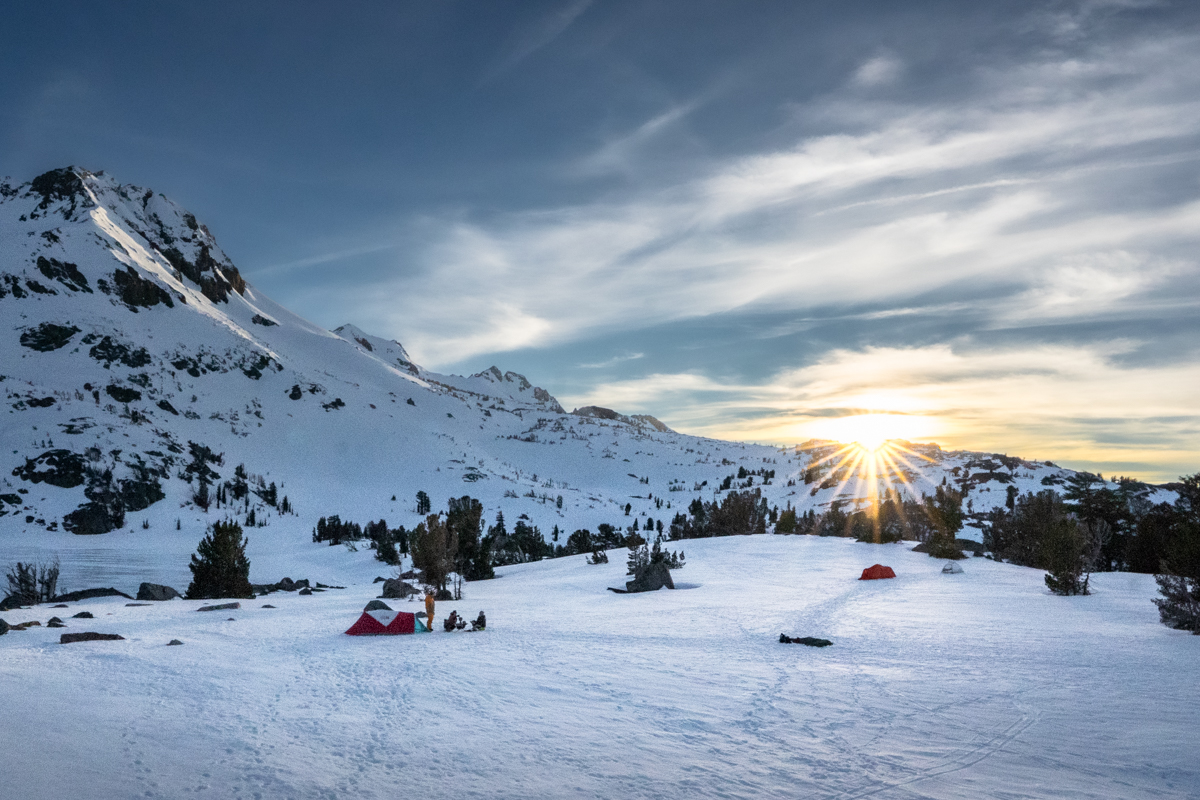
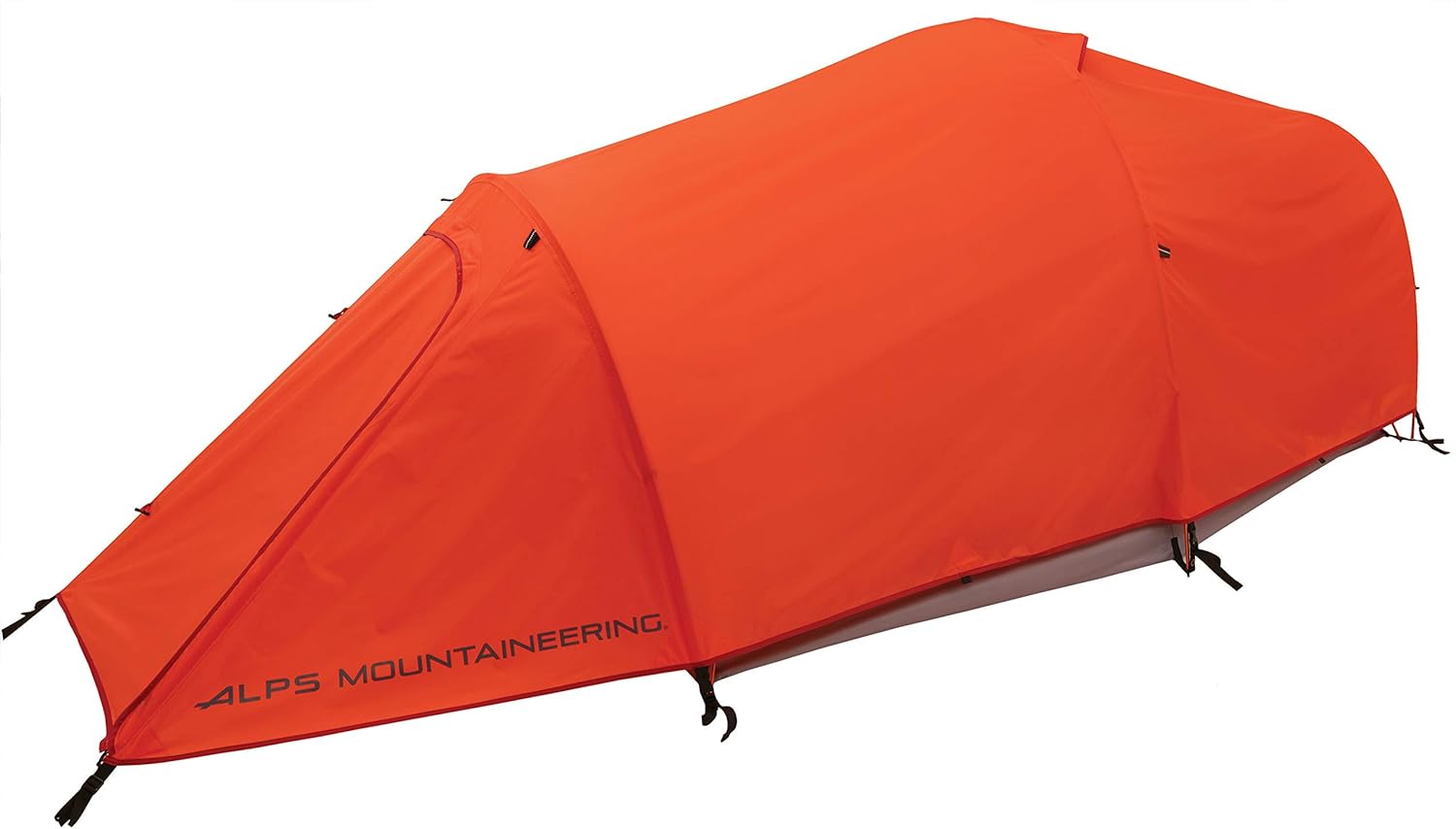 Category: Treeline
Packaged weight: 7 lb. 15 oz.
Floor area: 34.5 sq. ft.
Wall(s): Double
What we like: A great value and roomy.
What we don’t: Heavy, bulky, and limited performance capabilities.
We’ll start by saying that we’ve had positive experiences overall with Alps products, though they are budget-oriented and definitely not among our top performers. But you can’t argue with the value, which is why the Alps Tasmanian made this list. At only $280 full MSRP, you get a decently protective shelter that will do the trick for most casual winter campers. We particularly like the roominess of this tent, which at 34.5 square feet is one of the largest two-person models in our round-up. Plus, the large mesh vent at the top does a good job of promoting airflow and preventing condensation from building up.
It’s important to have reasonable expectations for a 4-season tent in this price range. First, the Alps Tasmanian is heavy at 7 pounds 15 ounces, not to mention it’s bulky and somewhat difficult to stuff into the included sack (although you’ll likely end up separating the tent body and poles to make it easier to fit in a backpack). Second, we don’t recommend pushing this tent to the limit in tough winter weather. It should perform fine in the cold and light to moderate wind, but the other tents here use higher-quality materials and much more complex designs. Finally, durability is always a concern with products that undercut the rest of the market in price. Alps Mountaineering covers manufacturing defects under their warranty, but that doesn't include anything related to normal wear and tear.
See the Alps Mountaineering Tasmanian 2
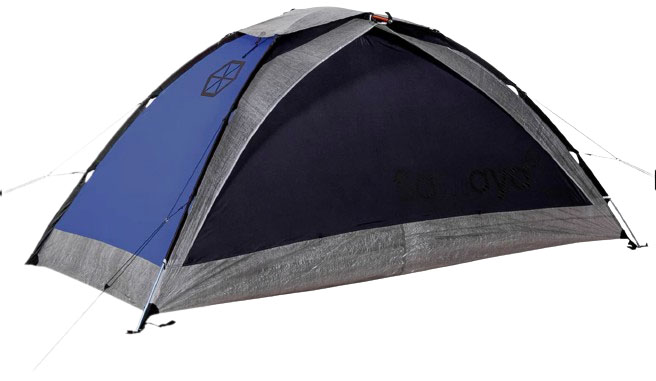 Category: Mountaineering
Packaged weight: 3 lb. 6.3 oz.
Floor area: 26.9 sq. ft.
Wall(s): Single
What we like: Lightweight and compact; we appreciate Samaya's innovation and strong focus on quality.
What we don’t: Pricey and less proven than many competitors.
Based in the French Alps, Samaya has taken the 4-season tent world by storm with exquisitely high-end offerings that hold nothing back. Their price points are undeniably steep, but you get what you pay for, including innovative R&D, premium materials, and meticulous attention to detail. The Samaya 2.0 is their best all-rounder, combining top-notch waterproofing and breathability with an impressively low weight. Black Diamond’s legendary—but since-discontinued—Eldorado used to be our choice for this slot, but the Samaya 2.0 boosts breathability with 3-layer Nanovent walls (in addition to a removable mesh door), uses a durable and waterproof Dyneema floor and “fly,” and still manages to undercut the old BD’s weight by almost 2 pounds.
Keep in mind there are some downsides to the minimalist design: The Samaya 2.0 is a tight squeeze for two, has only one door, and you’ll have to pay extra for a vestibule (available in both nylon and Dyneema). It’s also worth noting that we broke two poles on the larger 2.5 model when trying to slide them in and out of the very tight sleeves. While Samaya ended up replacing them, the 2.0 has a very similar design, so we recommend caution during setup and teardown. To be fair, most users don’t seem to have any problems, and Samaya’s offerings are truly in a league of their own for alpinists willing to make some sacrifices to keep weight down. For a bump in performance and quality, we've also been on some rowdy adventures with Samaya's Assaut2 Ultra, billed for technical ascents in gnarly conditions. It's super pricey but has a lot of appeal for dedicated ultralight mountaineers.
Read more: Samaya 2.0 Dyneema review
See the Samaya 2.0 Dyneema
.jpg)
 Category: Treeline
Packaged weight: 5 lb. 10 oz.
Floor area: 43.4 sq. ft.
Wall(s): Double
What we like: Great value; zip-off walls offer versatility for a variety of conditions.
What we don’t: Takes more time (and space) to set up than many mountaineering models here.
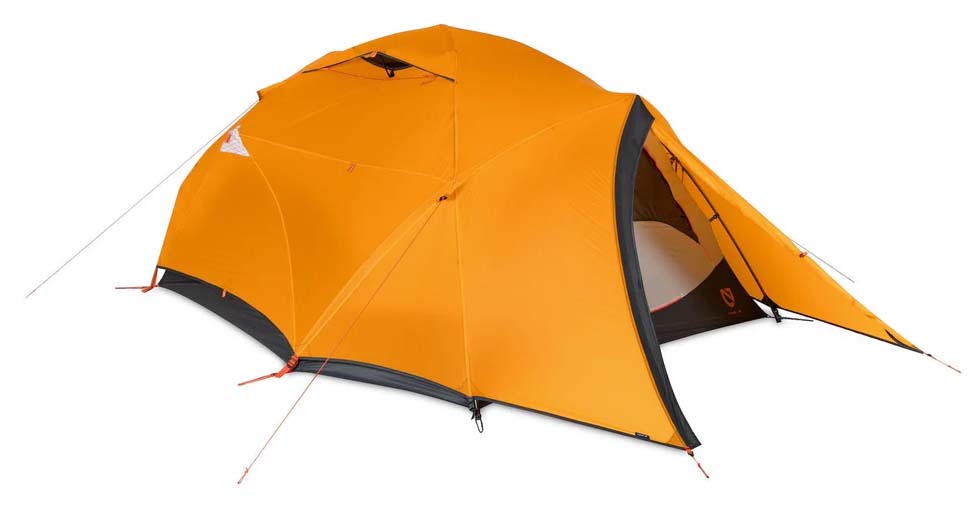
Many 4-season tents are overkill for mild winter conditions, especially when you can get by with a lighter, more breathable design. Enter the “treeline” category and our top pick, the Nemo Kunai. Marketed by Nemo as a 3-4-season backpacking tent, the Kunai offers reliable shoulder-season and mild-winter protection with a solid tent body and an extra pole that extends from side to side for added stability. When temperatures rise, portions of the canopy unzip to reveal mesh windows, which means increased airflow when you need it and wind protection when you don’t. All told, the Kunai is a versatile and lightweight shelter that's ideal for everything from spring ski traverses to fast-and-light winter camping.
The interior space of the 3-person Kunai is spacious with a generous peak height, but taller campers may feel cramped lengthwise due to the tapered shape. At the foot end of the tent, the width is only 60 inches, and our tall tester's sleeping bag often brushed against the walls. The Kunai also has only one door and one vestibule, which is less convenient than options with multiple doors and/or vestibules (though the door is at the end, making exit and entry easier with multiple people than a side-entry design). Finally, unlike the single-wall mountaineering tents here, the Nemo’s double-wall design is a bit tricky to pitch in inclement weather and doesn’t fit on tiny ledges nearly as well (especially given the need to guy out the fly). But the Kunai offers better protection and breathability for less weight than these designs, and you really can’t beat the versatility of being able to unzip the tent walls. Added up, the Kunai 3P offers excellent value and is a great choice for treeline camping and spring mountaineering.
Read more: Nemo Kunai 3P review
See the Nemo Kunai 3P
.jpg)
Category: Basecamp/treeline
Weight: 3 lb. 10 oz.
Floor area: 78.5 sq. ft.
Wall(s): Single
What we like: Incredible versatility for a comprehensive snow camp.
What we don’t: Floorless design means you’re more exposed to the elements.
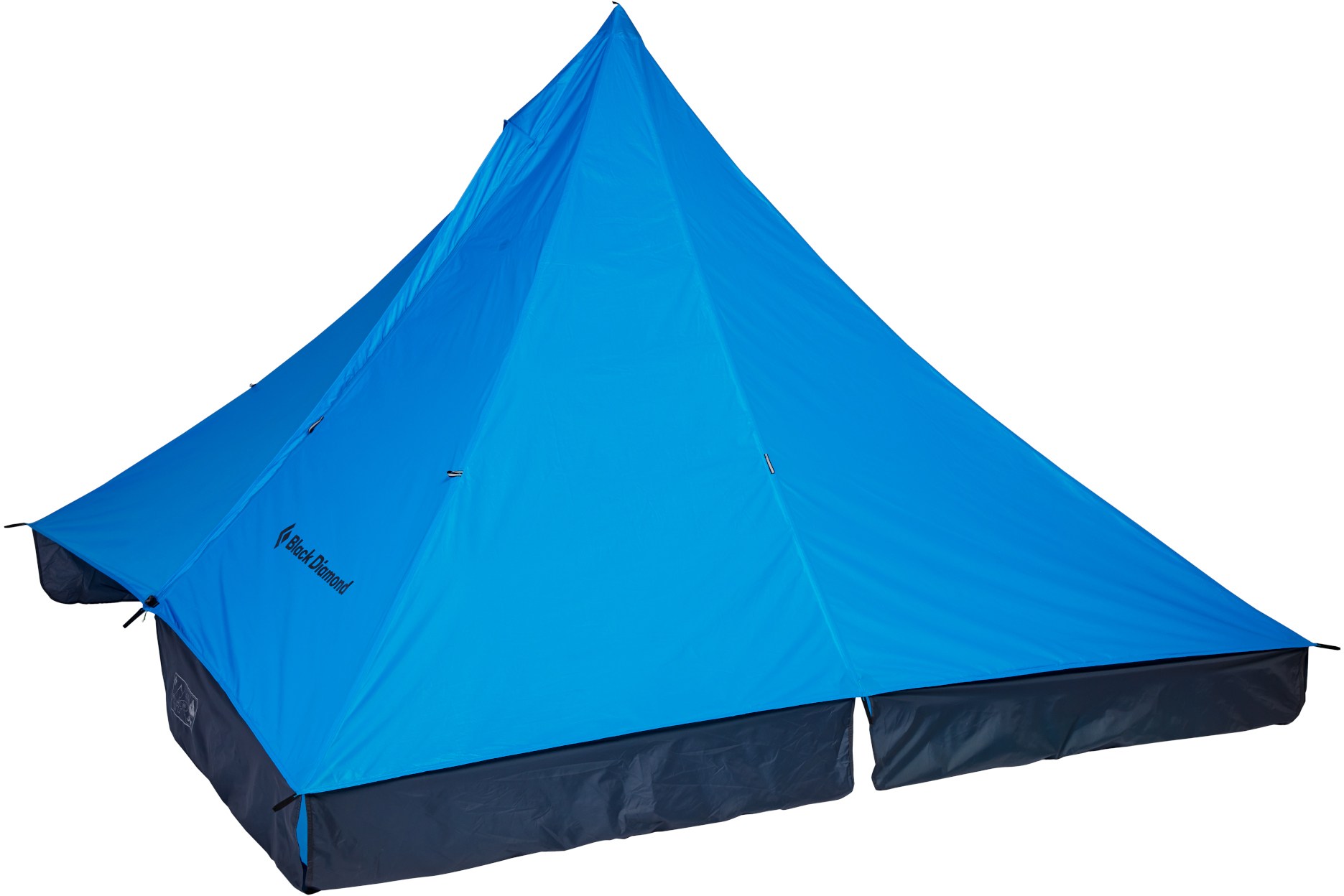
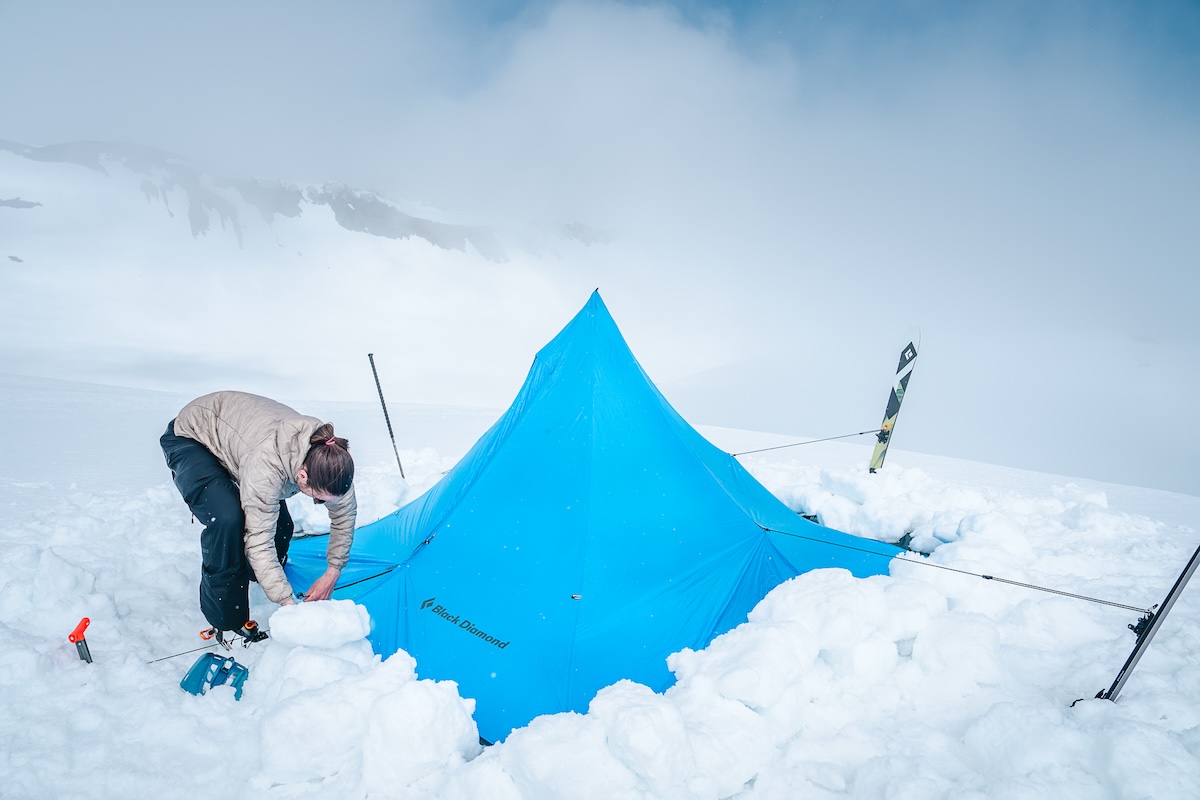
You’ll likely want a fully featured tent for sleeping in the snow, but as a dining shelter, gear storage, or simply a change of scenery when cabin fever sets in, the Black Diamond Mega Snow is a total basecamp luxury. And we use the word “luxury” lightly—with a single-wall construction and no floor, it’s far from the most protective tent here. But the value of this shelter really comes into full view while camping on snow: The center pole prop serves as a table, while the outer edges can be dug out to create seating for up to six. In addition, the Mega Snow features a roof vent (this is one shelter we encourage you to cook in), and mid-panel guy-out points provide added security in high winds. And the versatility doesn’t stop there—it can also double as a lightweight sleeping shelter in a pinch.
But calling the Mega Snow a 4-season tent is a bit of a stretch. Its tough 30-denier (D) canopy withstood strong winds and heavy snow when testing it on a late-season ski touring trip on Mount Rainier, but it just doesn’t compare to burlier tents like the Hilleberg Nammatj 2 GT or even the single-walled Samaya 2.0 Dyneema. In essence, the Mega Snow is a glorified tarp with no floor. Piling snow on the flaps around the perimeter of the tent helps keep gusts out, but your gear is still exposed to snow on the inside. And despite the vents at the top, the polyester build held onto condensation through the night and dripped on our faces when the temperatures rose in the morning. Ultimately, we don’t recommend the Mega Snow as a dedicated camping tent, but it really shines as a basecamp shelter. And as a final bonus, you can use ski poles as the center pole to save a few ounces, which helps keep this setup ultralight.
Read more: Black Diamond Mega Snow review
See the Black Diamond Mega Snow 4
 Category: Basecamp
Packaged weight: 10 lb. 5 oz.
Floor area: 48 sq. ft.
Wall(s): Double
What we like: A great value for a time-tested and sturdy basecamp design.
What we don’t: Availability can be hit or miss; offered in fewer capacities than the Trango.
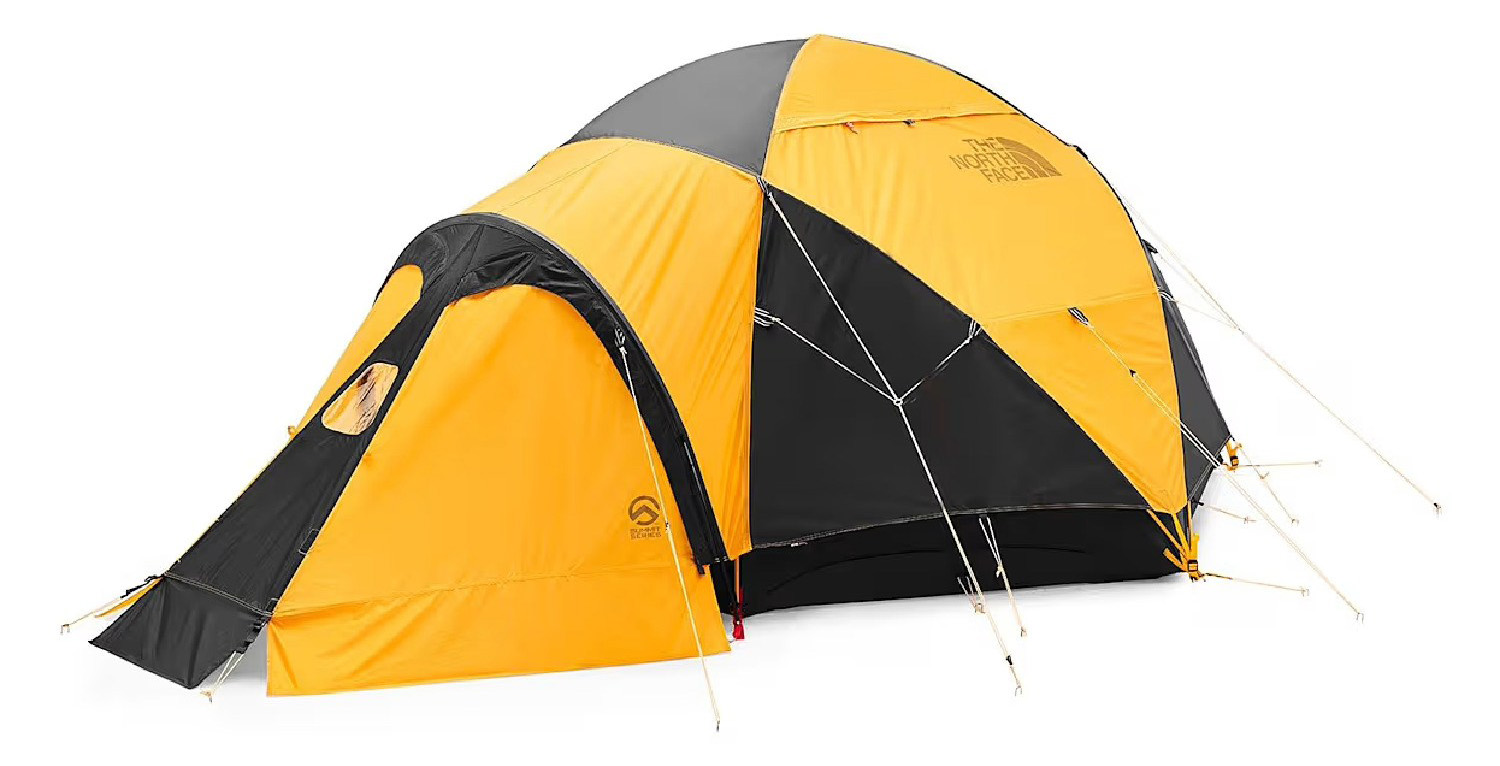
The VE 25 is one of expedition mountaineering's most popular tents, and for good reason. Similar to the Trango above, the three-person VE 25 features a burly double-wall build, stout poles, and time-tested fabrics that thrive in tough conditions. Two doors and vestibules provide multiple entry points and ample storage space, and you get eight internal pockets and an assortment of hanger loops to organize and dry out your gear. And for those tent-bound days (or weeks) in basecamp, the VE 25 ventilates well and provides ample space for two or three with a 48-square-foot floor plan and a peak height of 48 inches (3 in. taller than the three-person Trango).
Our main gripe with the VE 25 is that it can be tricky to find. It can be particularly hard to track down during the shoulder seasons. If you can get your hands on one, it’s a stellar tent: The combination of pole sleeves and clips results in noticeably more structural integrity in high wind than the Trango, and it’s significantly cheaper (compared to the Trango 3). Of course, weight is a factor with any basecamp design—if you're opting for a tent like the VE 25 or Trango, it's likely you're flying or portering into the mountains—and we wish the TNF were offered in a larger four-person capacity like the Trango (they do offer the massive Dome 5, though it's double the price of the VE 25). All told, for a great combination of value, protection, and livability for waiting out storms at basecamp, the VE 25 is tough to beat.
See The North Face VE 25
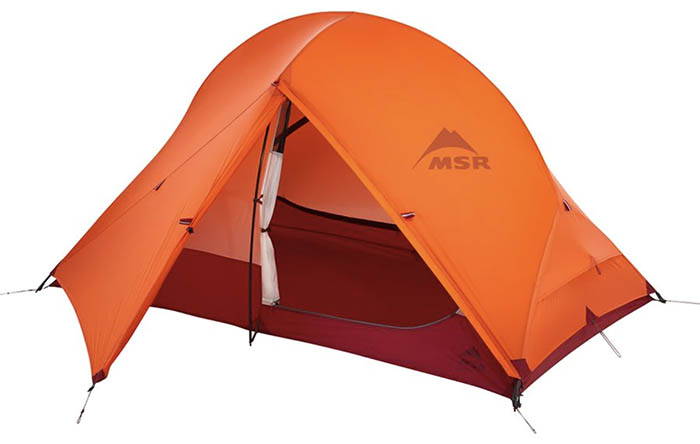 Category: Treeline
Trail weight: 4 lb. 1 oz.
Floor area: 29 sq. ft.
Wall(s): Double
What we like: Ultralight for a double-wall tent yet decently protective and roomy.
What we don’t: Pricey and not as versatile for mild conditions.
For backcountry ski trips or spring mountaineering when the weather is fairly good (or you won’t be fully exposed), it’s worth considering a tent in our treeline category. The double-wall Access toes the line between the 3- and 4-season categories, offering more bombproof protection than a standard backpacking tent (with solid tent walls and an extra pole for structure) in a streamlined, packable 4-pound-1-ounce design. And importantly, you still get two doors, two vestibules, and 29 square feet of floor area (we like to jump up to a three-person version for extra space or if you adventure with a canine). If you’re looking for a double-wall tent that provides 4-season protection at a low weight, the Access 2 is well worth a closer look.
Compared to many of the other 2-person options in our lineup, the Access 2 isn't as roomy, though its rectangular (read: non-tapered) floor plan makes head-to-toe sleeping with a buddy more appealing. It also features two doors and two vestibules—a big plus for livability—all at a respectable weight. But the steep price tag is hard to stomach, especially when you can get the 3-person Kunai for less or the Trango 2, our top pick, for just a bit more. In the end, this is still a great treeline option, though you’ll want to be sure not to push the Access too far into deep winter. The fly doesn't extend fully to the ground, so it’s a good idea to create a snow wall if you anticipate drafts and drifts. Overall, we’ve found the Access to be a wonderful fit for shoulder-season adventures, including ski trips into the B.C. backcountry and trekking in Peru’s Cordillera Huayhuash.
Read more: MSR Access 2 review
See the MSR Access 2
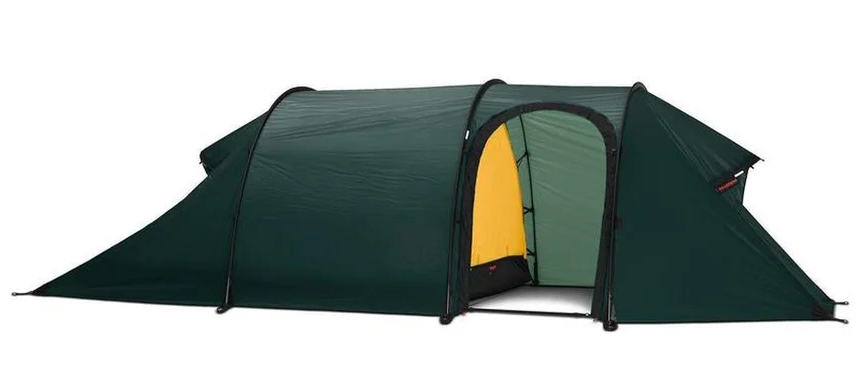 Category: Basecamp
Packaged weight: 8 lb. 6 oz.
Floor area: 30.1 sq. ft.
Wall(s): Double
What we like: Super roomy vestibule and unique aerodynamic structure.
What we don’t: Only one door and the peak height is low for a basecamping tent.
Based in Sweden, Hilleberg specializes in tents, with a strong lineup of designs for solo fastpacking, high-altitude mountaineering, and polar expeditions. Each model features ultra-premium materials and focuses on small details like no other brand, making Hilleberg some of the most reliable—and expensive—tents on the market. Their Nammatj GT is a very popular option for extreme mountain conditions, featuring strong Kerlon fabric and a tunnel-shaped design for remarkable stability and protection. You also get a whopping 25.8 square feet of vestibule space, which is a convenient design for cooking in inclement weather. All told, considering the all-in weight of 8 pounds 6 ounces, you’ll be hard-pressed to find a 4-season tent that does more while weighing less (and the standard Nammatj is only 6 lb. 10 oz.).
A nice alternative to many of the dome tents here, the Nammatj GT’s unique tunnel shape is aerodynamic in strong winds and easily sheds snow. This design makes it one of our top picks for the harsh conditions of high-altitude basecamps and polar exploration, but you do give up a bit of livability with only one door and a lower peak height (37 inches). It’s also worth noting that many guide services on Denali pitch the Nammatj (or four-person Keron 4 GT) using two sets of poles, as the poles have been known to bow and snap when the wind hits the tent just right. Finally, like everything from Hilleberg, the Nammatj GT will cost you a pretty penny. But if you’re considering tents like the Trango or VE 25 above and have the added budget, the Nammatj is well deserving of a spot on your short list.
See the Hilleberg Nammatj 2 GT
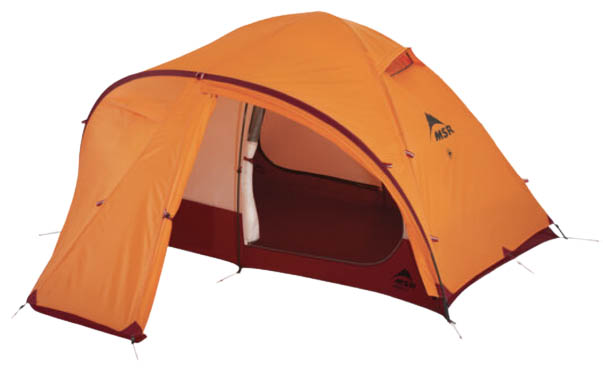 Category: Mountaineering/basecamp
Packaged weight: 7 lb. 13 oz.
Floor area: 33 sq. ft.
Wall(s): Double
What we like: Light enough for summit pushes yet comfortable for waiting out a storm.
What we don’t: Not as roomy as most basecamp options.
MSR’s Access above is built for spring conditions or winter camping below treeline, but we turn to their more substantial Remote for full-on mountaineering objectives. With a sturdy frame, bombproof Easton Syclone poles, and solid walls with zippered vents on each door, the Remote is ready for whatever Mother Nature throws its way. And while the storm is raging outside, the inside is nicely tuned for comfort, including excellent livability at 33 square feet for the two-person version (noticeably more than single-wall tents like the Samaya 2.0), near-vertical walls, and a large main vestibule. If you’re on the hunt for a sturdy double-walled tent that offers more protection than a treeline or mountaineering design without the heft or price of a true basecamp model, the MSR Remote is a nice middle ground.
We’ve taken the Remote on ski mountaineering trips along Canada’s Icefields Parkway and up Mount Rainier and found it to be a very capable companion in heavy wind and snow. That said, we did have some issues with condensation buildup: the thick rainfly material tends to trap warm air, with the only vents being the mesh panels on the doors (there are no dedicated vents at the top of the tent). Similar to the MSR Access, the Remote lacks storm flaps at each end, and the rainfly can hover as far as 5 inches off the ground when taut (that said, the tall bathtub floor should keep most of the elements at bay).
Read more: MSR Remote 2 review
See the MSR Remote 2
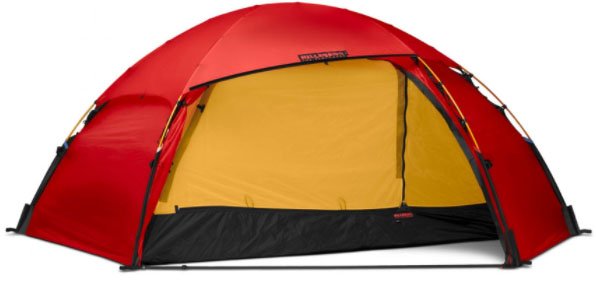 Category: Treeline/basecamp
Packaged weight: 7 lb. 4 oz.
Floor area: 31.2 sq. ft.
Wall(s): Double
What we like: Premium materials and construction, versatile for all-season use.
What we don’t: Expensive and heavy for a treeline tent.
The Nammatj GT above is a premium basecamp tent from Hilleberg, but for shoulder-season conditions, their Allak is a very popular option. Similar to designs like the MSR Access, the Allak features a lightweight yet sturdy dome structure that’s protective in a storm yet breathable enough for summer heat. In short, it’s among the most versatile all-season designs available, and with two doors and vestibules, the Allak’s 7-pound-4-ounce weight is considerably lighter than true basecamp models like the Trango.
The Allak walks the line between our “treeline” and “basecamp” categories, and Hilleberg’s Red Label (one step below their legendary Black Label) alludes to a similar classification. In other words, it’s a step up from a tent like the Access, but not quite on par with the Trango or VE 25 above in terms of protection. But in our experience, the Allak is strong enough to handle the gusty winds and heavy precipitation of true winter weather, making it a just-right option for winter camping in the Lower 48. Within Hilleberg’s lineup, you can also bump up to the Staika for a similar yet more protective build.
Read more: Hilleberg Allak 2 review
See the Hilleberg Allak 2
 Category: Basecamp
Packaged weight: 8 lb. 11.7 oz.
Floor area: 33 sq. ft.
Wall(s): Double
What we like: Incredible wind resistance and sets up quickly in bad weather.
What we don’t: Expensive and low on interior space compared to the competition.
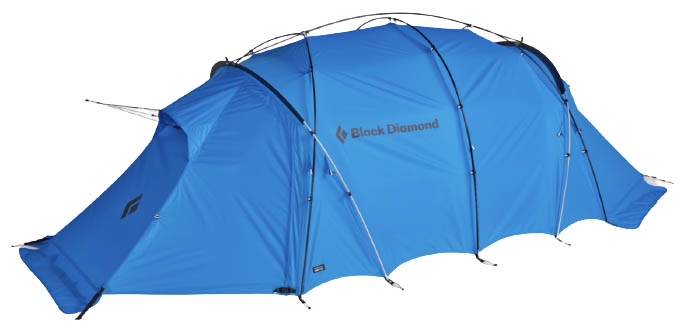
Black Diamond's Mission 2 competes with designs like the Mountain Hardwear Trango and TNF VE 25. The Mission is a double-wall tent with an external frame, which is ideal for getting a fast pitch in bad conditions (you don’t have to expose the inside of the tent to the elements). Further, the unique tunnel shape offers best-in-class stability (similar to the Nammatj above), and BD ups the ante with center hubs and crisscrossing poles for even better assurance in crosswinds. Tack on two generous vestibules, and you get a highly capable and weather-ready basecamp design—it's for good reason that the Mission has now become a staple in high-altitude environments in the Alaska Range.
Unlike most of the double-wall tents here, the Mission’s fly does not separate from the tent body, which limits ventilation and makes the tent a no-go for mild conditions or particularly sunny days on snow. And while it’s slightly lighter than much of the competition, the floor area takes a hit—the two-person Trango offers a bump in interior space with 40 square feet. A final downside is the steep price, but this is a solid basecamp entry from Black Diamond and particularly easy to pitch in high winds. Keep in mind that Black Diamond also offers the tent in three- and four-person models, the latter of which comes with an extended front vestibule for added versatility at basecamp.
See the Black Diamond Mission 2
Category: Mountaineering
Packaged weight: 4 lb. 2 oz.
Floor area: 26.8 sq. ft.
Wall(s): Double
What we like: Bivy-style tent design with double walls; effective condensation management; great vestibule access.
What we don’t: Heavier than single-wall bivy shelters; fly design a bit finicky.
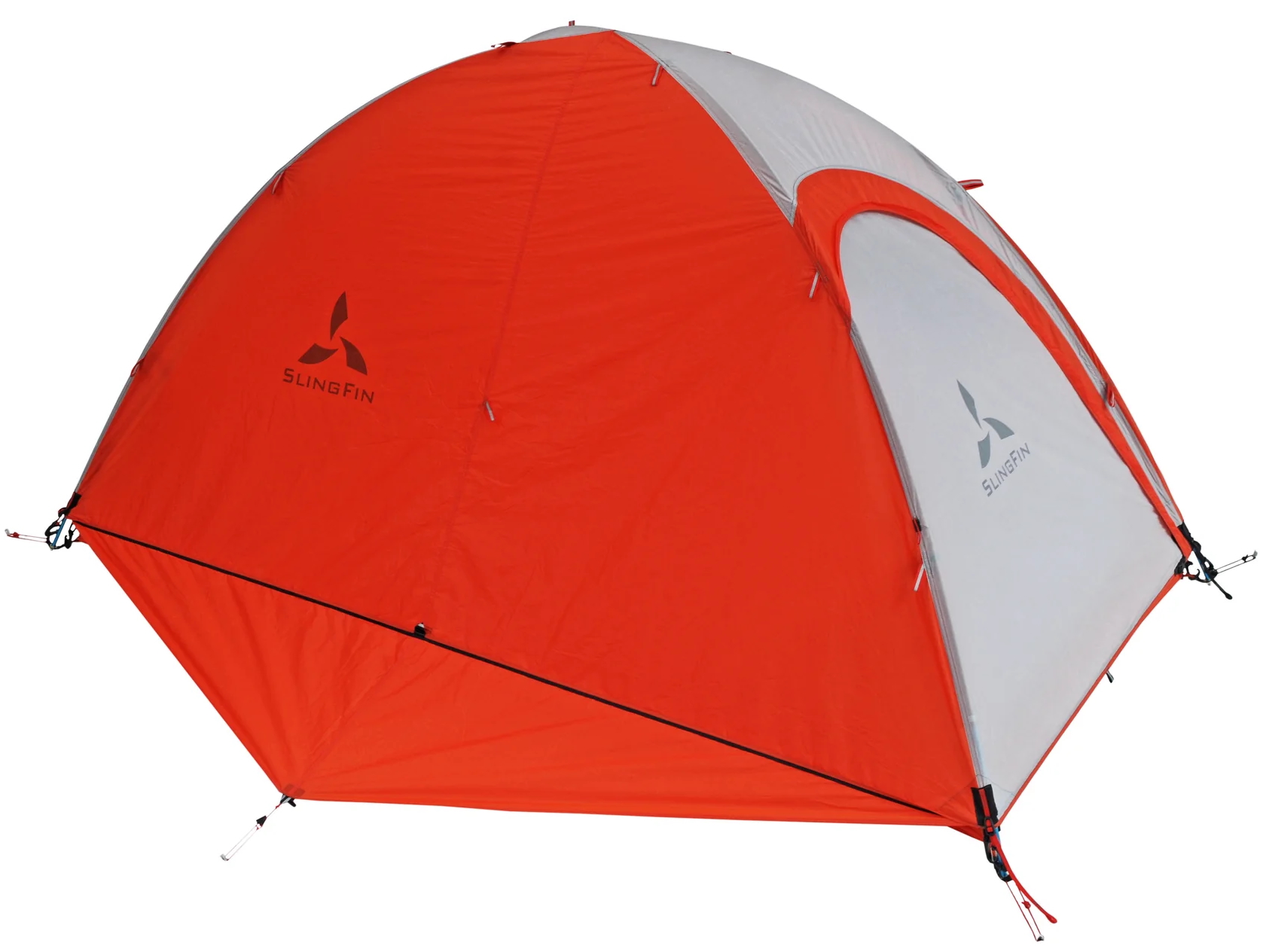
SlingFin’s HotBox is a rare bivy-style alpine tent that genuinely fixes the category’s biggest flaw: condensation. By pairing a compact, ledge-friendly footprint with a full double-wall design, it dramatically reduces interior moisture while remaining lightweight for the level of protection it offers. Set-up is also impressively user-friendly for such a technical shelter—the fly can stay attached during pitching, and SlingFin’s self-supporting WebTruss pole structure proved exceptionally stable in high winds during testing. Inside, eight pockets and large twin drawstring ports that access the side vestibules add a surprising amount of organization, gear storage, and ease of access, and the 26.8-square-foot floor space is on par with similar models.
The main downside is weight: Compared to single-wall bivy tents, the HotBox carries a noticeable penalty, which may deter fast-and-light climbers in cold, dry conditions. The fly also requires careful orientation to avoid being caught broadside in strong winds, adding a bit more thought to camp placement. But for most alpine objectives—especially when mixed precipitation and extended time in the tent are likely—the HotBox’s superior condensation control, thoughtful design, and added livability make it one of the most compelling bivy-style shelters we’ve tested.
See the SlingFin HotBox
Beyond the 4-season tents featured above, we tested some other well-built designs that ultimately fell just short of making our final list. Our focus is on highlighting true standouts—shelters that deliver the best mix of value, weather protection, and long-term reliability. Every tent we recommend has seen multiple seasons of real-world use, but we also believe it’s helpful to acknowledge the broader lineup of strong contenders we’ve put through their paces to give readers a fuller picture of the market.
We opted to remove the Black Diamond HiLight from our list this round. This is a stellar, lightweight, breathable single-wall tent for fair-weather climbing and a favorite of fast-and-light mountaineers, but it is nearly out of stock at the time of publication. While stock lasts at some vendors, it's worth snagging one.
| Tent | Price | Category | Weight | Area | Height | Wall(s) |
|---|---|---|---|---|---|---|
| Mountain Hardwear Trango 2 | $950 | Basecamp | 9 lb. 7 oz. | 40 sq. ft. | 38 in. | Double |
| Alps Tasmanian 2 | $280 | Treeline | 7 lb. 15 oz. | 34.5 sq. ft. | 46 in. | Double |
| Samaya 2.0 Dyneema | $1,210 | Mountaineering | 3 lb. 6.3 oz. | 26.9 sq. ft. | 39 in. | Single |
| Nemo Kunai 3P | $750 | Treeline | 5 lb. 10 oz. | 43.4 sq. ft. | 45 in. | Double |
| Black Diamond Mega Snow | $550 | Basecamp/treeline | 3 lb. 10 oz. | 78.5 sq. ft. | 65 in. | Single |
| The North Face VE 25 | $830 | Basecamp | 10 lb. 5 oz. | 48 sq. ft. | 48 in. | Double |
| MSR Access 2 | $800 | Treeline | 4 lb. 1 oz. | 29 sq. ft. | 42 in. | Double |
| Hilleberg Nammatj 2 GT | $1,295 | Basecamp | 8 lb. 6 oz. | 30.1 sq. ft. | 37 in. | Double |
| MSR Remote 2 | $860 | Mountain/basecamp | 7 lb. 13. oz. | 33 sq. ft. | 44 in. | Double |
| Hilleberg Allak 2 | $1,385 | Treeline/basecamp | 7 lb. 4 oz. | 31.2 sq. ft. | 41 in. | Double |
| Black Diamond Mission 2 | $1,300 | Basecamp | 8 lb. 11.7 oz. | 33 sq. ft. | 43 in. | Double |
| SlingFin HotBox | $750 | Mountaineering | 4 lb. 2 oz. | 26.8 sq. ft. | 41 in. | Double |
Type 2 fun isn’t for everyone, but the editors at Switchback Travel are no strangers to long sufferfests in the mountains. From high-altitude basecamps in the high Himalaya to backcountry ski trips in B.C., we’ve put many of the tents above through the wringer to bring you our favorites. Former senior editor and insatiable mountain athlete Jenny Abegg put together our initial list of 17 picks in 2017. Based in eastern Washington, Jenny has traveled all over the world seeking out seldom-climbed peaks and long, ambitious mountaineering routes. Senior editor Chris Carter now manages this guide. From days of waiting out driving storms on the snowy slopes of Mt. Kenya in Africa to trying to sneak in a few winks of sleep at the basecamps of peaks in Nepal, Chris has spent his fair share of nights cocooned in all sorts of 4-season shelters.
Our streamlined list of 13 models above represents years of research and real-world testing. When we put these stalwarts to the test, we take them into extreme environments to gauge their performance in howling winds and heavy precipitation. We evaluate interior space by spending considerable time in each tent (often a necessity in inclement weather) and prioritize designs that minimize condensation and hold up well over time. Finally, storage can be invaluable on extended trips, so we look for practical pocket layouts, fabric loops for stringing guy lines across the ceiling to dry wet gear, and generously sized doors and vestibules. Rest assured that as the market changes, we will continue putting new and noteworthy designs to the test, amending the list above based on our experiences.
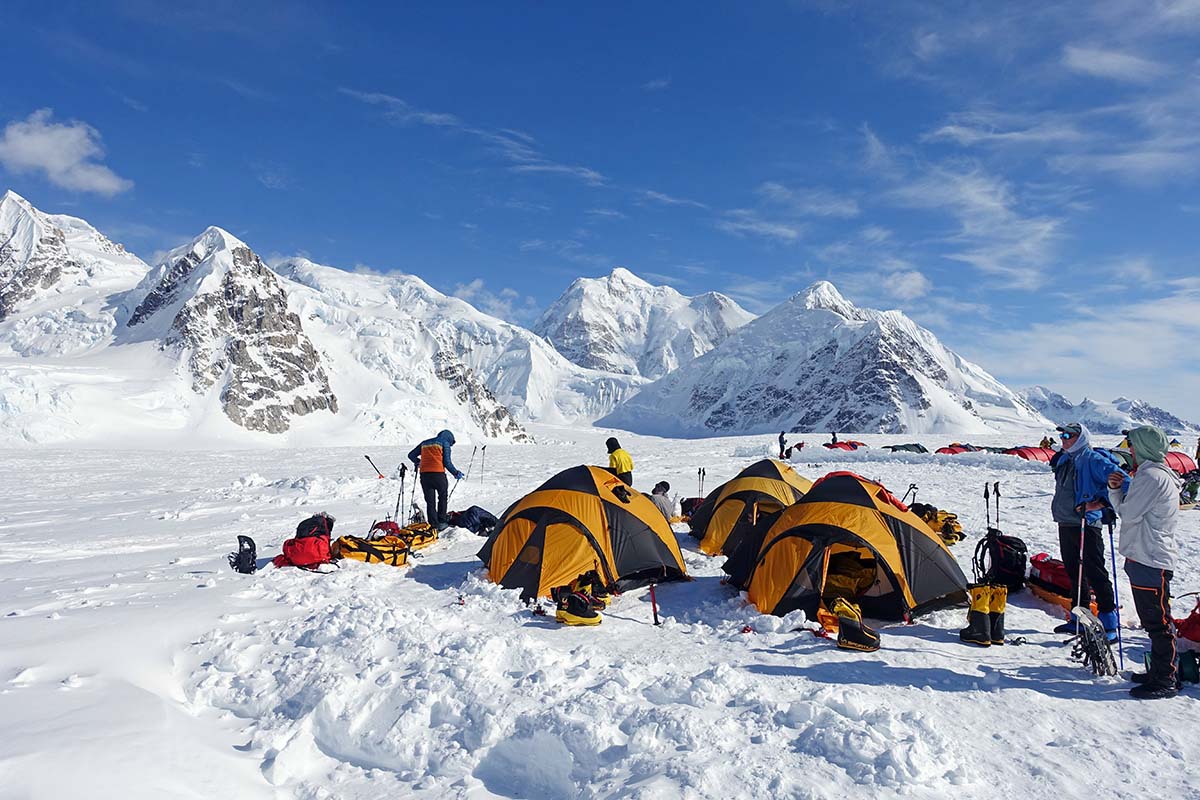
The term 4-season tent is a catch-all for any shelter that is made to withstand inclement winter weather. However, there’s still a fair amount of variation within the category, which includes bulletproof, spacious, and heavy tents (great for basecamping), lightweight single-wall builds (great for alpine pushes), and everything in between. Below, we break down our three main categories of 4-season tents: mountaineering, basecamp, and treeline.
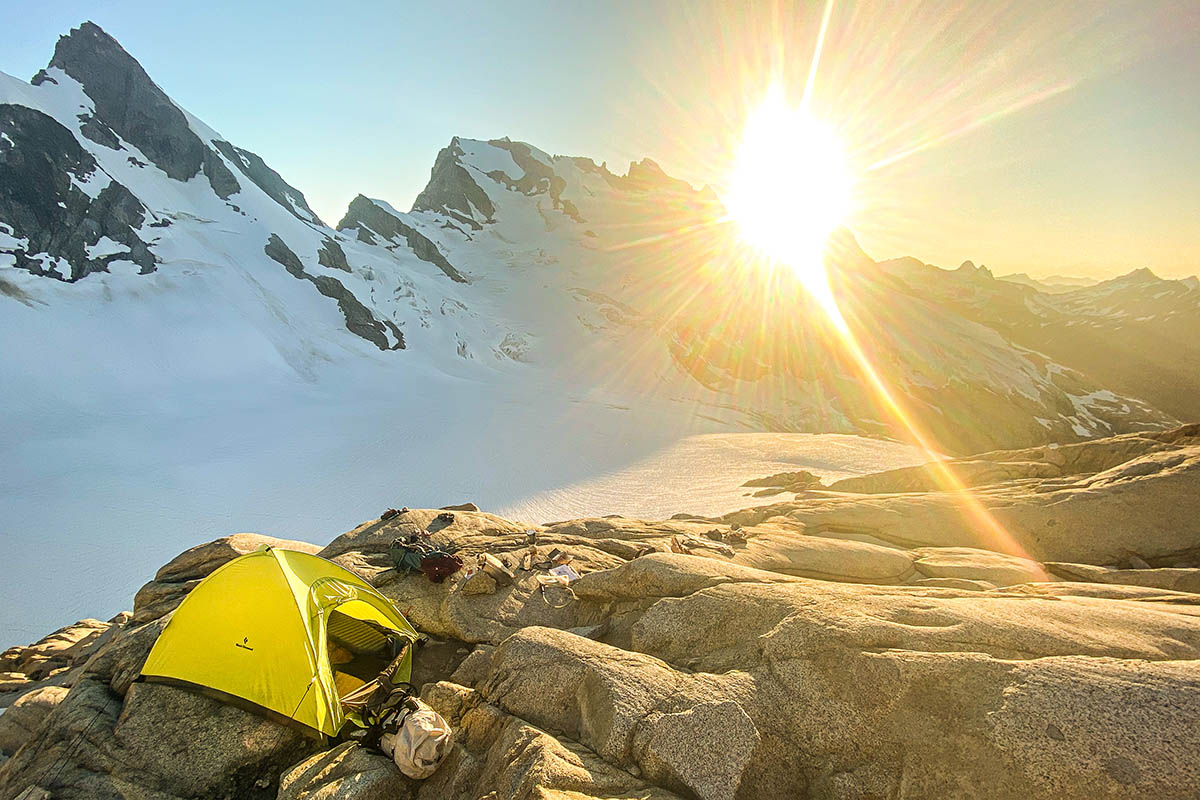
Mountaineering
Mountaineering tents are built for high-alpine environments with weight as a primary consideration. Many of these tents are of the single-wall variety (more on that below) and make few compromises in terms of wind and weather protection. Square footage tends to be lower than basecamping and treeline tents, and the same goes for peak height, allowing these tents to squeeze onto small mountain ledges and ridges. Almost all mountaineering tents are waterproof (or easily seam-sealed). One of our favorites in this category is Samaya's Assaut2 Ultra. It's surprisingly ultralight (2 lb. 1 oz.), with unique specs like a rated Petzl runner routed into the tent from the outside to safely clip to an anchor in truly absurd conditions. It's a tight squeeze for two but perfect for desperate shiver bivvies on narrow alpine ledges in freezing temps.
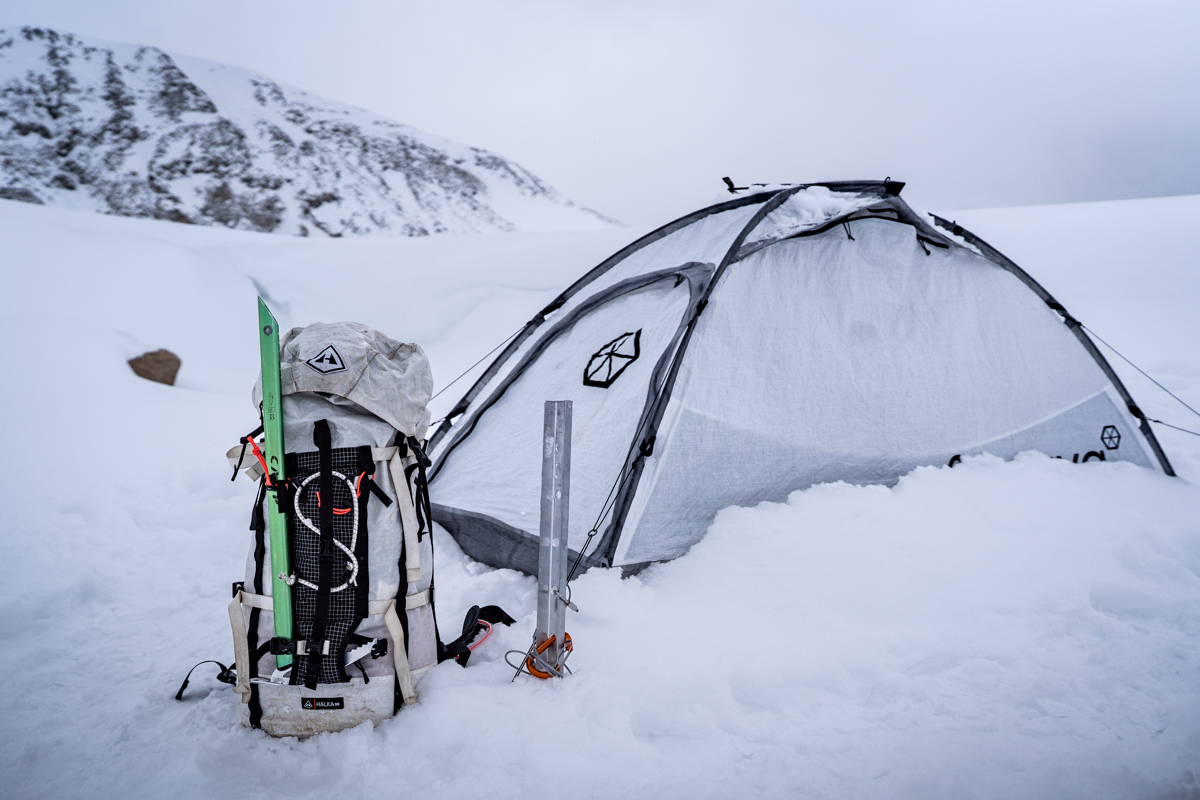
Basecamp
4-season tents of the basecamping variety are more comfortable and heavier than their mountaineering siblings above. To start, you may not have to carry your tent as far or as high, and therefore you can get away with packing more weight (and getting more tent in return). In addition, it’s highly likely that you’ll end up spending more time in a basecamp-style tent. Mountaineering tents are designed for fast and light adventures and summit pushes, but basecamping can be done in a variety of circumstances and conditions. Many of these tents have a double-wall design, which helps with ventilation, condensation prevention, and space, all at the expense of weight. The Mountain Hardwear Trango 2, The North Face VE 25, and Hilleberg Nammatj 2 GT are three of our favorite designs.
.jpg "Basecamping tents are often larger, heavier, and better ventilators than mountaineering models")
Treeline
Treeline tents are the most trimmed-down 4-season models on the market. As the name implies, tents like the Nemo Kunai, MSR Access, REI Arete ASL, and Hilleberg Allak are designed for winter camping but not necessarily for heavy exposure in the high mountains. Compared to a 3-season version, a treeline tent will have a more substantial bathtub floor, less mesh, and heavier canopy and rainfly fabrics. But these tents fall short of basecamp and mountaineering models in terms of their toughness and durability, and it’s best not to put them to the test. They are, however, a nice option for light winter adventuring and serious 3-season backpacking in unpredictable weather.
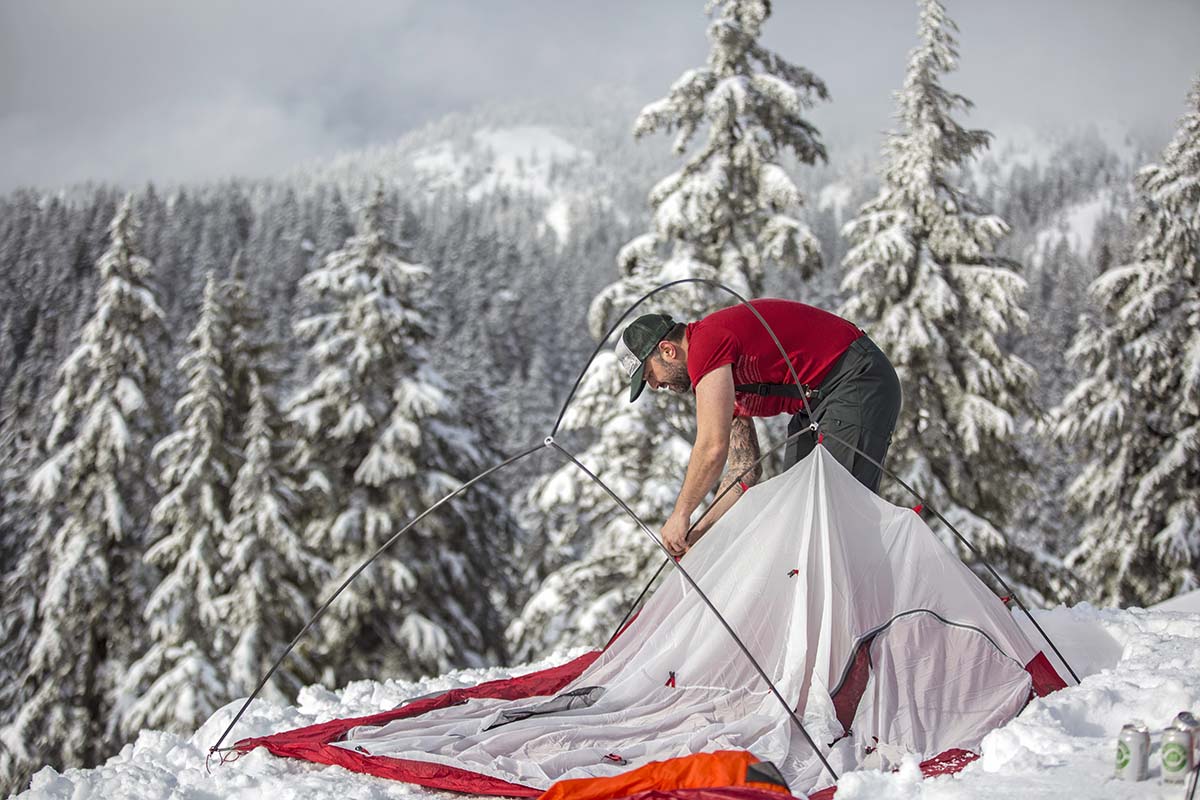
Four-season tents weigh more than their 3-season counterparts due to heavier and more durable fabrics, stronger poles, and beefier zippers. On the light end of the spectrum, the minimalist Samaya 2.0 Dyneema has a feathery packaged weight of just 3 pounds 5 ounces, while a heavy-duty model like The North Face's VE 25 is over 10 pounds. Even if you look at the trail weight instead of the packaged weight (which doesn’t factor in stuff sacks, stakes, or guylines), you’ll still be close to 9 pounds for a number of tents on this list for the two-person version (the three- and four-person models weigh even more).
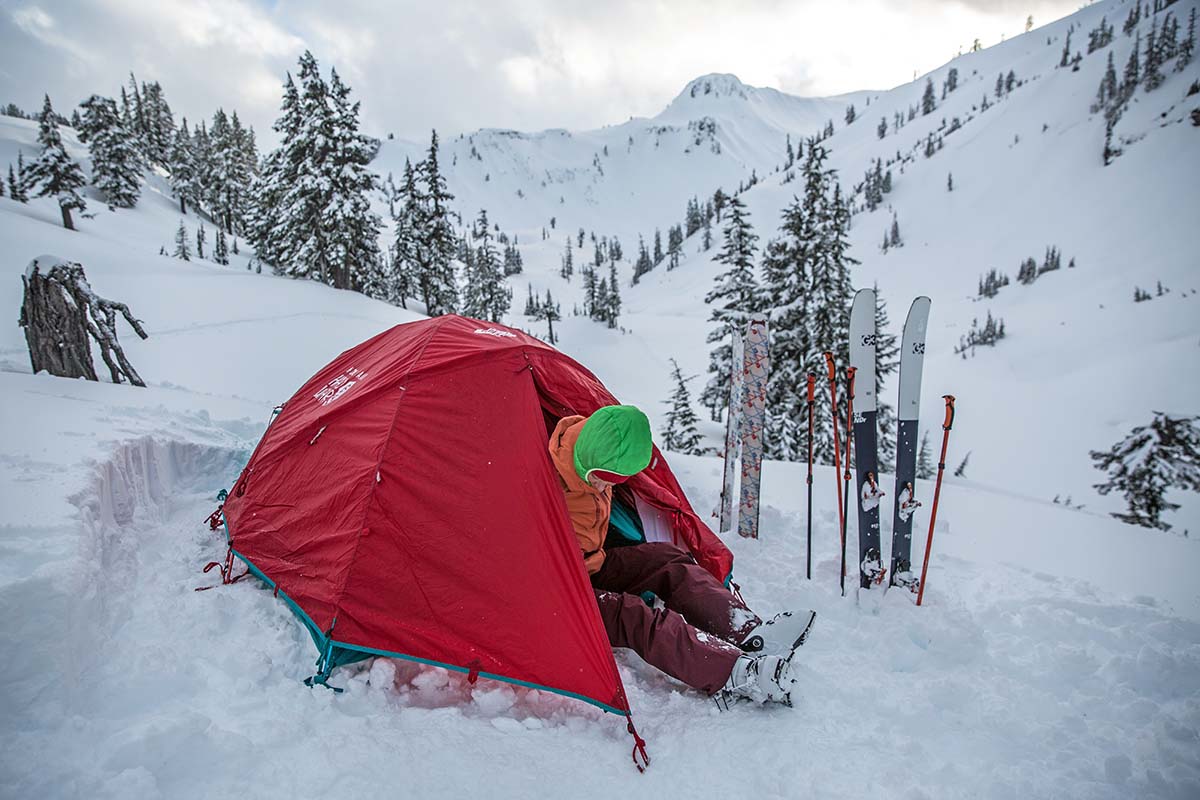
As with almost all types of outdoor gear, going up in weight has its advantages. Heavier 4-season tents generally are tougher and more weather-resistant, ventilate better, and have more features. You’re getting a whole lot more tent, which may end up being worthwhile. To paint a picture, we’ve been tent-bound in a Black Diamond HiLight (not featured above) for three full days, and even with the rose-colored tint of nostalgia, the experience still remains a dismal one. We surely would have traded a few pounds of peanut M&Ms for the comfort and weather protection of a heavier tent like the Mountain Hardwear Trango 2.
Weight and packed size generally go hand in hand, and there is a strong correlation between the two variables. In many cases, two or more climbing partners can split up the components of the tent to lessen the burden for each. It’s worth noting that this process can be more difficult for single-wall tents than the double-wall variety—with no rainfly, the tent body is the vast majority of the weight and bulk. But with most double-wall tents, the canopy and rainfly often can be split up fairly evenly.
.jpg)
A critical distinction among 4-season tents is between double and single-wall designs. Simply put, a double-wall tent is composed of two separate layers: the inner tent canopy and an outer rainfly (this is a similar design to most backpacking tents). Single-wall tents, on the other hand, have one layer of fabric to protect you from the outside elements. Single-wall tents are considerably lighter than double-wall models and still can be tough as nails but at the cost of comfort, weather protection, and—most significantly—ventilation.
.jpg)
Which type of 4-season tent design should you choose? Unless weight and packed size are your top priorities, a double-wall is a more comfortable place to be. With two layers of fabric between you and the elements, you get more robust and reliable weather protection. And most significantly, double-wall tents are far and away the more breathable option, as air can flow freely between the tent body and waterproof layer. But there are times when you simply can't carry the weight of a double-wall tent, such as during light-and-fast traverses or summit pushes (the good news is, these are fair-weather outings in general). If weight isn't a huge issue and you know you'll be waiting out bad weather, go for a double-wall tent; if you're counting ounces or climbing technical terrain with your pack on, that's a clear sign you need a single-wall design.
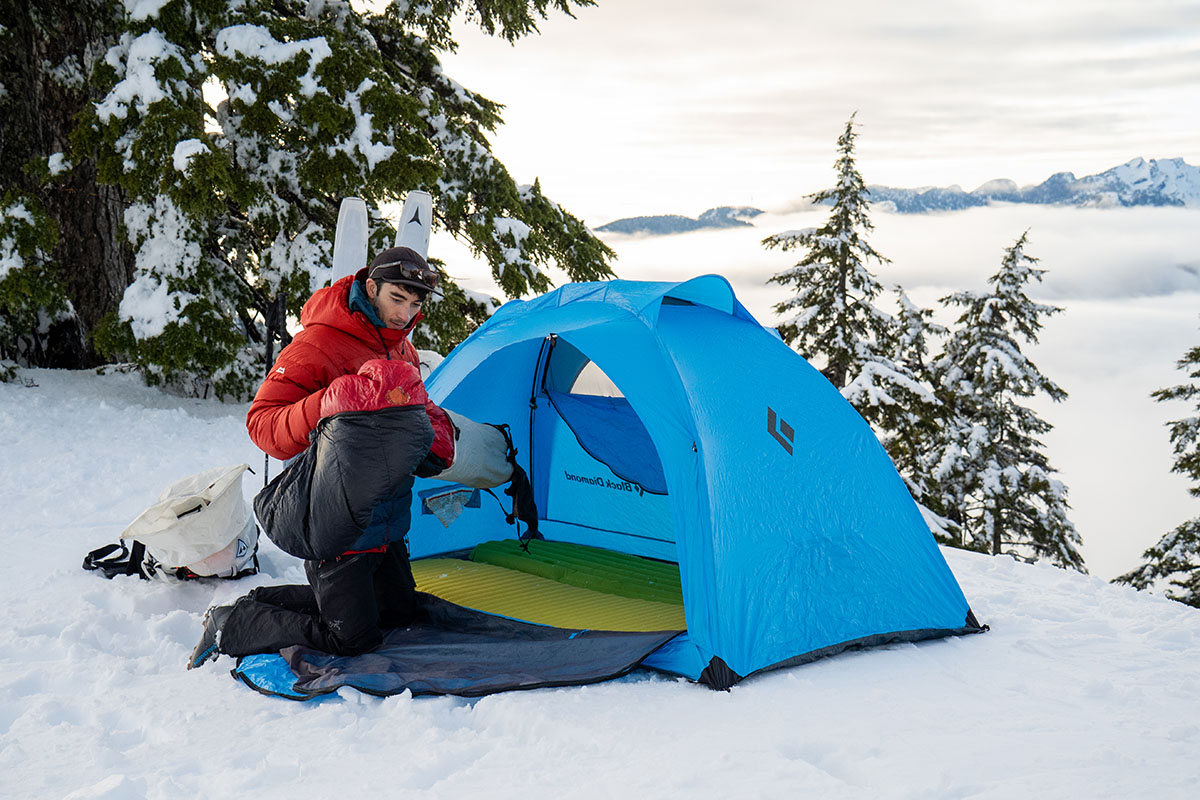
The interior space of a tent is most commonly measured by the floor area, which we’ve provided in square feet in our product specs and comparison table. Compared to normal backpacking tents, 4-season tents range from minimalist to roomy, depending on their intended use. For example, a mountaineering tent like the Samaya 2.0 is just 26.9 square feet, while the Mountain Hardwear Trango 2 measures 40 square feet. Two climbers crammed into the Samaya will be cramped like sardines, whereas the Trango has a lot more room to sprawl. The moral of the story: If you’re looking for space, tents of the basecamp and treeline variety win out.
_0.jpg "The North Face Mountain 25 has a spacious interior")
But square footage doesn’t tell the entire story as it only represents the floor: You also have the peak height and slope of the walls. A high peak height makes it easy to sit up and move around the tent, while heavily sloped walls have a tendency to make everything feel much smaller. We’ve provided the peak heights in our comparison table above, and the slope of the wall is best gauged by carefully studying the shape of the tent (or, better yet, getting inside and seeing for yourself). Many tents now feature a ridge pole across the top, which provides lateral stability against wind and snow loads while also offering more headroom (think of a cube as opposed to a pyramid). More headroom can make those tent-bound days more bearable.
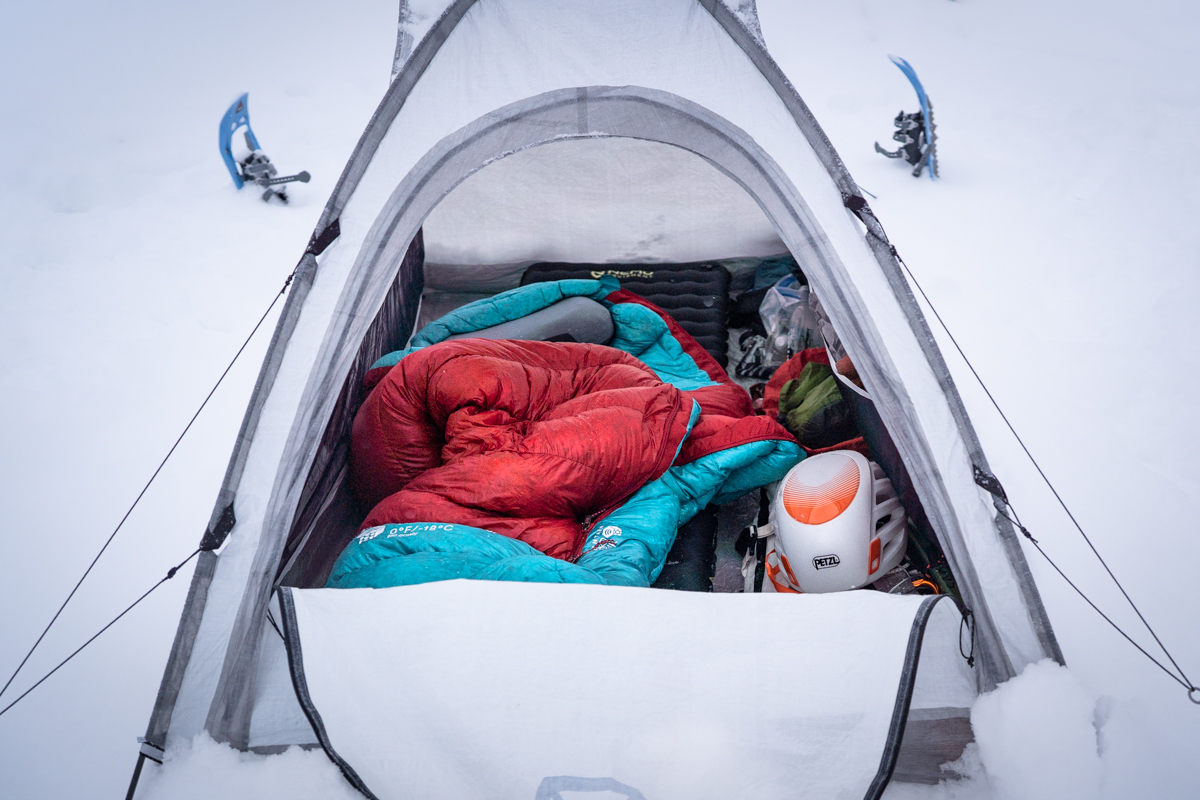
Last but not least: Make sure to find a tent that is a few inches longer than you are. Otherwise, you will have to sleep at an angle or in the fetal position, neither of which is optimal. Most 4-season tents can accommodate people over 6 feet tall, but Hilleberg seems to be the favorite brand for those who tower over the rest.
.jpg "A glacier view from the compact but lightweight Nemo Kunai")
By nature, 4-season tents are warmer than 3-season tents—they have less mesh, are designed to protect you from the elements, and therefore hold in more heat. Yet it’s important to keep fresh air flowing both to stay dry and to save you from the funk of your climbing partner’s socks. Over time, your breath will condense on the inner walls of the tent. In warmer weather, it will turn into beads of water on the ceiling and walls. In colder weather, it will turn to frost feathers. Both can fall on your face while you sleep and get your sleeping bag and other gear wet. And sleeping in a fully enclosed tent can make you feel groggy as you continually breathe stale air.
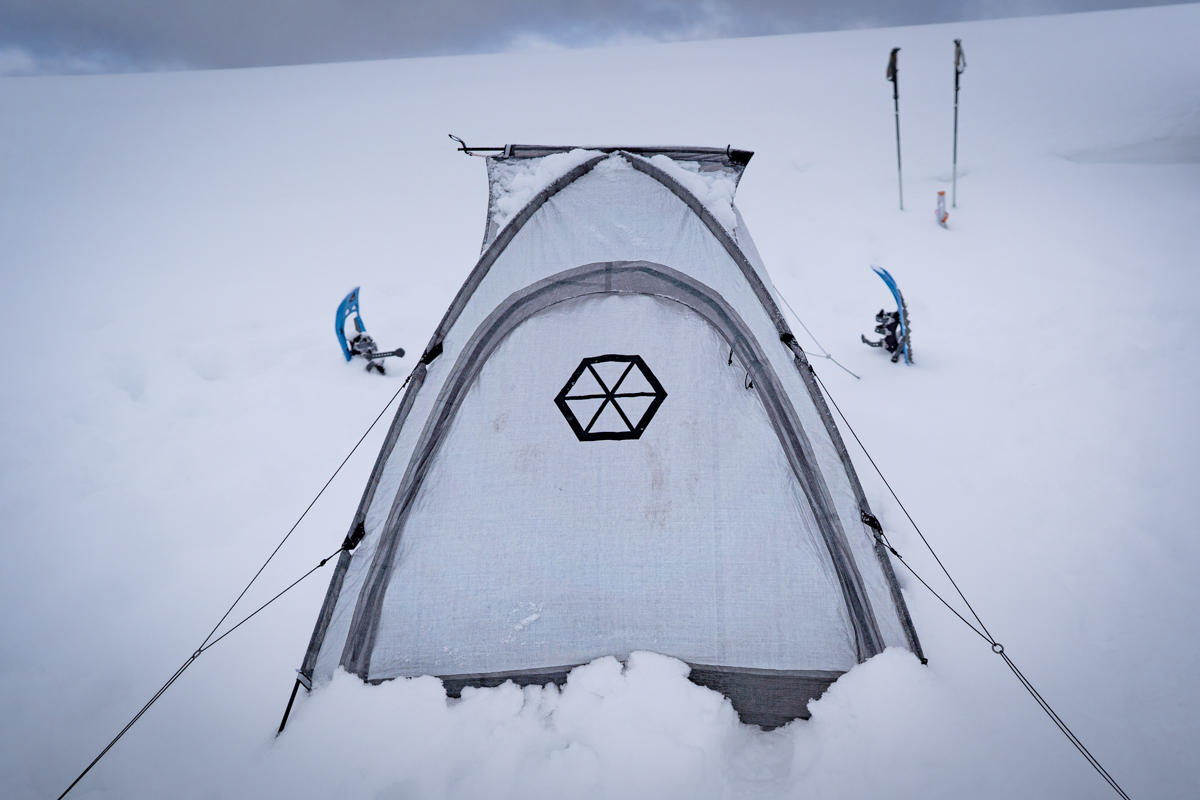
Proper ventilation will help to alleviate many of these issues. It’s important to remember that even the best 4-season tents are prone to some type of condensation, but some fare better than others. Double-wall designs, like the SlingFin HotBox, tend to breathe better than single-wall tents, and the more vents the better. If drafts don’t make you uncomfortable, leaving doors and any available vents open can help mitigate condensation. In the product descriptions above, we’ve tried to describe which tents, in particular, are strong or poor in terms of breathability, which certainly can be an important factor in your comfort.
Materials: Polyester, Nylon, and Dyneema
The majority of 4-season tents are built with nylon and polyester. At the time of writing, nylon is still the most popular material: It's relatively strong (even the thin varieties), resists tears and punctures, and has a fairly minimal weight and packed size. However, nylon's big flaw is that it’s hydrophilic, meaning it absorbs water. As a result, it both gets weaker and expands when wet (which explains why your tent fly sags after the rain) and is slow to dry. But when used alongside the proper waterproof coating (more on this below), it’s hard to beat. Notably, Hilleberg’s high-end Kerlon fabrics are nylon, and we also see it used in top-ranked tents like the Mountain Hardwear Trango 2, MSR Access, and The North Face VE 25.
.jpg)
Polyester has traditionally received a bad rap for being cheap, heavy, and not as strong as nylon. However, the last few years have seen a lot of advancements in lightweight polyester, and it’s now used in a few 4-season tents (including Black Diamond's Mega Snow and Mission, and the MSR Remote). Unlike nylon, polyester is not hydrophilic, meaning it does not absorb water, dries quickly, and remains taut when wet. What’s more, it won’t degrade as quickly when exposed to sunlight for long periods of time, which is great news for those headed to high altitudes. It’s true that its tear and puncture resistance isn’t quite as high as nylon in dry conditions, but this equation reverses in wet conditions, which is arguably when you need the most performance out of your tent.
.jpg)
Finally, there’s Dyneema Composite Fabric—often referred to as simply Dyneema, or DCF—a fabric known for its low weight, high tensile strength, and inherent water resistance. But despite its strong suits, Dyneema hasn’t made too big of a splash in the 4-season tent market. For one, it’s incredibly expensive, and most tents (except for those in our mountaineering category) aren’t particularly focused on weight savings at all costs. Further, it tends to puncture quite easily and doesn't compress down super small (despite its low weight). And finally, it falls short in the breathability department, which isn’t ideal when you’re tent-bound in a storm for days on end. As a result, we see Dyneema used—and only partially so—on just one tent here, the premium and ultralight Samaya 2.0.
.jpg)
Denier (Thickness)
You can’t talk about fabrics without also discussing their thickness. Nylon and polyester are measured in terms of denier (technically speaking, the weight of the yarn), while Dyneema is measured in terms of ounce per square yard (oz/sq.yd.). The 4-season tents in our basecamp category will most often use thick 70D materials—ideal for heavy use, strong winds, and UV resistance—while those in our treeline or mountaineering categories will save weight with thinner materials (the MSR Access 2 uses a 20D nylon fly and 30D nylon floor). This is clearly displayed in Hilleberg’s color labels: Blue Label tents use 70D nylon on the fly, while their lightest Yellow Label designs are 20D. As a result, you’ll need to exercise more caution with these lighter tents, and—unlike basecamp tents—they’re not made to stay pitched throughout an entire season.
Waterproof Coatings: Silicone and Polyurethane
Nylon and polyester aren’t inherently waterproof—for this reason, they must be treated with a coating to keep moisture at bay. Traditionally, the most common treatment has been PU (polyester urethane, or polyurethane), which is relatively inexpensive and highly waterproof. What’s more, it can be laid on thick for extra puncture resistance, is easy to seam tape, and is far less slippery than silicone—which is helpful on a tent floor to keep you from sliding around. But PU actually absorbs water (leading to mold and mildew growth) and eventually degrades over time; in fact, low-quality PU is prone to delaminating. Despite its downsides, polyurethane is still the most popular coating for tent floors, even in high-end designs.
Without question, the best waterproof coating is silicone. Silicone is fully waterproof (when’s the last time you saw your silicone kitchen tool absorb water?), strengthens rather than weakens fabric, and doesn’t degrade over time. Silicone treatment also makes fabric less prone to stretching, meaning your fly will stay more taut in the rain. Because of its strengths, we see silicone (often referred to as silpoly or silnylon) used in most high-end tents, especially on the fly. For example, all of Hilleberg’s tents use flies that are triple-coated with silicone on each side.
.jpg)
But silicone can’t adhere to seam tape or fire retardant, and it’s not the most comfortable application for a tent floor. For this reason, it’s common to see sil/PU combinations, which denote that the fabric has been treated on one side (usually the inside) with PU, and the other side with silicone. Of course, these materials aren’t as strong, stretch-resistant, long-lasting, or mold-resistant as pure silicone (often referred to as sil/sil), but they’re nevertheless a good compromise.
On an extended trip where inclement weather is likely, having ample space to store and dry your gear is an absolute necessity. Tents like the Mountain Hardwear Trango 2 are lined with pockets upon pockets. And yet it never ceases to amaze us how easily we fill those pockets with food, gear, and electronics once our packs are emptied. This storage is especially important considering that keeping your gear organized and separate from your partner’s is essential on any long trip (you wouldn’t want him or her to start eating your snacks!). Most tents also feature small loops meant to string guy lines across the ceiling, which is useful to dry wet gear after a long day in bad weather.
.jpg "We love the convenience of 2 doors and 2 vestibules")
Perhaps nothing on a 4-season tent is more important to comfort than the vestibule. A tent’s vestibule acts as a separate room that separates the dry, snow and rain-free interior of the tent from the harsh outside elements. Nothing will aggravate your partner more than soaking their dry down sleeping bag with your wet Gore-Tex and snow-ridden boots. The vestibule is where you seal yourself off from the majority of the outside weather and prepare to enter the tent dry, just like you would take your muddy shoes off outside before walking on someone’s carpet. Many tents have a smaller rear vestibule that can hold a few backpacks, but isn’t optimal for cooking or using as the main door. And keep in mind that many mountaineering tents forgo vestibules to shave weight, so be sure to choose accordingly if it’s an important feature to you.
.jpg)
Everyone who has backpacked knows that the number of doors a tent has matters a lot. Nothing is more frustrating than having to crawl blindly over your partner at 2 a.m. to answer nature’s call, and they would probably say the same. In general, lightweight mountaineering tents are most likely to have one door—it’s an easy way to cut weight and keep the footprint of the tent small (and the hope is that you’re not spending a lot of time in the tent anyway). Basecamping and treeline tents are likely to have two doors, which allows each person to enter and exit as they please. And one final consideration in relation to doors: A second door often means a second vestibule, which greatly enhances the storage opportunities and comfort.
.jpg)
In terms of tent pole quality, 4-season tents will have stronger (and heavier) poles that can withstand big gusts of wind. In cold weather, tent fabric shrinks, and plastics and metals get brittle. Snapping a tent pole in a storm easily could result in a shredded tent, but stout metal poles (Easton, DAC, etc.) with long connector joints will provide torsional strength. And beware of any tent pole with a plastic tip (the end part of the pole that connects into the grommet of the tent). One year on Denali, one of our gear testers saw over a dozen of the same poles shear off at the tip when a company switched from metal to plastic.
.jpg)
In environments with unpredictable weather, it’s imperative to make your tent bombproof against wind and storms. Once while returning to Camp Muir after summiting Mount Rainier, one of our testers watched a tent roll down the Cowlitz Glacier and fall into a crevasse (true story). He later found out that the team had “anchored” their tent down with basic 6-inch stakes meant to hold a standard tent backpacking in the dirt.
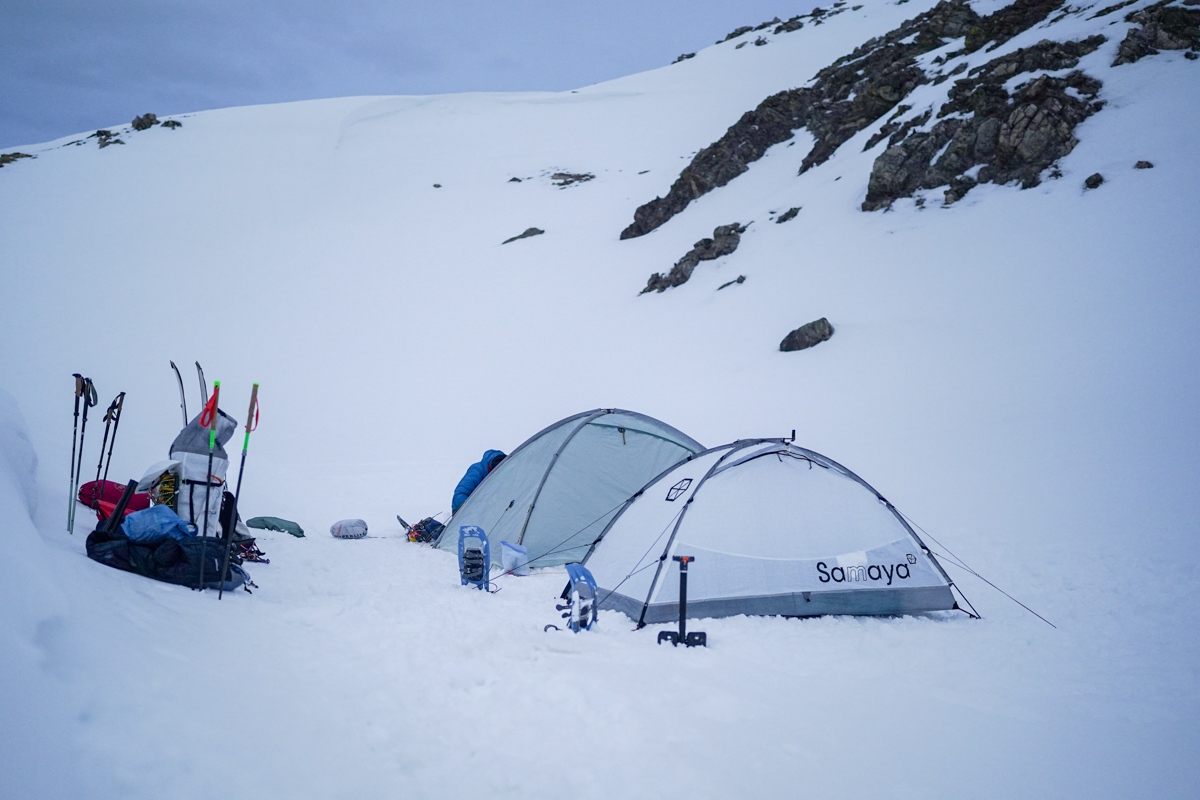
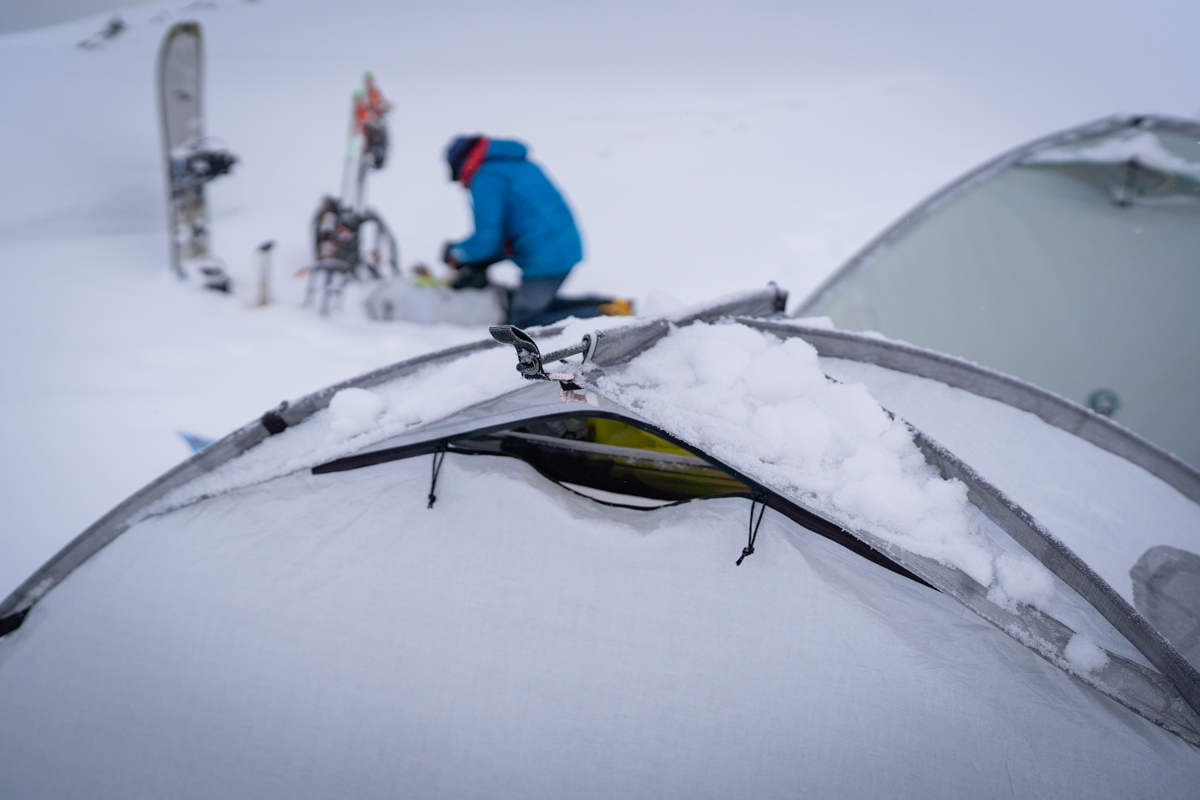
When using a 4-season tent in an alpine environment, it is not uncommon to use backcountry skis, ice axes, pickets, ski poles, bamboo wands, snowshoes, or anything else that can be securely buried and not bend or break under high loads. On big mountains like Denali, it’s advisable to dig down two feet or more and fill around your “stake” with very compact snow. If you don’t have long skis or poles at your disposal, you can make a “deadman” anchor with any spare pieces of gear lying around. Simply wrap a stick, rock, tent stake, pole—even a stuff sack filled with snow—with a guyline and bury it deep into the snow. What’s most important here is that you cover the deadman with heavy, compact snow so it does not become unanchored. When you are ready to pack up your tent, dig down to these anchors instead of just ripping them out of the snow, as it can be easy to lose your anchors (particularly stakes) if you don't.
.jpg "Skis and ski poles are very helpful for securing the tent")
You might be wondering why on earth we would recommend a non-waterproof tent like the Black Diamond HiLight (not featured above, but a worthy shelter nonetheless). After all, isn’t the whole purpose of a tent—especially a 4-season tent—to keep you dry? Yes—and no. Here is our reasoning: In truly wintry conditions when temperatures stay well below freezing, the chance of snow melting and seeping through the walls of a tent like the HiLight is slim to none (and if it does, the DWR coating puts up a fairly solid defense). If there ever was a time to skimp on waterproofing, deep winter is it. On the other hand, in warmer temperatures, there’s a good chance you’ll be using your tent as more of a shelter from wind than rain (think summer in Patagonia). In this case, a windproof tent is all you need.
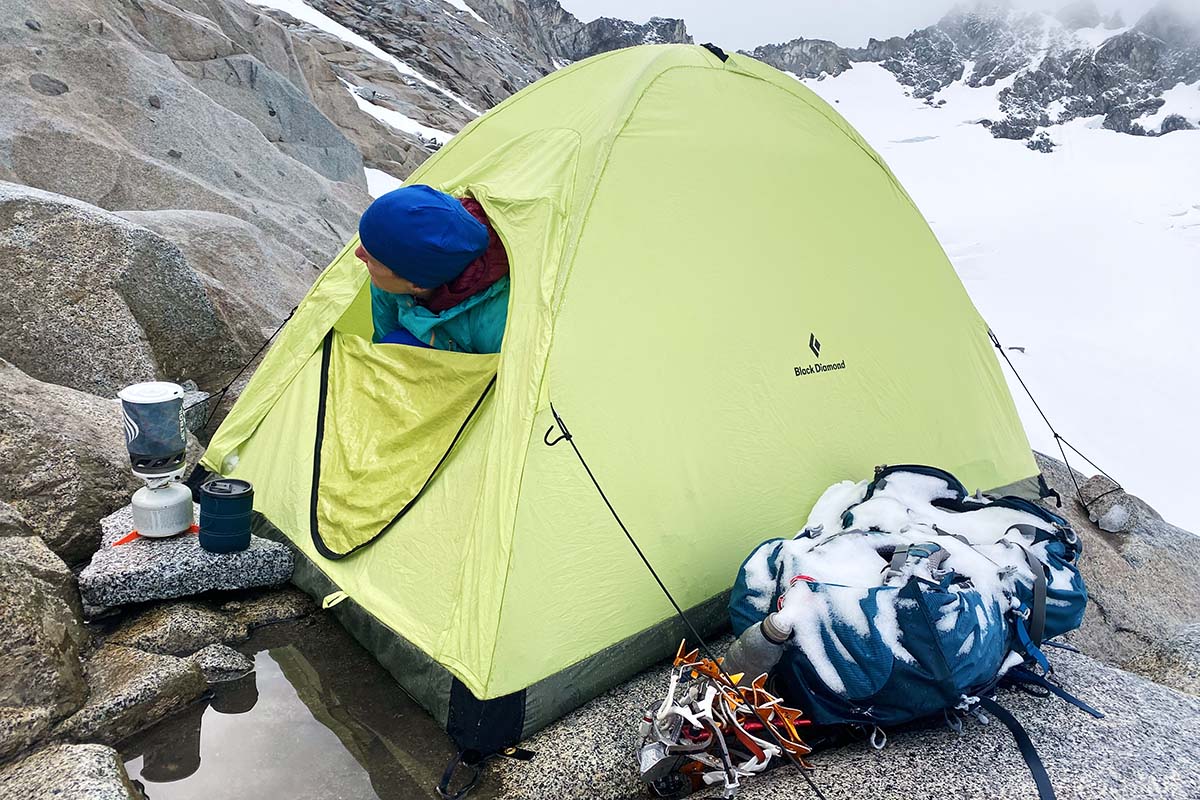
There are a couple of clear benefits to foregoing waterproof material in a tent. First, waterproof fabrics and seam taping increase weight and price—at 3 pounds 15 ounces and a reasonable price, the Black Diamond HiLight is an ultralight, affordable option. In addition, waterproofing generally detracts from breathability—especially in a single-walled tent—which means that the other waterproof models trap noticeably more condensation than the HiLight. But these benefits come with some responsibility. First, when you’re not sure of what the weather might do, leave your HiLight at home and bring a truly waterproof structure. If you do find yourself caught in inclement weather, routinely give your tent a shake when it’s snowing so that there is no opportunity for the snow to warm and turn to water. And finally, if your tent starts to absorb moisture rather than it beading up and rolling off, you can apply an aftermarket spray (like Nikwax's Tent and Gear Solarproof) to revive the fabric's waterproofing.
Four-season tents are the “take anywhere, do anything” tent, and they are designed to withstand the harshest environments in the world. We’ve watched entire vacations go by from the inside of a 4-season tent as inches of snow and rain fall outside, staying dry and comfortable inside (albeit stir-crazy and disappointed). Like the old adage says: “Don’t bring a knife to a gunfight.” Likewise, don’t bring a tent designed for the Pacific Crest Trail to the stormy realms of the Cascade volcanoes, Denali, or Patagonia’s Torre Valley.
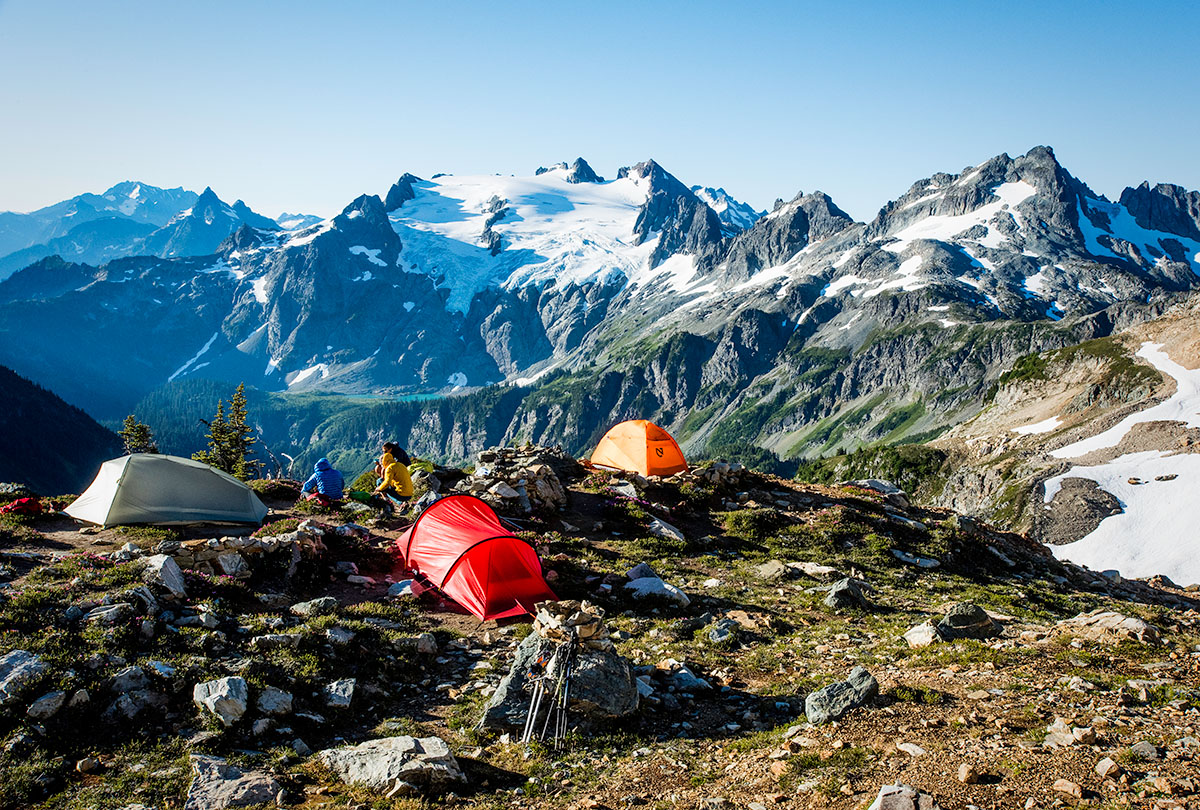
When you are using a 4-season tent, odds are you will be in a climate prone to inhospitable weather. 4-season tents are more robust, heavier, and more durable than standard backpacking tents and are designed to withstand heavy wind, rain, and snow. They’re also packed with features, including flies that extend farther down the main body of the tent (and some models feature snow skirts—flaps that are meant to be buried in snow), high bathtubs on the main body to prevent rain and snow from leeching into the tent, and large vestibules that provide ample room for storage and cooking. It’s not uncommon on big mountain expeditions in Alaska to see intricate kitchens where teams have dug pits in the snow and can comfortably stand, cook, and socialize in the enclosed space of their vestibule.
.jpg)
Most of the tents above feature a pole-supported design that provides 360-degree security from wind, rain, snow, and bugs. But for those who value weight-savings above all else, a 4-season shelter offers weather protection almost on par with a treeline model at half the weight or less. To maximize their strength-to-weight ratios, popular 4-season shelters like the Black Diamond Mega Snow above and Hyperlite Mountain Gear Ultamid 2 are floorless, non-freestanding, and utilize a center pole (often two attached trekking poles or ski poles) to create a taught pyramid shape. When properly set up, these tents can hold strong in moderate wind and shed driving rain and snowfall.
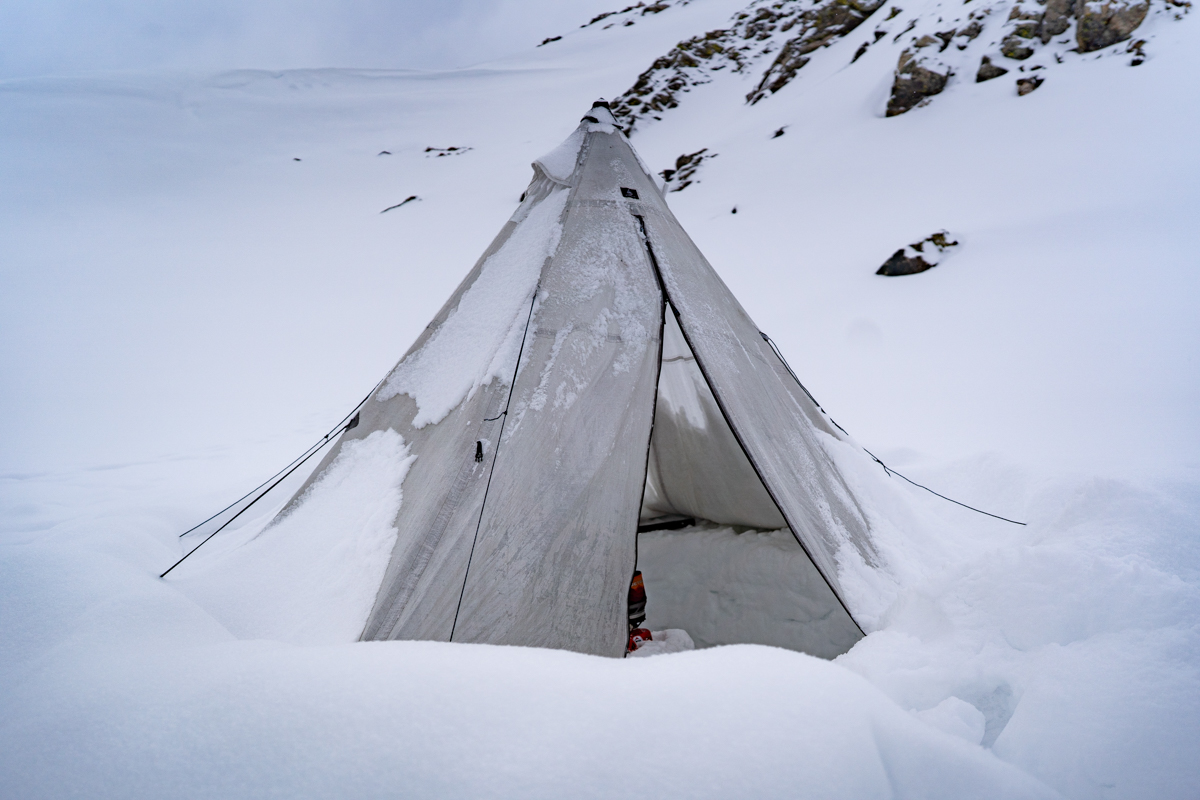
Our favorite use for a 4-season shelter is as an additional living space while basecamping on snow. By digging out the base, you can create a sitting and standing area for four (or more!) that offers a great change of pace from tent life. Then, when you need a true respite from bugs, wet ground, or seeping rain, you can always escape to the security of your tent. The most intrepid of adventurers might opt for a 4-season shelter as their dedicated sleeping area, but we only recommend this for trips when the weather is mild or when weight really wins out: long ski traverses, fast-and-light climbs, and backcountry treks that cover a lot of distance and require a very light pack.
Back to Our Top 4-Season Tent Picks Back to Our 4-Season Tent Comparison Table

51e0.jpg)
_11029.jpg)
%20s2306.jpg)
%20t4928.jpg)
3f56.jpg)