.jpg)
.jpg)
Photo Credit
If you've ever gone camping, hiking, or anything else in the outdoors, chances are you've used a headlamp. While this handy piece of technology requires little introduction, the impressive leaps in headlamp technology deserve some recognition. Drawing from collective decades of testing the best headlamps around the world—from the frigid slopes of Himalayan peaks to hot dusty nights on the African savannah—we narrowed in on a streamlined selection of worthy models, and the Petzl Actik Core came out on top. If you're looking for other lighting sources, we also have an extensive buyer's guide to the best camping lanterns.
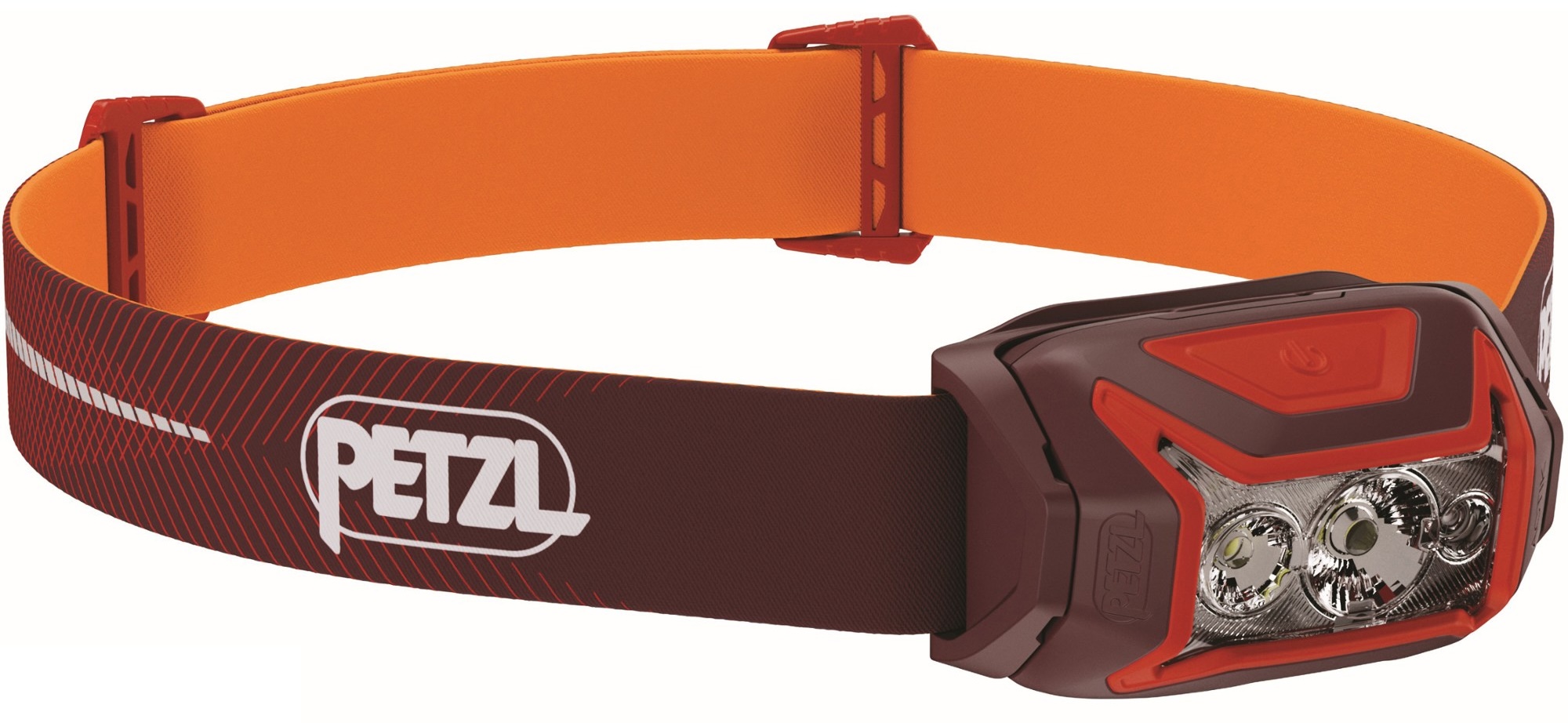
Weight: 3.1 oz.
Max lumens: 625
Batteries: Rechargeable/AAA
What we like: Bright; reliable and long-lasting battery that can swap out for AAAs.
What we don’t: Front-heavy design and some build quality issues.
Petzl’s Actik Core has long been one of our favorite headlamps, and the newest version carries the torch with a high-end combination of value, performance, and versatility. The 625 lumens on high lights up far-off sections of terrain, while the standard 100-lumen mode gets the job done for most slow-paced navigation and is gentle on battery life with a 7-hour burn time. But the main selling point for us is the battery versatility: You get the option between Petzl’s USB-C rechargeable lithium-ion Core battery and three AAAs, which is truly the best of both worlds for front and backcountry use. And the Core battery consistently delivers the most reliable burn time in our testing—on one occasion, our Actik lasted through a six-day backpacking trip, while our BioLite needed several charges. Another one of our testers has used previous versions of the Actik on all three trails of the Triple Crown thru-hikes, and all models he used are still going strong for him.
However, the Actik Core does have some downfalls worth mentioning. The most noticeable is the headlamp’s bulky, archaic-looking design, which is a bit too front-heavy for running (most headlamps of this brightness place their battery pack on the rear). Second, a plastic adjuster fell off our strap and rendered it fairly useless—thankfully, Petzl sells a replacement headband. And finally, many users have found the battery compartment difficult to access and open, although it does loosen up after some use. All gripes aside, we still think the Actik Core is the most reliable and versatile headlamp for all-around use. That said, if you don’t need the top-notch battery life or brightness, there are enough shortcomings—and competitive alternatives—to potentially direct your search elsewhere.
See the Petzl Actik Core
.jpg)
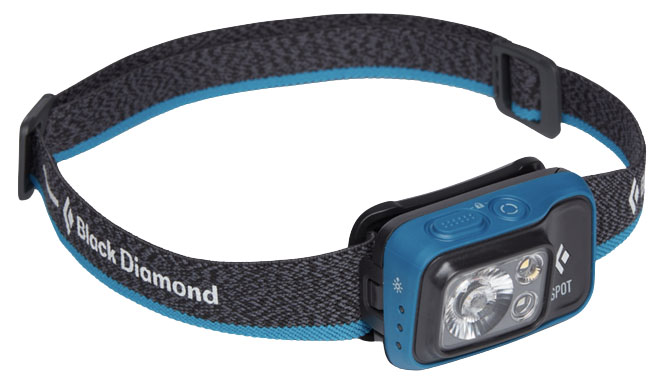 Weight: 2.5 oz.
Max lumens: 400
Batteries: Rechargeable/AAA
What we like: Slim profile, weather-resistant, and easy to operate.
What we don’t: Disappointing battery life; rechargeable battery must be purchased separately and requires a charger.
If the Petzl Actik’s downsides have you continuing your search, it’s worth considering the Black Diamond Spot. The latest Spot is available in a rechargeable 400-R version and the 400 here, which—similar to the Actik Core above—uses BD’s Dual Fuel technology to operate with either AAAs or a rechargeable battery (purchased separately). The headlamp features a streamlined profile (much slimmer than that of the Petzl) for minimal bounce, and the weight is low at just 2.5 ounces (with BD's battery). It also gets an IPX8 waterproof rating compared to the Actik’s IPX4, which gives it extra reliability in wet conditions. Finally, the Spot 400 is easy to operate, with a large central button that turns the headlamp on and off and a second button to scroll between modes, and you get a full suite of lighting choices, from the long-range LED to a softer proximity LED and red light for use around camp.
The Spot 400 is cheaper than the Actik Core if you choose to run it off AAA batteries, but you’ll have to pay an additional $45 for the rechargeable technology (the 1500 Battery and Charger). All in, the full-package BD is pricier than the Petzl, and it simply doesn’t measure up in terms of performance for backcountry use. For one, the need for a charger is unfortunate—it’s just one more item to carry and potentially lose (Petzl eliminates the need for a charger with a micro USB port directly on the battery). In addition, the Spot is not quite as bright as the Actik, with 400 lumens versus 625. And the real kicker is that battery life is not up to snuff: On one outing, our partner’s Petzl offered illumination throughout the night, while our fully charged BD dimmed to almost nothing. We don’t blame you if you’re won over by the Spot’s better user interface, slimmer profile, and high-end waterproofing, but the Petzl is still the more reliable and powerful design.
See the Black Diamond Spot 400
.jpg)
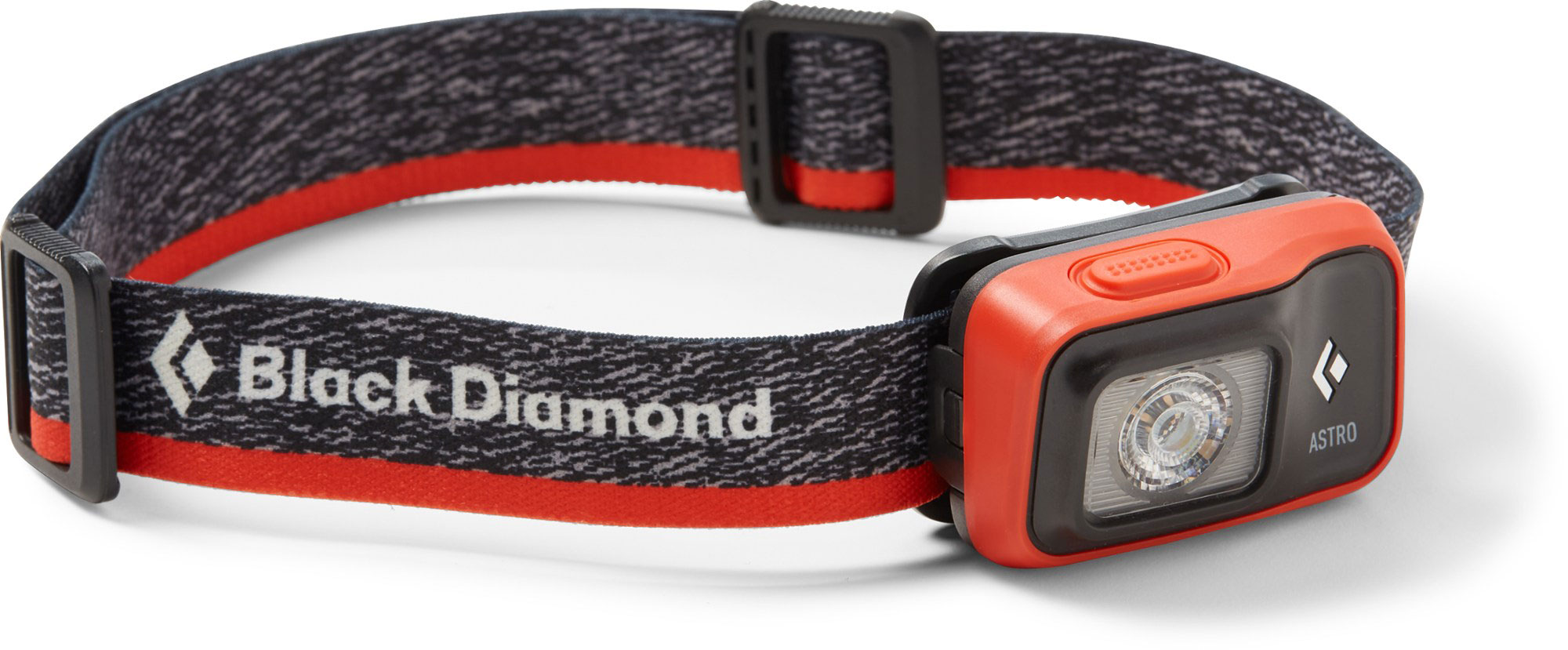 Weight: 3.5 oz.
Max lumens: 300
Batteries: AAA (rechargeable available)
What we like: Gets the job done for just $25.
What we don’t: Not super water-resistant and few lighting options.
If you’re on the hunt for a simple headlamp that will come in handy both at camp and around the house, the Black Diamond Astro 300 delivers. For just $25, the Astro puts out a very practical 300 lumens—including dimming and strobe modes—and lasts for four hours on the brightest setting (140 hours on low). What’s more, at 3.5 ounces and with a compact shape, it’s light enough to go practically unnoticed on your head or in a pack, which makes for a great, cheap emergency backup too. You can spend a lot of money on a brighter or longer-lasting headlamp, but the Astro is a great value and fully sufficient for most campers, hikers, and casual backpackers.
The Astro features Black Diamond’s Dual Fuel technology, which gives it the ability to run off of either AAAs or their lithium-ion rechargeable 1500 Battery (purchased separately). This is a massive improvement over the outgoing version in terms of versatility, and is a competitively low price for a rechargeable headlamp (on the other hand, the rechargeable Astro 300-R is just $45, although it lacks AAA compatibility). Keep in mind that with such a budget device, there are inherent downsides in terms of features and durability: The Astro’s IPX4 rating means it won’t survive submersion in water, and you don’t get distance and proximity lighting or a red light mode as we see in BD's more premium lamps. But simplicity is a strong suit for many applications, and it’s hard to beat the Astro’s combination of price and performance.
See the Black Diamond Astro 300
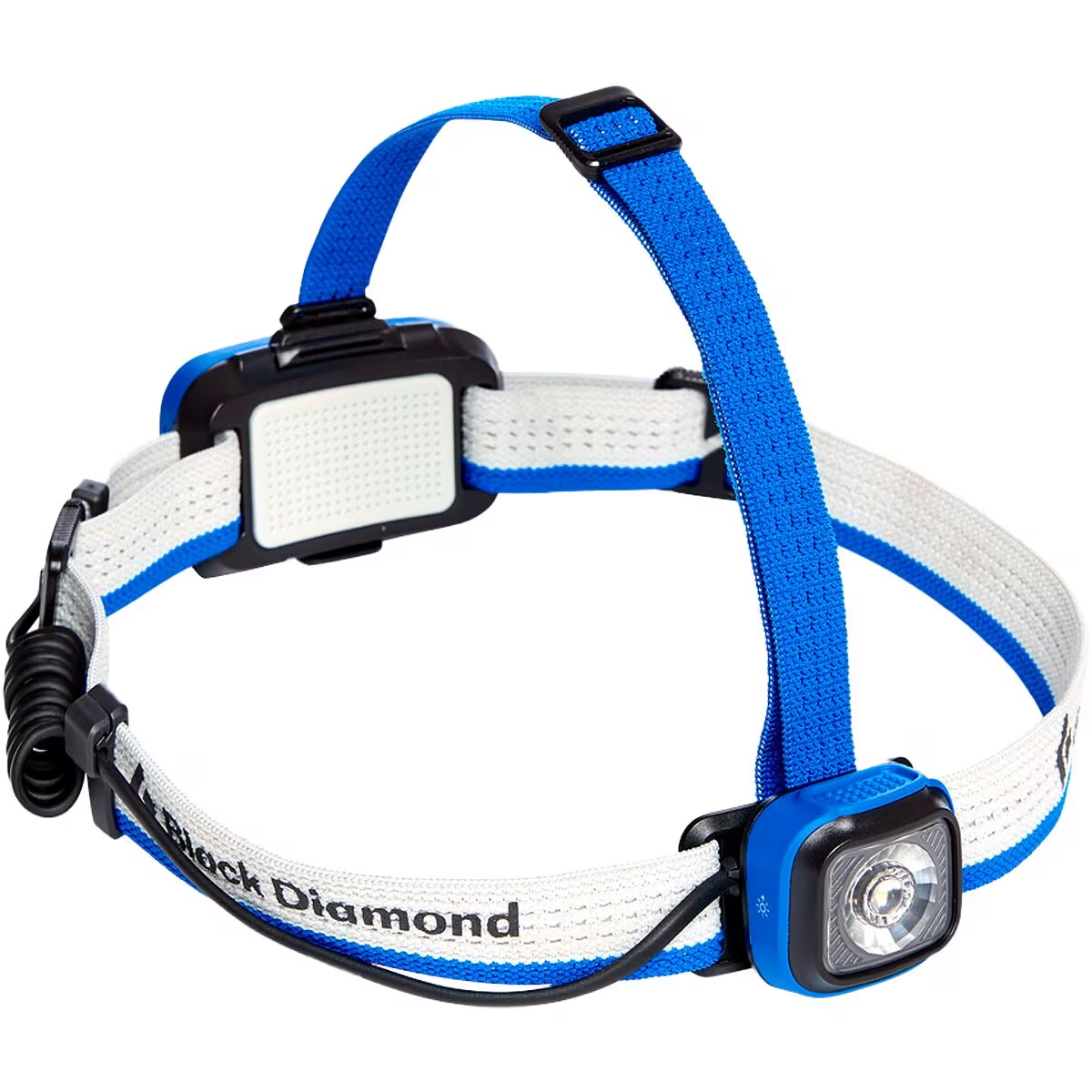 Weight: 4.5 oz.
Max lumens: 500
Batteries: Rechargeable/AAA
What we like: Compact front lamp and flashing red light at the rear.
What we don’t: Relatively heavy; battery pack is bulky.
When it comes to selecting the right headlamp for the job, running poses some unique challenges. For such an inherently bouncy activity, you’ll want a lightweight lamp that sits close to your head and doesn’t shift as you move. It’s also worth considering a model that includes a rear light—especially if you run on roads—or at least some reflective material on the headband. Within this category, the Black Diamond Sprinter is our favorite design. Its 500-lumen lamp is compact and decently bounce-free, and you also get a top strap (removable), reflective logos, and a rear flashing light. Finally, Black Diamond’s Dual-Fuel battery system is an ideal setup for long runs, giving you the option of swapping to AAAs if the USB-rechargeable battery runs out.
The Sprinter’s bright oval beam provides a great balance of distance and proximity lighting, but without a dedicated flood mode or red light option, it’s not an ideal lamp for use around camp. Further, the rear battery pack is rather bulky, and you’ll want to be sure you cinch it up well to mitigate bouncing. The BioLite Dash 450 is worth mentioning as an alternative—it’s more streamlined, lighter, and costs less—but we’ve been disappointed with its battery life, especially in the cold (and you don’t get the option of using AAAs in a pinch). And serious runners should check out the Petzl Nao RL here, which is our top choice for through-the-night trail efforts.
See the Black Diamond Sprinter 500
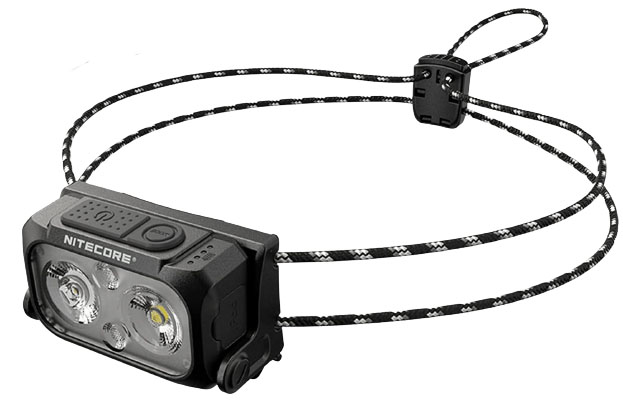 Weight: 1.7 oz.
Max lumens: 400
Batteries: Rechargeable
What we like: Superlight yet still quite bright.
What we don’t: Thin elastic strap isn’t as comfortable as a wider band.
For minimalists and true ounce-counters, our favorite ultralight headlamp of 2024 is the Nitecore NU25 400 UL. At just 1.7 ounces, the NU25 UL secures via a streamlined elastic headband, is surprisingly bright with a 400-lumen max output, and is rechargeable via micro USB. We’ve also found it incredibly easy to operate (cryptic toggling between modes is a common issue with headlamps), with one button for the white beam and one for red, and the battery seemingly lasts forever. All told, as a high-powered emergency light or for those trying to keep their load as light as possible, the NU25 UL is a bright and relatively cheap option.
Keep in mind that the Nitecore NU25 UL has four brightness settings: 400, 200, 60, and 6 lumens (the red mode is a constant 10 lumens). There’s no dimmer, which is a bummer, but certainly something we can get used to. And while the elastic strap goes a long way toward streamlining the weight, it’s certainly not something you’ll want to have on your head all night. But for those in the market for an ultralight headlamp, it’s our top all-around pick of the year.
See the Nitecore NU25 400 UL
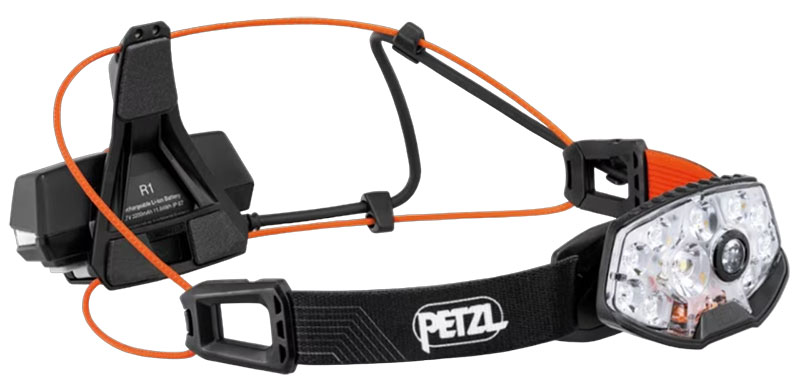 Weight: 5.1 oz.
Max lumens: 1,500
Battery: Rechargeable
What we like: Reliable and bright headlamp for serious running, skiing, and mountaineering.
What we don’t: Battery cannot be charged on the go or extended to your pack/jacket; expensive.
The headlamps above offer sufficient brightness for most activities, but if you’re moving quickly or route-finding in the darkness, you don’t want to mess around. Perhaps no sport tests this as much as ultra running, where it’s commonplace for runners to race through the night. And among ultrarunners, the Petzl Nao RL is the go-to headlamp, packing a whopping 1,500 lumens and a powerful 3200 mAh rechargeable battery (the Actik Core’s is 1250 mAh) into a well-balanced and svelte 5.1-ounce design. Rather than a dedicated spot or flood light, the collection of small LEDs work together to deliver lighting for proximity, movement, and distance; you also get the option between standard mode and Petzl’s Reactive Lighting, which optimizes the brightness and beam pattern to the changing environment. If you’re willing to throw down this much cash for a smart, powerful, and long-lasting headlamp, put the Nao RL at the top of your list.
Unlike many super-charged headlamps, the Nao’s battery cannot be charged on the go, nor can it be extended to ride in your running vest or jacket. This is a bit of a downside, especially for long efforts or when venturing out on cold winter nights. And unlike Petzl’s Core battery in the Actik above, the Nao’s battery cannot be traded out for AAAs—so most users will choose to pick up a spare. What’s more, not everyone will love the unique strap system, and the on/off button can be very difficult to toggle while wearing gloves. But for those looking for the brightest light at the lowest weight with respectable battery life to boot (in standard mode, the Nao runs for 5 hours at 250 lumens—compare that to the Actik’s 7 hours at a much dimmer 100 lumens), you’d be hard-pressed to find a better design. And for even more brightness, check out Moonlight’s Bright as Day collection (we cover the 800-lumen model below), which offers up to 4,000 lumens for serious skiers and mountain bikers.
See the Petzl Nao RL
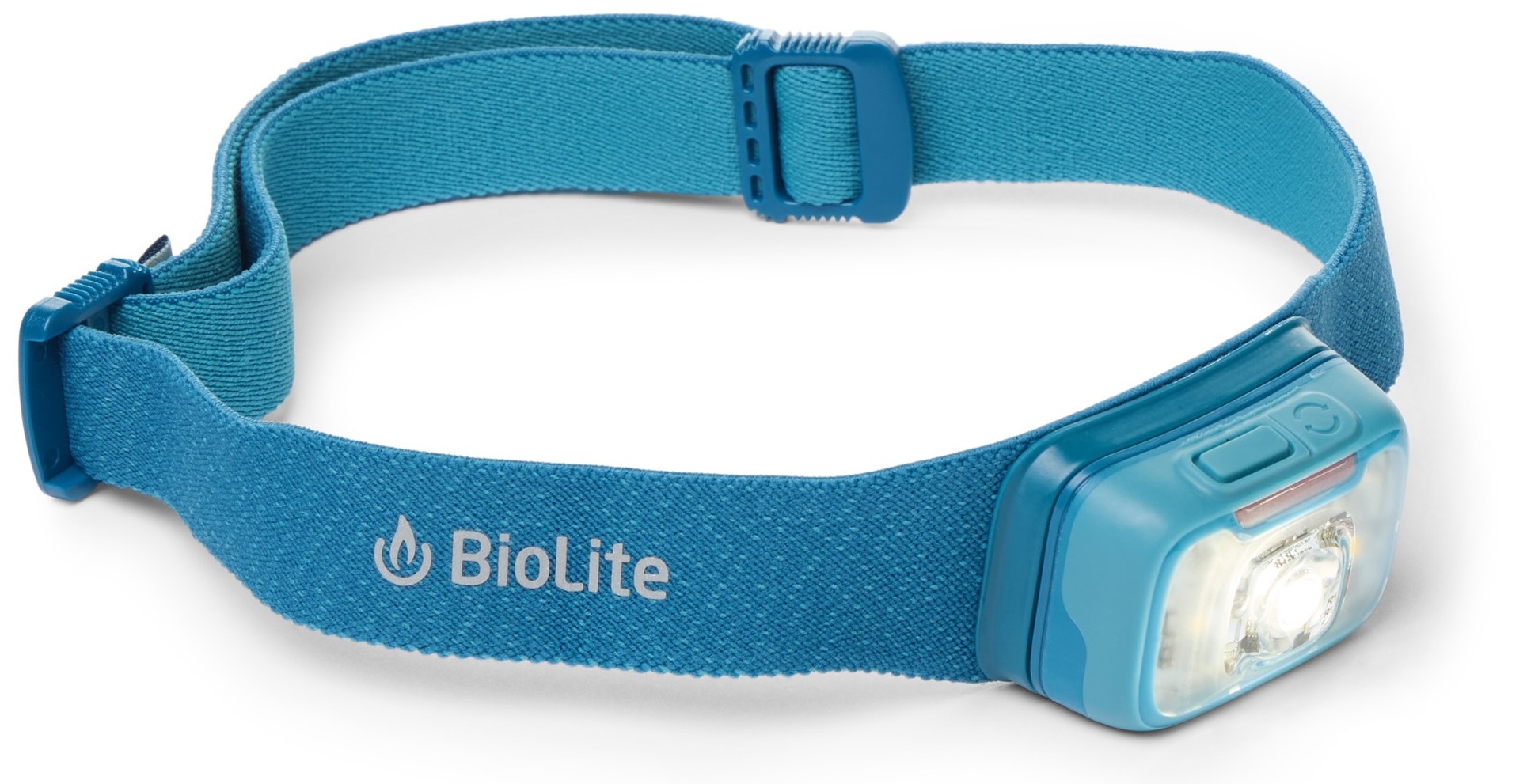
Weight: 2.6 oz.
Max lumens: 500
Batteries: Rechargeable
What we like: Sleek and comfortable design; easy to operate; IP67 submersible waterproofing; quick charging.
What we don’t: Battery drains quickly at higher outputs.
BioLite has long prioritized wearer comfort, and the new Range 500 is arguably the most refined execution of that philosophy to date. Designed with a "barely there" headband feel, this headlamp eschews bulky rear battery packs for a slim, balanced front unit that stays firmly in place during movement without "crunching" your forehead. With a maximum output of 500 lumens and an intuitive two-button interface, it excels at the fundamentals of camp life and hiking. We particularly appreciate the mode memory—which ensures the light returns to your last used setting, such as the adjustable red light—and the simple press-and-hold dimming function. For tasks ranging from setting up a tent in the dark to walking the dog, the Range 500 offers a high-quality, predictable beam and a soft, pliable fit that makes it easy to forget you're even wearing it. It's also impressively light, at a mere 2.6 ounces. Tack on the IP67 submersible waterproofing, and you get one heck of a backcountry-ready design.
While it is a "best-in-class" option for comfort, the Range 500 is not a long-distance light cannon. Its 500-lumen burst is perfect for scanning 100 yards to investigate a noise in the brush, but as a regulated light, it will automatically dial down its brightness as the battery depletes to preserve its runtime. This means it isn't the ideal choice for high-intensity activities like overnight ultra-running, where sustained high output is mandatory. Additionally, while the buttons are large enough to be functional, they can still feel a bit fumbly when used with heavy winter gloves. However, for the price point, the addition of a warm flood mode and a red light makes the 500 a significant value over the lower-output 300 and 400 models, cementing it as a top-tier pick for general outdoor use.
See the BioLite Range 500
.jpg) Weight: 2.8 oz.
Weight: 2.8 oz.
Max lumens: 700
Batteries: Rechargeable/CR123A
What we like: About as bombproof as it gets.
What we don’t: Battery drains fairly quickly in turbo mode.
For activities like high-altitude mountaineering, alpine climbing, and backcountry rescue, you’ll need a headlamp built to withstand significant abuse, and Fenix’s HM50R fits the bill nicely. This headlamp is rugged with a full aluminum casing, powerful with a 700-lumen max output and beam distance of around 370 feet, and dust- and waterproof with an IP68 rating, which means it can handle being submerged in up to 2 meters of water for 30 minutes. And the rest of the design is equally well executed, including a single side switch that makes it easy to toggle between settings (the headlamp has four output levels), a reflective headband, and compatibility with cold-resistant CR123A batteries (in addition to the included rechargeable lithium-ion battery).
Not everyone needs the specialized features or ultra-tough build, but the good news is that the Fenix is reasonably priced for the amount of output and performance you get. Sure, you could step up to a more serious model like Fenix's HM65R, but that will run you some additional cash and tack on a bulkier design. Alternatively, Nitecore’s HC33 bears a strong resemblance to the HM65R but with even more output at full tilt (1,800 vs. 1,000 lumens) for just a bit more than the HM50R here. Keep in mind that with all high-powered headlamps, you’ll want to only use the brightest mode when it counts. The Fenix’s 700-lumen “turbo” mode will drain the battery in only 1 hour, while the lower settings range from 8 hours to 42 hours, respectively.
See the Fenix HM50R V2.0
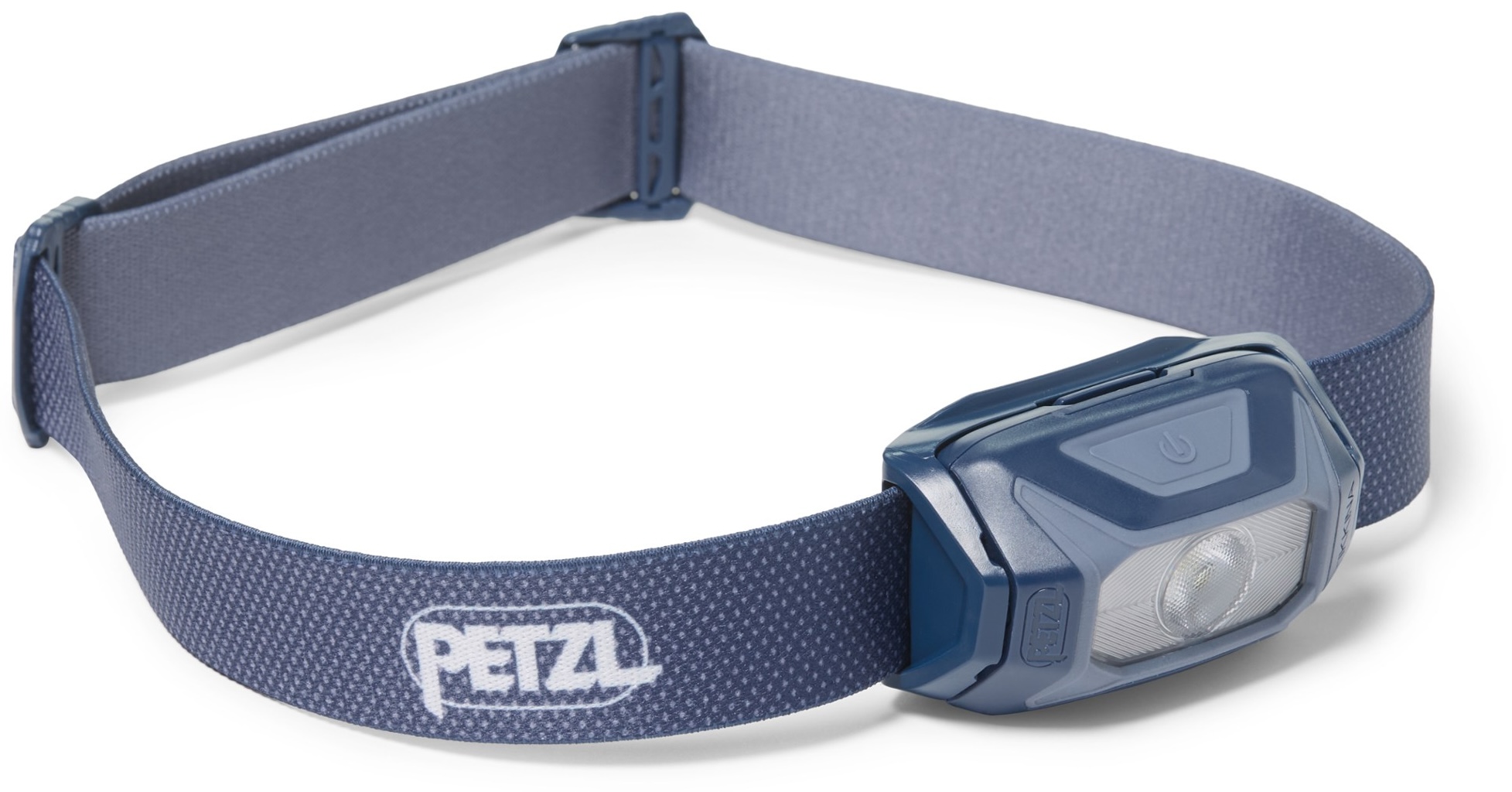
Weight: 3.2 oz.
Max lumens: 300
Batteries: AAA (rechargeable available)
What we like: Easy to use and a good price.
What we don’t: Average light quality and no red light option.
For camping trips or use around the house, a simple headlamp like the Petzl Tikkina is a fine choice, featuring 300 lumens of maximum output from a single white LED. The center button is easy to find and operate, and the beam is ample for nighttime cooking and setting up tents in the dark. As with the Actik Core above, the Tikkina is compatible with Petzl’s Core rechargeable battery, although in this case it’s an accessory that is purchased separately. If you're looking for a rechargeable headlamp there are better values out there (including the BioLite 325 above); but for the casual user who doesn't mind AAAs, the Tikkina hits a nice balance of performance, weight, and price.
The Tikkina goes head-to-head with our top budget pick, the Astro 300. The headlamps are identical in terms of brightness, and they both have IPX4 ratings, and are designed to run on either AAAs or a rechargeable battery (the lithium-ion batteries from both Petzl and BD will cost you more). Neither model has a red light—which some might want for nighttime reading—but the Astro does have a lockout mode (helpful for preventing accidental battery drain) and is lighter, less bulky, and cheaper. But it’s hard to go wrong with Petzl (we’ve found their headlamps to be very reliable and long-lasting), and the Tikkina is nevertheless a high-quality budget option.
See the Petzl Tikkina Headlamp
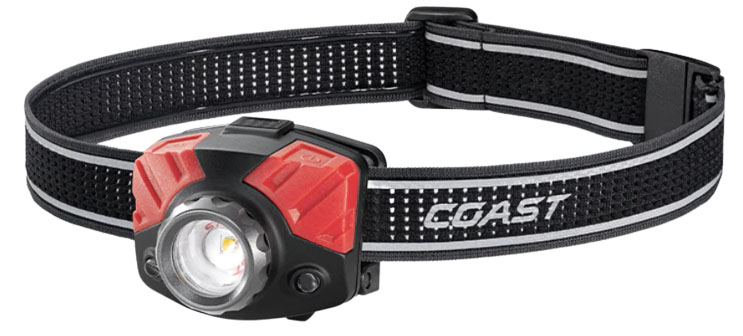 Weight: 3.2 oz.
Max lumens: 1,000
Batteries: Rechargeable/AAA
What we like: Long beam distance; great value.
What we don’t: Short battery life; outdated looks.
Oregon-based Coast Products flies a little under the radar compared to Black Diamond or Petzl, but they have a strong lineup of quality headlamps. A shining example (no pun intended) is their FL75R: With an affordable price, the FL75R packs up to 1,000 lumens and an easy-to-use focusing ring that works just like a high-powered flashlight, twisting to adjust from flood to spot. Its simple functionality is absolutely painless in use (unlike some of the more confusing headlamps above), and there’s no need to cycle through various modes to swap between proximity and distance. Coast doesn’t skimp on brightness, either: In turbo mode, the FL75R can illuminate up to 168 meters (551 ft.), which is one of the longest beam distances on our list.
So why the mid-pack finish for the Coast FL75R? Its major shortcomings are battery life and bulk. For reference, our top-ranked Petzl Actik can keep you illuminated for up to 100 hours, while the FL75R will last you just 14 hours on its lowest setting (which admittedly is still quite bright at 110 lumens). And for those who are looking for a suitable hiking or backpacking lamp, the FL75R is on the larger side and a bit archaic-looking to boot. But we definitely appreciate the giant buttons and easy-to-toggle focusing dial, and the beam distance and brightness is truly impressive—great for spotting the route, finding friends, or navigating back to your campsite. For budget shoppers who don’t want to sacrifice performance, the Coast FL75R is a great value.
See the Coast FL75R
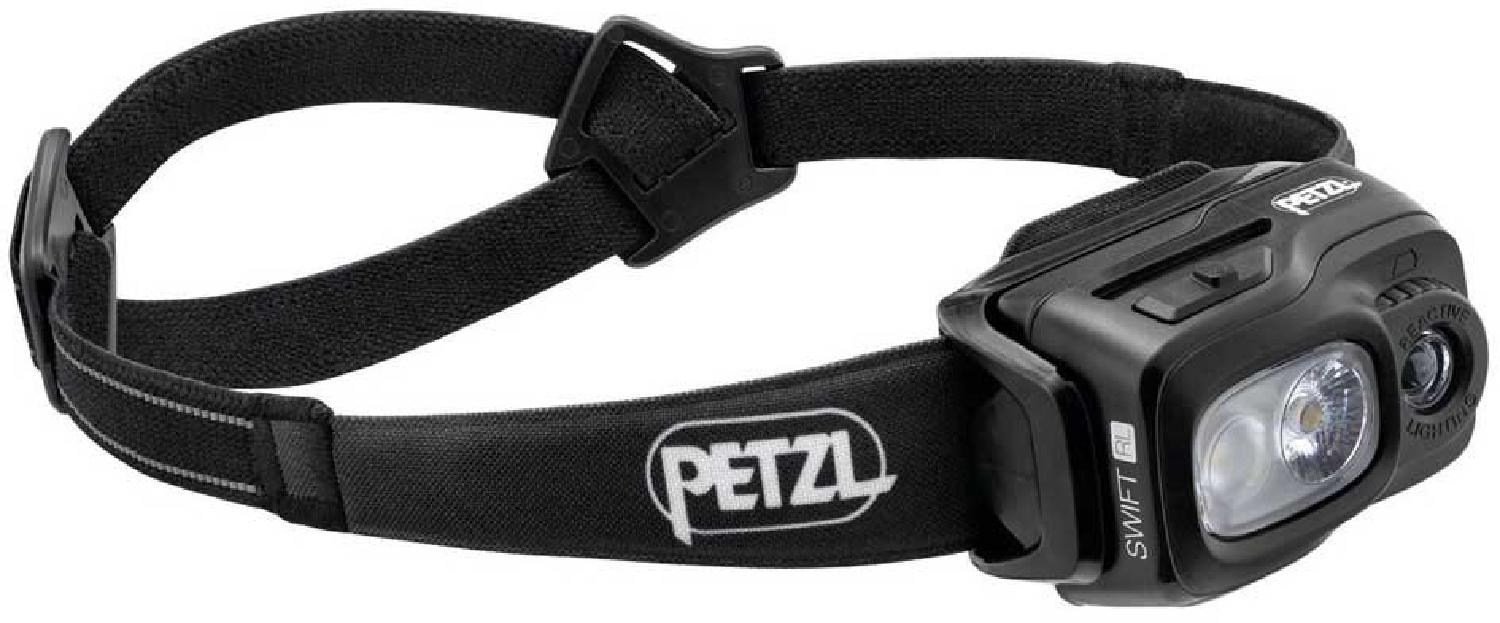
Weight: 3.5 oz.
Max lumens: 1,100
Batteries: Rechargeable
What we like: Compact yet bright; reactive lighting offers hands-free illumination and optimizes battery life.
What we don’t: Expensive and overkill for most.
The most powerful of Petzl’s compact headlamps, the Petzl Swift RL shouldn’t be overlooked by those looking for a high-end light. This lamp features the same Reactive Lighting tech as the Nao RL above, which is not only convenient for adapting to the environment hands-free (think of it as the photochromic lens of headlamps) but also optimizes battery life throughout the charge. In standard Reactive mode, you get a minimum of 7 hours of burn time and up to 275 lumens of light, which is sufficient brightness for navigating trails and even more complex terrain. Compare that to the top-ranked Actik Core, which lasts for 7 hours at 100 lumens, and the contrast is obvious: The Swift RL is a much more powerful lamp for just a small weight penalty.
But for much more than the Actik, you’ll have to ask yourself if you really need the additional brightness and tech. The Swift RL’s 2350 mAh battery is undeniably powerful, but (like the Nao’s power pack) it’s not designed to be swapped for AAAs, which limits versatility for long stints in the backcountry. And if you’re moving at a slow pace or just need a headlamp for around camp, the brightness capacity is certainly overkill (most hikers can get by with 100 to 200 lumens). But for serious runners and skiers who get out a lot in the dark and prefer the compact build over a heftier model like the Nao RL above, the Swift RL certainly has a lot to offer.
See the Petzl Swift RL
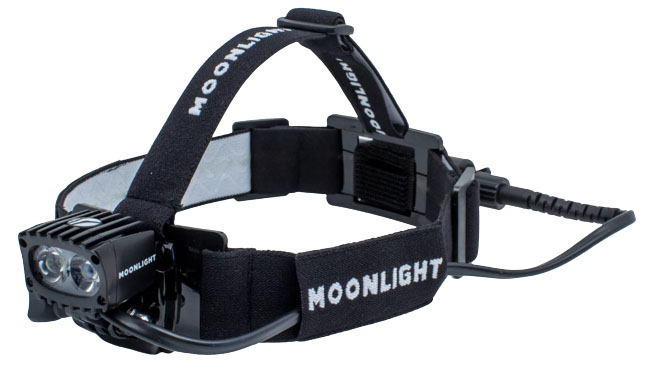 Weight: 8.7 oz.
Max lumens: 800
Battery: Rechargeable
What we like: Removable battery pack is great for cold conditions.
What we don’t: Expensive and heavy.
Norway-based Moonlight isn't a big name this side of the Atlantic, but the small startup offers some of the most reliable high-performance solutions, backed by the legend himself, Kilian Jornet. Their Bright As Day collection features removable batteries that are easy to recharge or swap out and can be stored in your chest pocket while in use (keeping a battery warm helps preserve its lifespan). Given that battery issues are a primary downside of high-powered headlamps, we really appreciate this design.
The Bright As Day 800 will get the job done for most (it was Kilian’s choice for running both the Hardrock 100 and UTMB in 2022), but skiers and mountain bikers will likely want to step up to a brighter model. And while these headlamps are undeniably heavy (the 800-lumen version is 8.7 oz.), the ability to extend the battery to your pocket goes a long way. What’s more, each Bright As Day model features a removable light, which can be affixed on a Go-Pro mount or bike handlebar (mounts sold separately). All told, you’d be hard-pressed to find a more reliable high-performance headlamp. If you’re running through the night in an ultramarathon, skimo training at your local hill, or rallying on mountain bikes in the darkness, a Moonlight headlamp is worth the investment.
See the Moonlight Bright As Day 800
 Weight: 3.4 oz.
Max lumens: 1,800
Batteries: Rechargeable/CR123
What we like: A super bright and feature-packed two-in-one design.
What we don’t: Overkill for most outdoor recreation; not the most user-friendly or low-profile design.
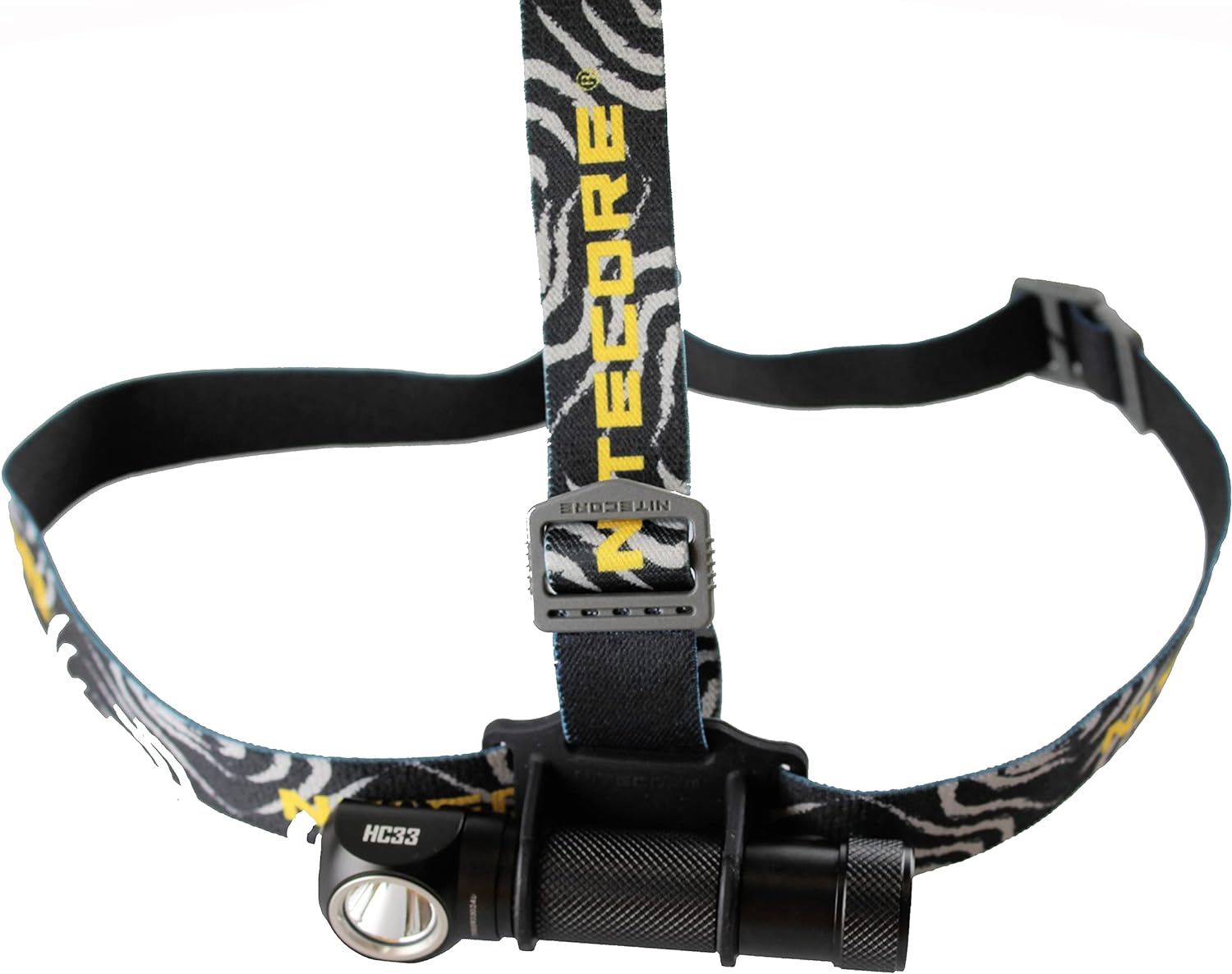
Last but certainly not least is Nitecore’s feature-packed HC33 headlamp. Starting with brightness, you get settings ranging from just 1 lumen on “ultralow” to a whopping 1,800 at full tilt, making this the brightest option on our list by a wide margin. We also appreciate the handy battery life indicator—just loosen the cap and count the flashes—as well as the magnetic tail cap for affixing to the back door of our vehicle when cooking dinner at camp. A final feather in the Nitecore’s cap is the ability to separate the light from the strap for use as a handheld flashlight—and an incredibly bright and far-reaching one at that.
Why the last-place finish for the Nitecore HC33? In short, 1,800 lumens is overkill for most recreational uses—we advise steering clear of the “turbo” setting any time you’re in close proximity to other groups. The 187-meter beam length is also impressive but realistically more than most folks will ever need (exceptions include backcountry rescues, emergency use, and night hunting). And then there’s the bulky strap design, which makes the HC33 a bit unwieldy to wear, along with the recessed button that makes it difficult to toggle between settings, especially with cold fingers (we’ve accidentally blinded our friends more than once). Finally, while the headlamp can run off of CR123 or rechargeable batteries, the former limits you to 780 lumens at max output, while the latter will run you some additional cash. In the end, we like the Nitecore for its two-in-one functionality and competitive specs at a reasonable price, but very few activities demand this level of performance.
See the Nitecore HC33
Beyond our top picks, we’ve rigorously tested a wide range of high-quality headlamps that ultimately didn’t secure a spot in the final selection. Our goal is to highlight the true standouts. Every design we recommend has been vetted over multiple seasons to ensure it earns its place in your kit; however, we believe sharing these "honorable mentions" provides helpful context and a more complete picture of the current market.
We opted to leave the Black Diamond Storm 500-R out this round, primarily because we think the Spot is a better all-rounder for most. It is also not compatible with AAA batteries and runs on the heavier side of the spectrum. That said, it still offers great battery life and brightness in a relatively light and streamlined build, making it a worthy competitor.
The Petzl Iko Core is another headlamp we've been testing for a while, but opted to leave out this round. While we love its ultralight weight and slim profile for running, its design is somewhat polarizing and we find ourselves reaching for other headlamps more often when setting out on runs. We prefer its older sibling, the Petzl Nao RL, and feel it's superfluous to include both in this round-up. In a similar vein, the Black Diamond Distance 1500 headlamp has accompanied us on a lot of long runs recently, but in light of the other long-lasting options here, it just didn't merit inclusion in our round-up. We prefer the Nao RL for ultramarathons, and it just doesn't carry as comfortably as we were hoping when bopping around on trail.

| Headlamp | Price | Weight | Max Lumens | Batteries | Max Beam | IP Rating |
|---|---|---|---|---|---|---|
| Petzl Actik Core | $88 | 3.1 oz. | 625 | Rechargeable/AAA | 115m | IPX4 |
| Black Diamond Spot 400 | $60 | 2.5 oz. | 400 | AAA (rechargeable available) | 100m | IPX8 |
| Black Diamond Astro 300 | $25 | 3.5 oz. | 300 | AAA (rechargeable available) | 55m | IPX4 |
| Black Diamond Sprinter 500 | $100 | 4.5 oz. | 500 | Rechargeable/AAA | 52m | IPX4 |
| Nitecore NU25 400 UL | $37 | 1.7 oz. | 400 | Rechargeable | 81m | IP66 |
| Petzl Nao RL | $200 | 5.1 oz. | 1,500 | Rechargeable | 200m | IPX4 |
| BioLite Range 500 | $70 | 2.6 oz. | 500 | Rechargeable | 100m | IP67 |
| Fenix HM50R V2.0 | $60 | 2.8 oz. | 700 | Rechargeable/CR123A | 115m | IP68 |
| Petzl Tikkina | $20 | 3.2 oz. | 300 | AAA (rechargeable available) | 65m | IPX4 |
| Coast FL75R | $66 | 3.2 oz. | 1,000 | Rechargeable/AAA | 168m | Unavailable |
| Petzl Swift RL | $135 | 3.5 oz. | 1,100 | Rechargeable | 155m | IPX4 |
| Moonlight Bright As Day 800 | €159 | 8.7 oz. | 800 | Rechargeable | 64m | IP67 |
| Nitecore HC33 | $65 | 3.4 oz. | 1,800 | Rechargeable/CR123 | 187m | IP68 |
Whether we’re waking up before the sun for an alpine objective or spending time around the campfire with friends, getting benighted is an unavoidable part of adventuring outside. Thankfully, the modern headlamp market is jam-packed with quality outdoor options, many of which have earned permanent spots in our packs. Former editor-in-chief John Ellings put together our initial list of 10 picks in 2016. A jack of all trades, John always has a need for a quality headlamp, whether on a late-night mountain bike ride or a remote backpacking trip. Senior editors Chris Carter and Maddie Downie now co-manage the guide. Both backcountry enthusiasts, they are frequently burning the midnight oil on rowdy adventures in all sorts of environments—from big wall missions on El Cap to late-night ski laps in the PNW.
Our lineup currently includes 13 headlamps that run the gamut from ultralight options for minimalists and ounce-counters to ultra-bright designs for emergency use. We’ve put these standouts to the test on all sorts of outdoor adventures, from unexpected mountain bivvies to placing gear on early-morning multi-pitches. In addition to brightness, other top considerations include battery life and compatibility, weight and bulk, and the number of settings offered. Comfort is another important factor, especially for runners and other athletes who will benefit from a snug, low-profile fit. All of the picks above stood out in one or more of these metrics, and we’ll continue adding any other high performers as they become available.
.jpg)
When buying a headlamp, one of the first questions you might be asking is, “how bright of a light do I need?” Brightness is measured in terms of lumens, and the lamps here have max outputs ranging from 200 to 1,800 (the Nitecore HC33). Most headlamps also have dimming capabilities or numerous modes that allow you to choose your level of brightness for any given situation—for example, the Petzl Actik Core has three settings ranging from 7 lumens to 625.
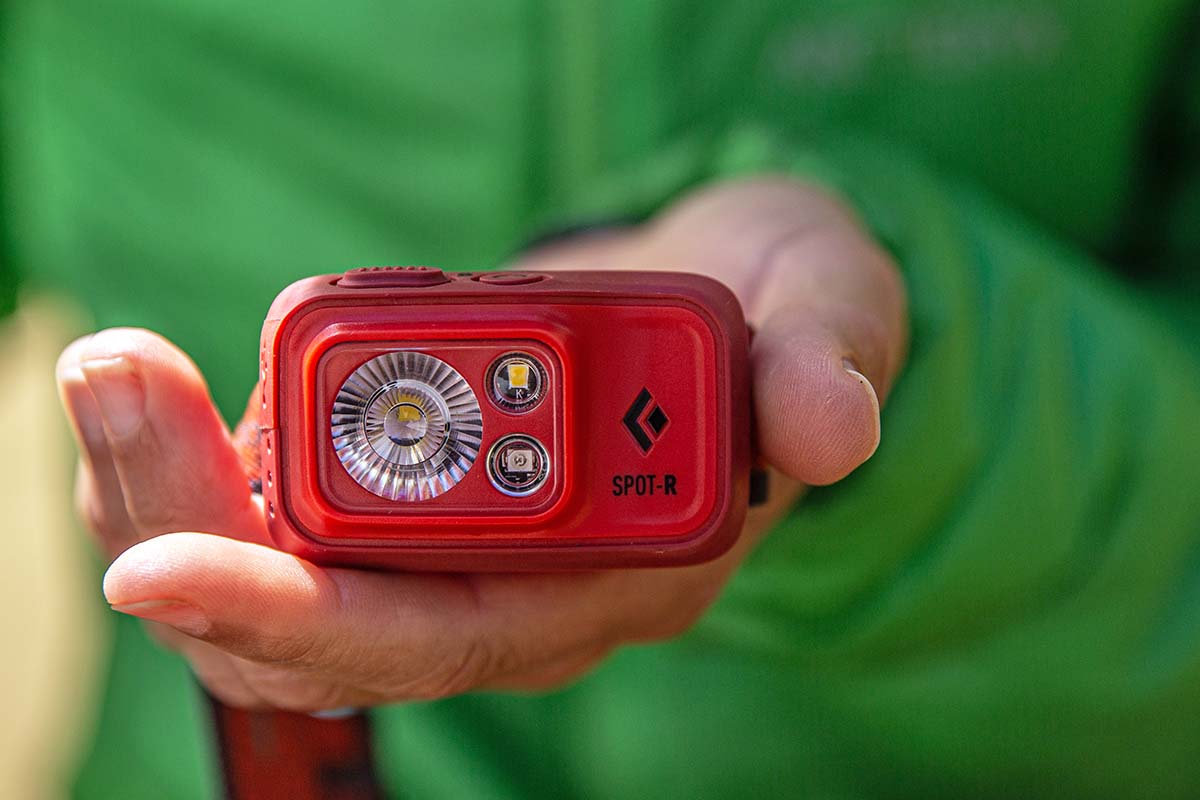
When deciding on the proper number of lumens, it's worth considering that you shouldn't plan on using the light's maximum setting for extended stretches as it will drain the battery quickly, but it's sure helpful to have a strong beam just in case. In general, we’ve found that 100 to 300 lumens are great for around the house and slow-paced outdoor activities like hiking, backpacking, and camping. For a navigational aid in complete darkness, you’ll want to jump into the 300-plus-lumen category. And for extremes like caving and spelunking, climbing at night, or when you’ll be traveling at higher speeds (such as a night trail run or mountain bike ride), plan on starting your search at 600 lumens (cavers generally shoot for much higher lumens). Headlamps with 1,000+ lumens, like the Nitecore HC33 (1,800 lumens at full tilt), are generally overkill for most outdoor recreation, though they may be suitable for night hunting or fishing, as well as in emergency situations (a super bright light can be used to attract attention or navigate tricky terrain).
.jpg)
It's important to note that lumens do not perfectly represent the brightness and quality of a headlamp. What a lumen actually measures is the amount of visible light that these lamps can generate, which doesn't always translate to distance or how well it will illuminate a trail or campsite (for more on this, see "LED Types" below). The good news is that the picks listed above are quality headlamps with advanced optics (and we call out any exceptions), so lumens remain a helpful indicator of how bright your headlamp will be. Just be sure to also take into consideration beam distance, beam type, and brand reputation as opposed to relying solely on the lumen spec.
.jpg)
The average headlamp features a range of lighting modes, including spot, flood, colored, and strobe lights. The default setting for most lamps is their powerful LED spot beam, which focuses the light at a distance rather than casting it wide around you (the max distance these can reach is listed in the "max beam" section of our comparison table). While not necessary in all circumstances, a long-distance beam can be helpful for looking far down a trail, trying to spot an anchor while rappelling, or even for extreme uses like caving.
.jpg)
Not all headlamps have a flood light option, but it’s a great function to have for proximity lighting. Best for around camp or in a tent, flood lights cast a wide beam and maximize the view right in front of you. Some headlamps will have two LEDs, one for spot lighting and one for flood lighting, while others (like the Coast FL75R) allow you to shape one single LED into a distance beam or an up-close flood. The Petzl Nao RL strays from the norm with a series of small LEDs that are smartly programmed to deliver proximity, distance, and movement lighting. In their specs, many manufacturers will call out a lamp’s beam distance.
.jpg)
Many mid-range and high-end headlamps also include red (and sometimes blue and green) LEDs. We’ve found these useful for reading or hanging out at night as the soft light doesn’t blind your friends or disturb your tentmates. Another plus is that these lights don’t make your pupils readjust when you turn them on, so they’re great for navigating a dark tent or retaining night vision when romping around after dark. Red light also doesn't attract as many bugs—something to consider when whipping up your dinner in the evening. Those with specific night needs will find that blue and green LEDs have their place (hunters, for example, will use blue for tracking as it allows them to differentiate between green foliage and the red blood of the animal). A number of headlamps also have some sort of emergency strobe function, which simultaneously is very visible and doesn’t eat into your batteries as quickly.
_0.jpg "Using the red light on the Black Diamond Storm")
Battery Types: AAA, Rechargeable, and Hybrids
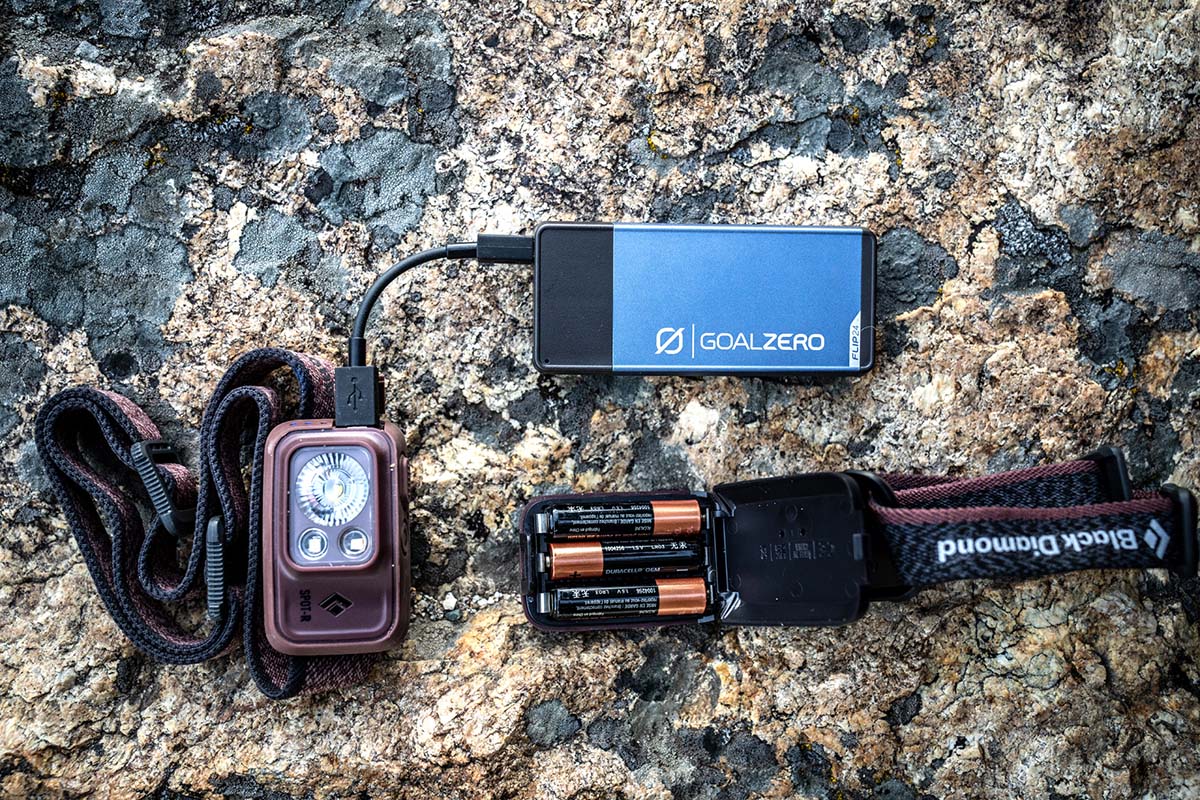
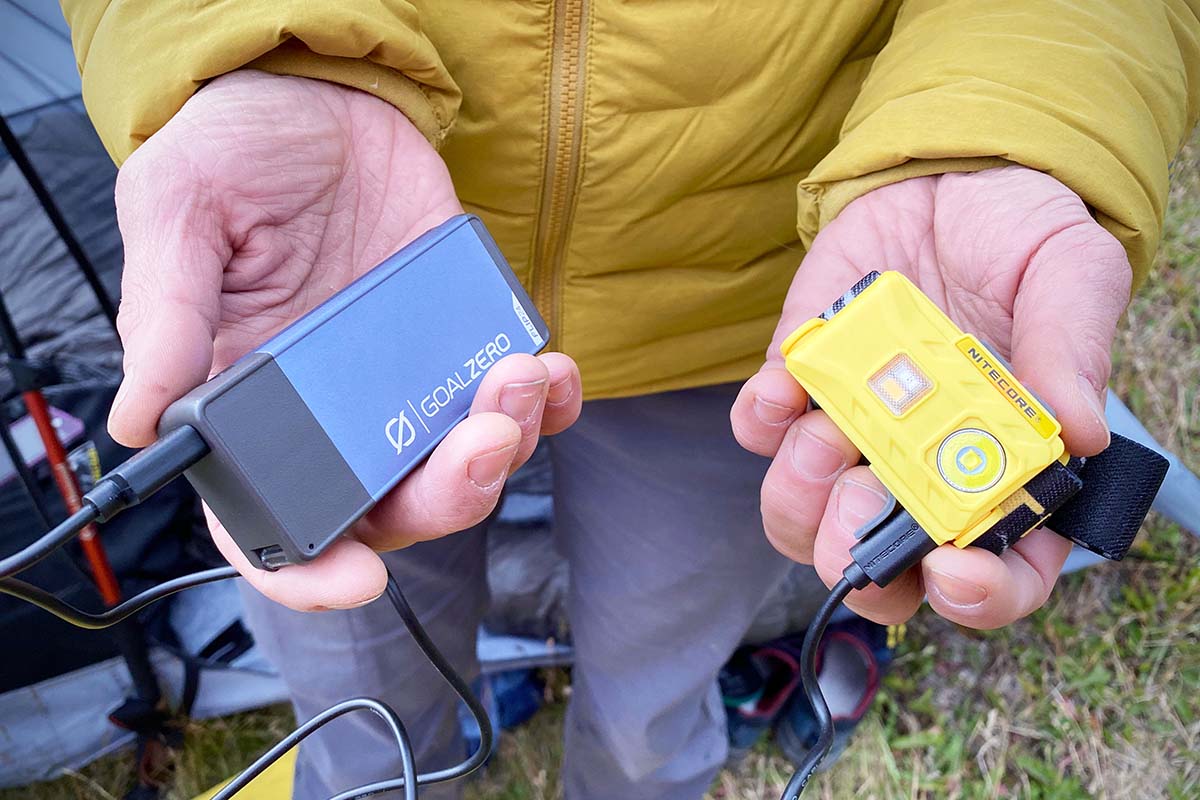
Most standard LED headlamps are powered by AAA batteries or a rechargeable lithium-ion battery, housed in either the main body of the light or at the back of the strap. Rechargeable batteries have become more ubiquitous in the past few years and are our preferred style for their convenience and streamlined size. The main downside with rechargeable batteries is that reviving a dead lamp is not as easy as swapping out AAAs, meaning you’ll need to bring along a power bank or solar panel (or a replacement battery) if you’re in the field for days on end. For all rechargeable options, you do pay a little price premium, but keep in mind that the cost and waste of AAA batteries certainly can add up. In the end, we recommend rechargeable headlamps for most people and uses, but if you’re looking to save money, want a cheap backup, or don’t anticipate using your headlamp often, a AAA model can be a fine way to go.
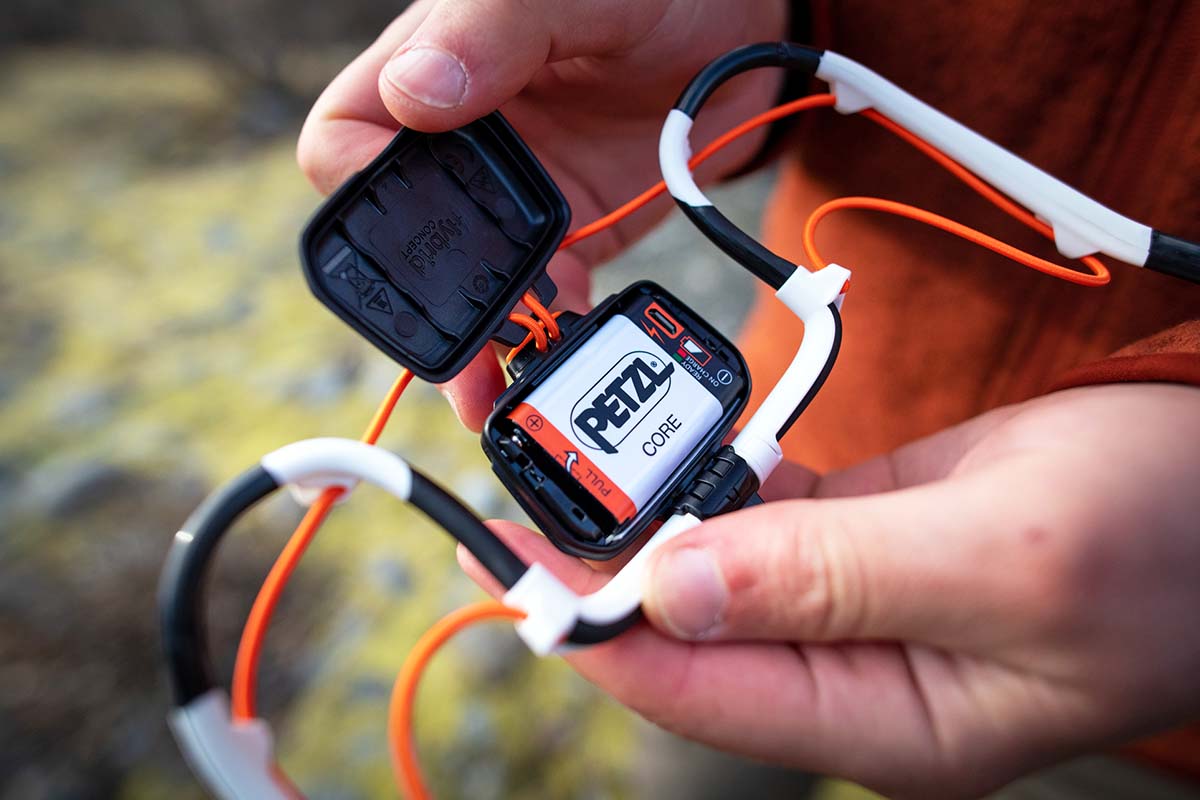
Some headlamps offer the versatility of both a rechargeable battery and compatibility with AAAs. Petzl was the initial brains behind this technology: Their USB-rechargeable Core battery can be purchased separately ($30) and functions with any of their headlamps that also run off three AAA batteries. Black Diamond offers a similar design (they call it Duel Fuel technology) in a number of their models, including the Storm, Spot, Astro, and Cosmo. These headlamps come with AAA batteries, but are compatible with BD's 1500 lithium-ion battery (purchased separately). Our main gripe with BD's design is that the battery must be charged on the included charging dock, whereas Petzl's Core eliminates the need for extra equipment with a micro-USB port right on the battery. Both are great options for those wanting the benefits of a rechargeable headlamp alongside the versatility of AAAs, but we much prefer Petzl's design.
.jpg)
The majority of weight-conscious headlamps combine the LED and battery pack into one unit on the front of the head, but more powerful lights place their battery packs on the back of the strap. This is a bulky system, but it’s often the best option for distributing the weight. Further, to help carry the load, this style often features an additional strap running right over the top of the head for support and a secure fit. Finally, some headlamps have a detached battery pack that allows you to carry it close to your body to keep it warm in cold temperatures (for more on this, see “Cold-Weather Performance” below).
Battery Life
While we’re on the subject of batteries, let’s dive into a few thoughts on battery life. We used to list the advertised specs from the manufacturers (which often include the battery's lifespan in low, medium, and high), but over time found these numbers to be wildly unreliable. What's more, factors such as temperature, the age of the battery, and the recovery time (i.e. how long the light has been off) can have a big impact on longevity. In the end, there are a few general rules worth following: Using more lumens will drain a battery significantly faster than using fewer lumens (for this reason, we recommend being conservative with your brightness setting), and lithium-ion batteries are more powerful than AAA. And in terms of rechargeable batteries, we've found Petzl's Core batteries to be among the longest lasting between charges, and BioLite's to be among the quickest to die.
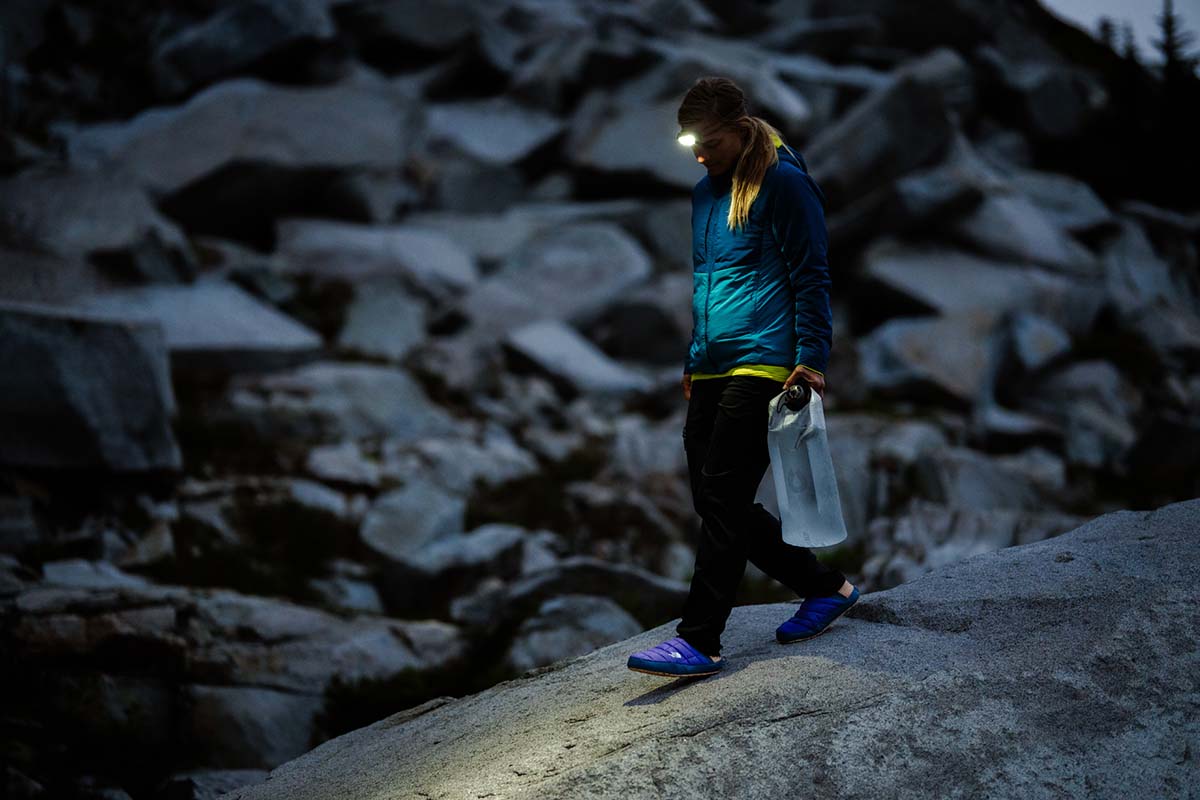
Keep in mind that some lights are regulated (like the Petzl Actik Core), where you’ll get a near-constant light output before it drops off a cliff when the battery is spent. Other headlamps will fade as the battery life wanes. Headlamp manufacturers are getting much better at reporting these specs, but it still sometimes takes some digging to get the full answer. Look for charts that list the runtime alongside the lumens level, or, if the light is unregulated, check and see if the manufacturer lists the maximum beam distance throughout the lifespan of the batteries. These will give you a better like-for-like comparison.
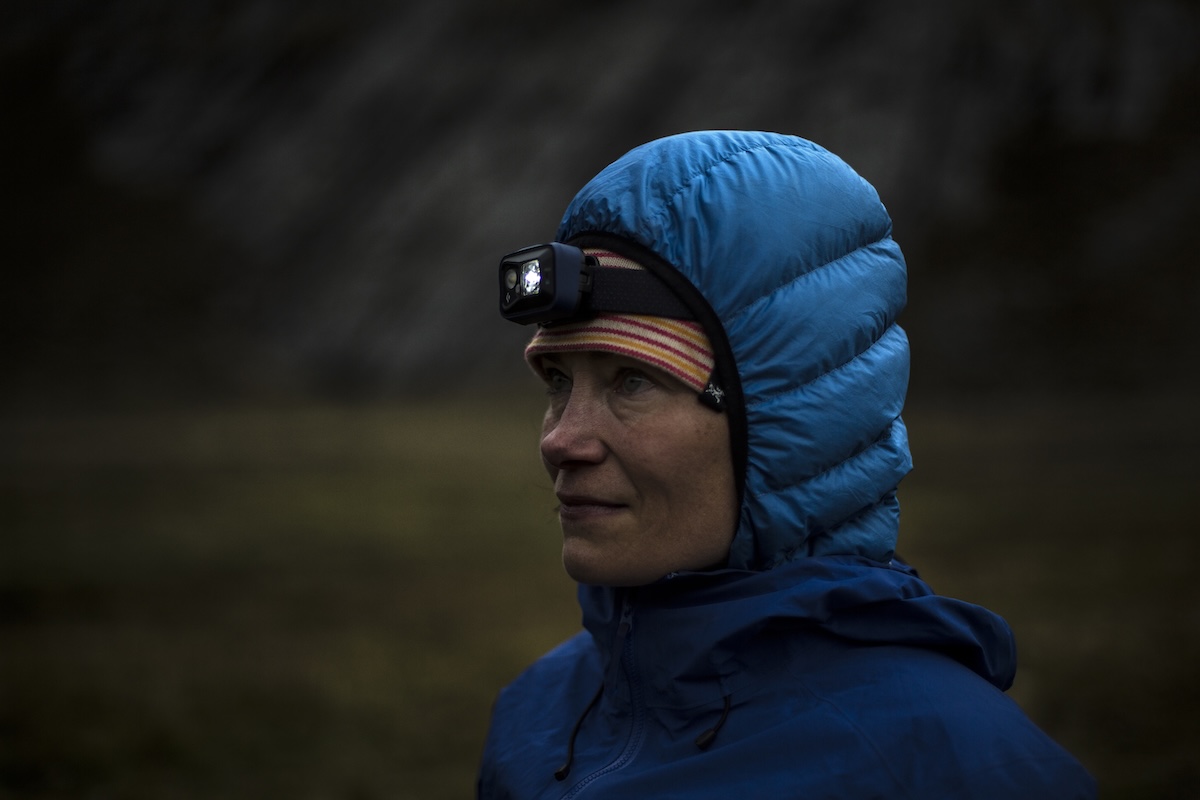
The weight of a headlamp varies from barely noticeable to downright hefty (some models weigh north of a half-pound). Typically, the more powerful the headlamp and the more serious its intent, the heavier the lamp. Lightweight headlamps are made with thin plastic casing and require fewer batteries, while heavier options use aluminum or thick plastic to better handle hard impacts. If you don't need the most extreme lighting options, it's a good idea to purchase a lightweight lamp. They're more comfortable to wear, don't inhibit movement, and are easier to squeeze into a pack.
How the weight is distributed also plays an important role. What seems like a minuscule decrease in weight makes a big difference in use: The Black Diamond Spot is comfortable doing just about anything, while the others start to bob up and down if you start running. Putting the battery pack at the back of the strap becomes necessary as the weight continues to climb.
Tied directly to the weight of the headlamp, strap styles range from minimalist to strong and supportive. There are two primary strap designs: a simple elastic nylon that wraps around the sides of your head and a two-piece system that has an additional strap running over the top of your head. The two-strap style is popular for heavier lamps or more serious adventuring when you’ll be wearing a helmet like rock climbing, mountaineering, or caving. Most folks, however, still choose the simple around-the-sides design. They’re usually helmet-compatible, easy to adjust, and plenty supportive for most uses around the house or in the outdoors. We've been loving how comfortably the BioLite Range 500 carries on runs and fast-paced hikes.
.jpg)
For serious outdoor use and extended exposure to the elements, you will want to consider the weather resistance of your headlamp. Some cheap headlamps offer little to no protection—as soon as the rain starts to pour, you’re best off covering up and heading for your tent. But most mid-range and high-end models bump up the protection. The weather worthiness of electronics is tested using the IP ratings scale: On the low end, IPX0 equates to no protection at all, while IPX8 at the high end means the item can sustain prolonged immersion. Known for their durability, the Fenix HM50R V2.0 and Nitecore HC33 get an impressive IP68 rating, which means that they're rated to withstand both dust (the "6" in the spec) and full submersion for up to 30 minutes. The majority of the headlamps on this list are certified to at least IPX4, which should be enough to handle most rain and snow. The bottom line is that if you plan on spending time exposed to the elements, check the IP rating of your headlamp before buying (it’s the right column in our handy comparison table above).
.jpg)
Taking care of your electronics in the cold and keeping them operating can be a challenge (we know this well from taking camera batteries into the backcountry). In terms of headlamps, the first consideration is battery type. Traditional alkaline batteries are the worst of the bunch at working in the cold, so it’s best to step up to lithium or rechargeable NiMH batteries for better performance. In addition, exposure to the cold can contribute to draining any type of battery, but there are ways to mitigate. Some headlamps, like those in the Moonlight Bright As Day collection, are made with a removable battery pack that can be stowed inside a pocket while powering the headlamp. And no matter what model you have, you’ll want to keep your headlamp in a relatively warm place when you’re not using it (we like to pack ours inside of wool socks) and even sleep with it inside your sleeping bag at night.
.jpg)
There is perhaps no outdoor activity that demands more from headlamps than caving—and this section could consequently be an entirely separate article. If a headlamp fails as you venture underground, you are truly up a creek. For that reason, headlamps designed with caving in mind need to be water-resistant or waterproof, extremely bright, shockproof, and have long battery lives. They should also have long-distance beams for illuminating large passages. We tend to only cave with headlamps that have at least an IPX7 waterproof rating and a minimum of 1,500 lumens—though 600-1,000 lumens will suffice for most caving scenarios. A cardinal caving rule is that you need at least three light sources that are sufficient to cave with. As with rock climbing, redundancy is key. We always carry a backup headlamp that is at least as powerful as our primary, and a third emergency light (in addition to some cheap glowsticks, which have many uses in caving).
.jpg)
Our absolute favorite headlamps for caving are the Fenix HM61R V2.0—which features a water and dustproof IP68 rating and 1,600 lumens—and the Zebralight H600c Mk IV 18650. This powerhouse churns out 1,616 lumens with an IPX8 rating. Both of these headlamps have bombproof durability, are simple to operate when wearing muddy gloves, are lightweight, and can be removed from the headband for use as right-angle flashlights. The Zebralight was our primary headlamp of choice for a recent descent of Fantastic Pit in the famous Ellison's Cave—a nearly 600-foot vertical drop. It fended off incessant mist and kept gigantic passages illuminated for hours without fail. All told, cavers face higher consequences if their headlamps die than hikers or runners and should carefully consider their light sources before dipping into the dark.
.jpg)
If you’ve ever run at night, you know that a good running headlamp is worth its weight in gold. The best headlamp for running will have a lightweight and streamlined build for minimal bounce and a well-balanced beam that lights up both your immediate surroundings and the path ahead. Many have features like red taillights for visibility on the road and reflective markings on the band. Our top pick for night joggers (the Black Diamond Sprinter 500) is a running-focused design that offers a top strap for security, a compact lamp, and both reflective logos and a rear red light. Keep in mind that by opting for such a running-specific light, you do give up some all-around versatility—the Sprinter’s one LED doesn’t switch between distance and proximity modes, making it less useful for around-camp use or spotting far-off anchors while climbing. And serious ultrarunners (especially 100-plus-mile racers who run through the night) should consider a more powerful and long-lasting lamp like the Petzl Nao RL or Black Diamond Distance 1500.


4525.jpg)
%20(s)%20(1)8245.jpg)
51a9.jpg)
-%20sac4b.jpg)
56da.jpg)
c9f6.jpg)
_099a8.jpg)