

Photo Credit
Whether you drive a small hatchback or a large SUV, adding a cargo box to your vehicle’s rooftop can go a long way toward improving organization, carrying capacity, and comfort. These boxes come in a range of sizes to accommodate all kinds of gear (including skis) and vary in terms of durability, ease of use, aesthetics, security, and more. Most of the top models are built by roof-rack giants Thule and Yakima, but brands like Inno and Jegs also have some solid contributions. Below you’ll find our breakdown of the best rooftop cargo boxes, from premium luxury models and compact carriers to popular all-rounders that get the job done for most activities, with Thule's Motion 3 XL Low as our favorite overall model. For more details, check out our comparison table and buying advice below the picks, along with details about our testing process.
Editor's note: This guide was updated on January 27, 2026, to reflect our current market and recent testing experiences (see our list of tested and dismissed rooftop cargo boxes below). We also added the Thule Force 3 L to the list after positive experiences with the design's durability and versatility. Lastly, we ensured all other information was up to date at the time of publication.
 Dimensions: 84.8 x 35 x 14 in.
Available volumes: 14 (XL Low), 16, 18, 21 cu. ft.
Access: Dual-sided
Skis: 4-6 pairs up to 200cm
What we like: The best all-around combination of quality, features, and ease of use.
What we don’t: Expensive, and can be hard to open and close when it's cold.
If you’re in the market for a rooftop cargo box, there’s no shortage of high-quality options to choose from. That said, Thule’s Motion 3 is a standout, featuring a refined fit and finish, user-friendly installation and operation, and five sizes ranging from 14 to 21 cubic feet (this includes two "Low" versions, like the XL Low here, which are great for lower clearances and toting skis and snowboards). While not cheap, they’re also not the most expensive roofboxes you can find, and the Motion 3 maintains a high-end feel and sleek, good looks. We also love the SlideLock mechanism, which indicates (via a swath of red) whether the box is unlocked or not closed properly, and won't allow you to remove your keys until it is. After nearly a year of testing the XL Low roof box for various activities and in all kinds of weather, we've come to depend on its reliable, user-friendly design.
There are several other reasons we rank the Motion 3 so high, including its quick-mount system (which ensures quick and proper installation), large handles, smooth-operating locks, internal tie-downs with straps, and a stiff lid that requires little adjustment to fit into place. The updated Motion also boasts a wing-shaped profile and a forward-leading nose to help reduce drag and improve fuel efficiency. We can confirm that it works—we've never noticed any noise or significant drop in gas mileage. It takes notably more hand strength to operate the SlideLock when it's very cold and icy, and a few times we've had to force the box closed by pulling down on the nose or tail rather than the side rail. But overall, the Thule name is revered for a reason, and it’s hard to go wrong with this premium all-rounder. If you need some storage solutions, Thule also makes a GoPack duffel set that's perfectly sized to fit in their roof boxes and then pack away in a convenient storage roll when not in use.
Read more: Thule Motion 3 XL Low review
See the Thule Motion 3 XL Low

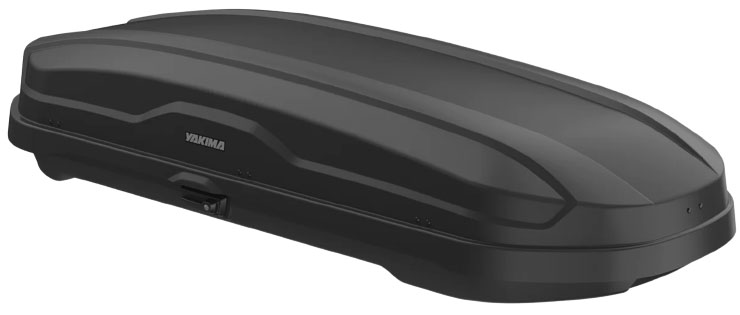 Dimensions: 84 x 32 x 16.5 in.
Available volumes: 16, 18 (XL), 22 cu. ft.
Access: Dual-sided
Skis: Up to 195cm
What we like: Versatile shape, easy to install, and less expensive than the competition.
What we don’t: Increased road noise compared to sleeker designs; we’ve had issues with the durability of the lock.
Yakima offers a range of rooftop cargo boxes from budget to premium, and the SkyBox NX XL is their best all-rounder. Although it’s not as expensive as some premium competitors, it shares several features: it’s easy to install and move between cars, with plenty of front-to-back adjustability to avoid any hatch clearance issues. It opens smoothly from both sides, thanks to durable shell reinforcement, and features a sturdy full-metal handle. The interior is spacious and features a nearly flat floor (thanks to the low-profile installation clamps), a tall and wide nose, and an extended shape. And aside from an issue with the lock core, the SkyBox has held up well in testing and doesn’t show a single scratch after coming into contact with tree branches. This box can accommodate everything from bulky luggage to skis and snowboards up to 195 centimeters in length.
But the SkyBox NX’s shape does have its downsides: We’ve found that the blunter nose has a noticeable impact on road noise (compared to sleeker designs like the Thule Motion 3), and it lacks the high-end appearance of more aerodynamic boxes. We’ve also had some issues with the locks on the SkyBox icing over in the winter, and our tester reported that the lock core on his Skybox popped out and is proving difficult to replace. In the end, the Yakima can’t match the premium build of our #1 pick, but it’s nevertheless a great runner-up with a boost in usable space and some relief for your wallet. And it’s also worth noting the SkyBox NX Skinny, which we recently tested. The Skinny is smaller (12 cu. ft.), less expensive, but still a great choice for snow sports enthusiasts as it can fit skis and boards up to 195 centimeters. That said, those looking to maximize storage will get more by spending the extra for the XL.
Read more: Yakima SkyBox NX 16 review (prior version)
See the Yakima SkyBox NX XL

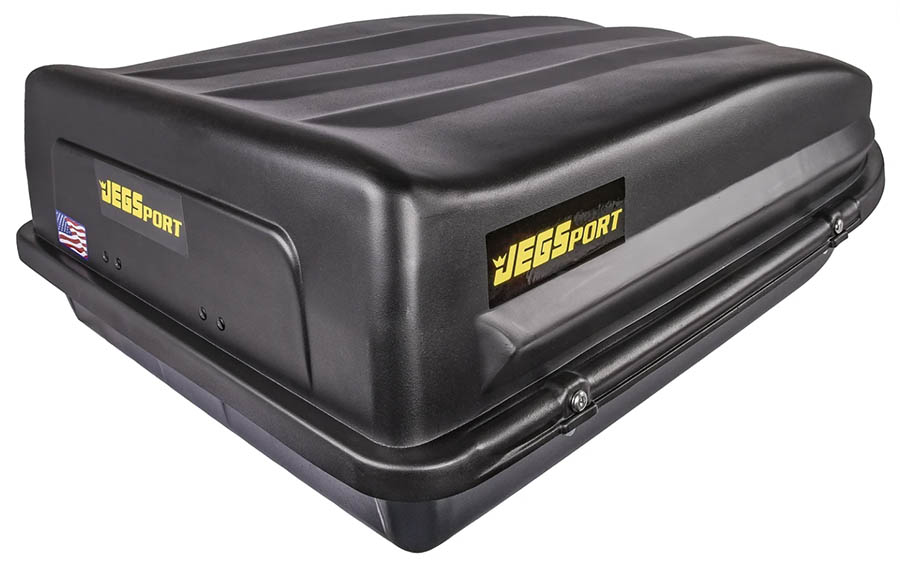 Dimensions: 57 x 38.5 x 17.8 in.
Available volumes: 10, 18 cu. ft.
Access: Dual-sided
Skis: Not compatible
What we like: Generous capacity and dual side access at a low cost.
What we don’t: Flimsy feel and can’t accommodate skis.
You can spend $1,000 or more on a roof box, but the budget Jegs Rooftop Cargo Carrier is a popular option that will get the job done for a fraction of the price. It’s short on bells and whistles, but it has everything a car camper needs and nothing they don’t, including dual-side access and 18 cubic feet of storage, which is more than our top-rated roof box. Furthermore, with its extra-wide and tall dimensions, the Jegs can accommodate a significant amount of bulky cargo that skinnier haulers can’t (for an extra boost, opt for Jeg’s 90093 model, which is almost 2 inches taller). All told, for a simple box that you don’t plan to leave on your car year-round, this is an affordable and decently road-worthy option.
Of course, there are inherent downsides to opting for such a budget design. The Jegs’ flimsy build feels cheap, lacks the structure of more premium boxes, and won’t hold up as well over time. What’s more, its tall and wide shape isn’t the most aerodynamic, and with a short 57-inch length, it can’t accommodate skis (for a budget ski carrier, check out the Yakima RocketBox Pro 14 below). In terms of installation, simple U-bolt mounts attach via pre-drilled holes, rather than adjustable tracks, meaning you’ll likely need to adjust your crossbars or drill new holes to achieve a good fit. Finally, the locks aren’t the most confidence-inspiring for deterring break-ins, and you’ll have to undo two each time you want to access your gear. But it's hard to be overly critical at this price, and for budget shoppers willing to compromise on quality, Jegs is a good place to start.
See the Jegs Rooftop Cargo Carrier
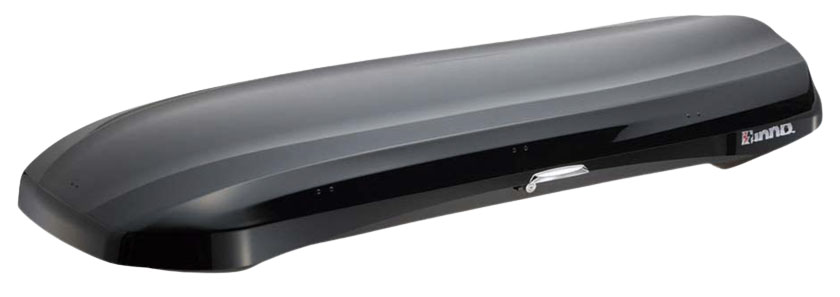 Dimensions: 80 x 33 x 11 in.
Available volume: 11 cu. ft.
Access: Dual-sided
Skis: 6-8 pairs up to 185cm
What we like: Contoured base helps keep a low profile without sacrificing too much depth.
What we don’t: Interior height is only 9.2 inches, which may be constricting for some.
If you park in a garage or frequent enclosed parking lots, you’ll want to think twice before purchasing a rooftop box. Many models here add almost 2 feet to your car's roof height (including the box and rack), which could be a no-go for SUVs and vans. However, the good news is that there are various options available for those who need to maintain a low profile. The Inno Wedge 660 is one of the top designs in this category, featuring a contoured shape that only rises 11 inches above your rack’s crossbars. And it’s got more going for it than just clearance: The Wedge has a premium fit and finish, including easy tool-free installation, memory mount system that makes it easy to remove the box when not in use, a stylish and aerodynamic shape that minimizes wind noise and accommodates a rear antenna and hatch, as well as dual-side opening to increase access and organization.
We had a few complaints with the Inno in testing. We like that the key can’t be removed unless the box is completely shut, but the system is picky, and we found it necessary to manually press the front and back ends closed in order to remove the key. The plastic lid feels somewhat flimsy, though we haven’t experienced any durability issues to date. We also had issues storing bulky gear due to the low interior height. There are a few other low-profile models available, including the Thule Pulse Alpine (also 11 cu. ft.), which is less expensive than the Inno but rises 11.3 inches off the crossbars and opens only on the passenger side. And the Thule Motion 3 XL Low above will only add 12 inches to your vertical clearance. If you’re cutting it close on clearance, you can’t go wrong with any of these options, but it’s worth doing the math and studying the features before making a purchase. If the Inno Wedge suits your lifestyle, it's a good price for a low-profile, well-crafted design.
Read more: Inno Wedge 660 review
See the Inno Wedge 660

 Dimensions: 91 x 37 x 10 in.
Available volume: 15 cu. ft.
Access: Dual-sided
Skis: Up to 215cm
What we like: A luxury cargo box both inside and out.
What we don’t: Pricey, and the Thule Motion 3 is more refined for not that much more.
If we were to hand out an award for the best-looking cargo box, the GrandTour Lo would be in the running. This roofbox is suitable for a luxury vehicle, featuring a high-gloss finish, a low-profile design, and a contoured base that keeps it securely in place on the crossbars. And the inside earns style points as well: The mounting system features a removable knob to tighten each clamp, which is then stored to the side, creating a sleek, flat base and more room for your gear. If you're looking for something long and low (ideal for skis and low-ceilinged garages), the 10-inch-high GrandTour Lo is the lowest cargo box in our lineup and a capable, good-looking option.
The GrandTour Lo shares a similar feature set with many of the other premium boxes here: It can be opened from either side, has tie-down points to secure your gear (including straps), and uses stiffeners to keep the lid from flopping. It’s not as aerodynamic as the Motion 3 XL Low, but it costs less and offers over 6 inches of additional length. When compared to the Inno Wedge, however, the premium details are obvious. The lid isn’t as flimsy, the handle is sturdier, and it sits 1.5 inches lower on the crossbars. Price is our main concern, and in most cases, we think it's worth spending up for the higher-end Motion 3 XL Low. However, if you require a low-profile option and want something sleeker and more premium than the Inno Wedge, the GrandTour Lo is a great choice. Note: The GrandTour Lo is out of stock at the time of publication, but we have confirmation that it will be restocked soon.
See the Yakima GrandTour Lo

Dimensions: 73.6 x 28.7 x 14.4 in.
Available volumes: 11, 14, 16 (3 L), 18, 21 cu. ft.
Access: Dual-sided
Skis: 5-7 pairs up to 175cm
What we like: Durable and functional at a good price.
What we don’t: Cheaper look and not the most aerodynamic.
Thule's Force line contains their mid-range cargo boxes. The 3 L here is our favorite from the series for its versatile shape, which is great for toting skis, camping gear, suitcases, and more. In fact, Thule claims it can fit skis up to 175 centimeters, but we managed to fit our 185-centimeter skis inside without issue. It also retains many of the premium features available on pricier models, including a dual-sided opening, six tie-down points, and built-in stiffeners for added load-bearing capacity (up to 165 lb.). We’re big fans of the mounting system, which is identical to the one used on the Motion XL Low: the quick-mount design made it easy for us to secure the box exactly where we wanted it. Plus, the Force 3 L is larger than the Motion XL Low and a better option for storing bulky gear. Put together, the Force is a workhorse of a cargo box with a durable build and versatile shape.
It’s a tough call between the Yakima SkyBox NX above and the Force 3 L. In side-by-side testing, the Force 3 L proved to have a more durable locking system and a more intuitive mounting design than the SkyBox. But the Force 3 L isn’t as aerodynamic as the SkyBox, and it’s noticeably noisier on the road. And if aesthetics matter to you, it’s worth noting that the Force 3 L has a bulky look that's reminiscent of cheaper designs. Finally, the SkyBox is less expensive than the Force 3 L, which is what ultimately pushes it ahead. But if durability and function matter more to you than aesthetics and aerodynamics, the Force 3 L is a great option.
See the Thule Force 3 L
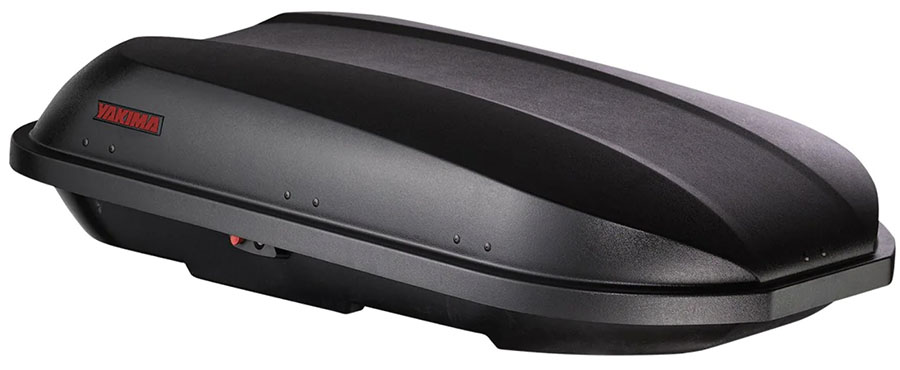 Dimensions: 74 x 33 x 16 in.
Available volume: 14 cu. ft.
Access: Dual-sided
Skis: Up to 170cm
What we like: Premium feature set at a good value.
What we don’t: Too short for most skis and pricier than true budget options.
Yakima is practically synonymous with roof boxes, and the RocketBox is the brand’s entry-level model. In our experience, it’s a step up in quality from the Jegs above, and it isn't as bulky or stout, which helps it blend in with the more premium competition. Plus, unlike the Jegs, the RocketBox can store skis (though the 170cm length maximum is limiting). Value-conscious shoppers will appreciate the RocketBox’s tool-free installation, dual-sided opening, and separate latch and locking mechanism, which aren’t always included at this price. And the shorter length makes it compatible with compact cars and hatchbacks.
However, despite its strong suits, the Yakima RocketBox does come with some concessions in terms of quality and performance. Many users cite durability concerns due to the flimsy build, and the nose design doesn’t resist weather as well as that of higher-end models. Further, the 14-cubic-foot capacity is on the small side for larger families or gear-heavy endeavors, and, as mentioned above, the max length of 170 centimeters will be limiting for many skiers. And while it’s a step up from the Jegs in terms of shape, it’s still bulky-looking. However, it remains a step up from true budget designs, with more user-friendly mounts and higher-quality latch and lock mechanisms. All told, for a practical middle ground at a good value, the RocketBox Pro 14 is well worth a look.
See the Yakima RocketBox Pro 14

Dimensions: 63 x 38 x 19 in.
Available volume: 18 cu. ft.
Access: Rear
Skis: Not compatible
What we like: Inexpensive, spacious, and slightly less bulky than true budget options
What we don’t: Only opens at the rear.
It might slide to the bottom of our list, but the SportRack Vista XL still has several things going for it. First off, with 18 cubic feet of capacity and a 19-inch height, the Vista is great for bulky items like golf clubs or strollers. Its build is stiffer than that of budget alternatives like the Jegs Rooftop Carrier, making it easier to operate and longer-lasting. There aren’t many bells and whistles with this design, but it does have a tool-free installation, which is convenient. But the biggest upgrade you get in going with the Vista over the Jegs is styling. It’s still bulkier than the premium designs on this list, but it’s a step up from the Jegs, with a slightly more egg-shaped design that tapers at the back (the Jegs comes to a point at the back).
There are sacrifices you make in going with the SportRack Vista over the Jegs, however. The most glaring weakness is Vista’s rear-opening—we strongly prefer a box that opens on the side for better access to all our gear. Further, like most of the budget options here, the SportRack does not accommodate skis, and the U-bolt mounting system isn’t quite as sleek as more modern clamp styles. And finally, the Vista is more expensive than the Jegs. It's still a few hundred dollars less expensive than any other cargo box on this list, but those with strict budgets will stick with the Jegs. Still, the Vista is a nice option for those who care enough about styling to spend a bit more for it.
See the SportRack Vista XL
The rooftop cargo box market is always evolving, so to keep up, we're constantly researching and testing new and intriguing models. We have high standards for this expensive gear, and prioritize durability, ease of installation, aerodynamics, and weather resistance. As such, not every model we test makes the cut. We understand that you may be curious about what cargo boxes we tested and dismissed, and the reasons we decided to do so.
To start, we removed the Thule Pulse M from our list in this update. While far from a poor design, it didn't outperform any of the other cargo boxes featured here. It's pricey for only having one-sided access, a flimsy locking system, and a short build that only accommodates skis up to 155 centimeters.
We also opted to remove the Goplus Rooftop Carrier. In testing, the box didn't have a confidence-inspiring construction (the lid was very flimsy), and it's not long enough to hold most skis. The crossbar compatibility (spread of 16 to 15 inches) is also limiting. And a recent price bump doesn't make it stand out in the budget space.

| Rooftop Cargo Box | Price | Dimensions | Avail. Volumes | Access | Skis | Weight |
|---|---|---|---|---|---|---|
| Thule Motion 3 XL Low | $1,150 | 84.8 x 35 x 14 in. | 14, 16, 18, 21 cu. ft. | Dual | Up to 200cm | 52.9 lb. |
| Yakima SkyBox NX XL | $849 | 84 x 32 x 16.5 in. | 12, 16, 18, 22 cu. ft. | Dual | Up to 195cm | 53 lb. |
| Jegs Rooftop Carrier 18 | $319 | 57 x 38.5 x 17.8 in. | 10, 18 cu. ft. | Dual | N/A | 28 lb. |
| Inno Wedge 660 | $800 | 80 x 33 x 11 in. | 11, 13 cu. ft. | Dual | Up to 185cm | 42 lb. |
| Yakima GrandTour Lo | $1,099 | 91 x 37 x 10 in. | 15 cu. ft. | Dual | Up to 215cm | 62.5 lb. |
| Thule Force 3 L | $880 | 73.6 x 28.7 x 14.4 in. | 11, 14, 16, 18, 21 cu. ft. | Dual | Up to 175cm | 43 lb. |
| Yakima RocketBox Pro 14 | $699 | 74 x 33 x 16 in. | 14 cu. ft | Dual | Up to 170cm | 40 lb. |
| SportRack Vista XL | $450 | 63 x 38 x 19 in. | 18 cu. ft. | Rear | N/A | 28 lb. |
This guide is newer to our repertoire, though it was a no-brainer considering how much gear the Switchback Travel team totes around for testing. We put together our first iteration of this review in 2021, featuring 13 cargo boxes. Testing for that initial round was based in the Pacific Northwest, where our team was constantly exploring, donning everything from skis and skins to backpacking packs loaded with everything needed for days of on-foot exploration. Editor-in-Chief Penney Garrett took the reins on the lineup in 2024. Penney calls the Lake Tahoe region home, and she's always hauling around whatever gear the season calls for, from skis, kayak paddles, and PFDs, to a smattering of duffel bags for a weekend getaway. Editor Maddie Downie started pitching in with testing in 2025, helping to whittle down our list to a more considered 8. Though she mostly uses her cargo box to haul skis to resorts and trailheads, she also loves car camping and long road trips, where gear organization is essential.
A good cargo box can help you stay better organized, free up space inside your car, and (our favorite part) carry more gear! While many things remain the same from model to model, a well-intentioned build can make a difference. If you plan to use your cargo box a lot, paying up for a more premium option may be worthwhile. Every cargo box we test has been assessed for security, weather-worthiness, stability, ease of use, aerodynamics, and more. Keep in mind that you'll need a good rack system to support your box, and take some time to consider what you plan to transport. The market doesn't change as often for cargo boxes as it does for many other pieces of gear, but you can be sure that we're always checking and will update this guide accordingly as new and noteworthy options are released.

The first step in selecting a rooftop box is to identify the maximum length of carrier your vehicle (or vehicles) can accommodate. Importantly, you don’t want the box to be much longer than the roof of your car—a box that extends over your windshield (front or rear) will compromise your ability to see the road and have a negative impact on aerodynamics (see below). And second—and applicable if you drive an SUV, wagon, hatchback, or van—you’ll want to make sure that the backend of your box doesn’t get in the way of your rear hatch opening or antenna.
Thankfully, it’s easy to find a good fit without having to “try on” multiple models: Simply measure the distance from the front crossbar of your roof rack to your open hatch, then compare it to the cargo box’s specs (both Thule and Yakima have published helpful fit guides). Hint: To maximize your length, you can move the front crossbar as far forward as possible.
.jpg)
Next, you’ll want to identify the type and general size of the gear you plan to haul. For most, these versatile carriers offer a great storage solution for bulky outdoor equipment, including skis and poles, fishing rods, and camping and backpacking supplies. And the list goes on: Perhaps you’re toting golf clubs, a stroller or baby carrier, or even construction and gardening tools. With your cargo in mind, you’re ready to decide on the right size box for you. There are several factors to consider here, including volume and length. It's also worth considering if you need a low-profile design (for low-clearance areas) or a half-width box (to make room for a bike or kayak, for example).
Rooftop Cargo Box Volume
Rooftop cargo boxes come in a range of volumes, generally measured in terms of cubic feet (length x width x height). The options on our list range from 14 cubic feet (the Yakima RocketBox Pro 14) to 18 cubic feet (the Yakima SkyBox NX XL and the Jegs Rooftop Carrier 18). That said, many cargo boxes come in larger or smaller capacities (from 10 to 21 cu. ft.). But for most users, we recommend a box in the 16- to 18-cubic-foot range, which should accommodate overnight camping gear for three to four people. If you’re sizing up, you’d better have a good reason. Remember that bigger isn’t always better: Larger rooftop boxes are more expensive, heavier (more difficult to install/remove), and create more drag, which negatively impacts gas mileage and road noise.

Interior Length
Not everyone will be picky about the length of their cargo box, but this is an important consideration primarily for skiers and snowboarders. Because rooftop cargo boxes are so popular for toting snow gear, most manufacturers specify the length of skis (and sometimes the number of pairs) that each model can fit. For example, the Yakima GrandTour Lo accommodates skis up to 215 centimeters in length, while the Thule Motion 3 XL Low fits 3 to 5 snowboards and 5 to 7 pairs of skis up to 200 centimeters. The length is also an important number if you’re looking to tote bulky items like strollers (height comes into play here, too), gardening tools, or climbing stick clips. If you’re considering the length spec, keep in mind that it measures the box at its longest point. It’s a good idea to take a look at the box's shape, too, as tapered ends and contoured bases can result in significant wasted space.

Low-Profile and Narrow (Half-Width) Designs
Most rooftop cargo boxes add about 15 to 18 inches to your vehicle's height, but if you routinely navigate city parking garages or park in a garage or carport, you might want to consider a low-profile design. Low-profile cargo boxes are generally 13 inches or less in height (Thule’s “Alpine” sizes fit into this category), with particularly streamlined models like the Inno Wedge 660 adding just 11 inches of bulk above your vehicle’s crossbars. Not only do they offer lower clearance, but these designs are also more aerodynamic overall, resulting in slight reductions in drag and wind noise. And whether you opt for a standard-height or low-profile box, it’s a good idea to confirm your vehicle's final dimensions to avoid potential disasters in confined areas.
.jpg)
If you plan to haul additional gear on your roof rack—popular items include a kayak or bike—you may want to consider a narrow or half-width design. Compared with a standard box, 24 to 26-inch-wide models like the Yakima SkyBox NX Skinny shave off a foot or more in width, leaving a good portion of your rack available (an average crossbar measures about 50 in. wide). The main downside in selecting a narrow model is less overall storage—the NX Skinny has a small 12-cubic-foot capacity—and they’re often long, which can lead to compatibility issues with a rear hatch. But for the right user, they’re a very functional option.
.jpg)
Rooftop cargo boxes consist of a stable base that connects to the vehicle’s rooftop and a clamshell lid that opens via hinges on both ends, giving you complete access to the contents inside. While most of the picks above can be accessed on both sides, some models have one-sided or rear access (the SportRack Vista XL is the only one with rear access).
The most user-friendly carriers feature dual-sided access with a handle and lock on both sides, allowing you to open the box from either the driver or passenger side of the vehicle (but not both at once). This versatility is helpful whether you’re parked on a busy street or need to find something tucked away in the far corner of a cavernous box. One-sided and rear access are more common on budget designs. Before opting for a design with one-sided or rear access, consider the limitations: These styles are less convenient for organizing and accessing your gear (and, in the case of a rear-opening, you’ll probably have to close your hatch to toggle the handle).

The devil is often in the details, and a box’s open and closing mechanism and lock designs are some of the main features that distinguish bargain models from more user-friendly, premium haulers. Some designs combine these two features, with basic lock mechanisms that also function to secure the lid to the base (i.e., when the box is unlocked, the lid is ajar). While this simplified design saves money, it also puts a lot of strain on the delicate lock and key. On the other hand, more high-end boxes have a mechanism that opens and closes their latch—a push button, twist handle, or slider—and a separate lock that secures the lid when closed. What’s more, they usually have indicators that show when they’re ajar (the SlideLock on Thule's Force 3 L and Thule Motion 3 displays red), which provides an extra level of confidence that your lid is secure.
.jpg)
All of the picks above come with at least one lock and key (boxes with dual-sided access feature a lock on both sides). The majority of designs only allow you to remove the key when the lock is locked. Although some users find this feature inconvenient, it prevents you from leaving the box unlocked or from accidentally losing your keys inside. And if you have other Yakima or Thule products mounted on your vehicle(s), you might like Yakima’s SKS (same key system) and Thule’s One-Key system, which allow you to swap out the cores with an identical set so that you can open all of your accessories (including ski/snowboard racks and bike racks) with the same key. And a final note: Manufacturers specify that these locks are not theft-proof but rather intended as theft deterrents.

The majority of rooftop cargo boxes are barebones on the inside, with many featuring just a simple cavernous compartment for your gear and usually a pull strap to close an out-of-reach lid. Some models include tie-down points (straps are included in most cases), which can be a nice feature for securing a loose load. Moving into the ultra-high-end models is where we start to see more features. For instance, Thule's Vector (now discontinued) added a removable, felt-lined base to protect gear, a motion-sensing interior LED light, and a white lid to make it easier to see your gear at night. But while these are nice features, they’re not worth the large price bump for most, especially when you can make similar after-market customizations to a more affordable box.
.jpg)
All of the roof boxes above are made with durable ABS plastic that holds up well to repeated opening and closing and the rigors of the road. However, their level of quality (or lack thereof) becomes more apparent when looking at the details. Rigidity increases with premium models (via added stiffeners), while budget designs like the Jegs Rooftop Carrier have floppy lids and bases that you’ll want to carefully close and secure (they might not line up easily). Another distinction comes in the amount of overlap between the lid and base, which is important for wind resistance (especially at the nose). And all the little details add up, too, including mounting hardware, hinges, handles, and locks—if any of these break, your box will likely be out of commission. Finally, whether you opt for a matte or gloss finish is mostly a matter of personal preference, although it’s common to see a sleek aesthetic on more luxury designs (like the Yakima GrandTour Lo and Thule Motion 3).

One of the key advantages of opting for a cargo box over a rooftop bag or basket is the ability to keep your gear protected from the elements. The majority of rooftop boxes are highly water-resistant, with waterproof plastic shells, weather-sealing around the edges, and large lips that seal the gap between the base and lid. However, the design has a few inherent vulnerabilities. In some cases, wind can cause gaping at the front of a box (allowing moisture and air to enter), and water can also seep in through mounting holes on the base. Some designs include vinyl stickers to cover unused holes, while more premium models feature mounting hardware on a track to help mitigate water entry. But regardless of the cargo box, it’s a good idea to assume that it’s not fully waterproof. Dry bags or waterproof duffel bags are helpful for protecting vulnerable items (make sure to place them away from the base and edges), but if there’s any question, we recommend storing your gear inside the vehicle.

Generally speaking, the bulkier your cargo box—especially in terms of width and height—the more drag it will create. And while the exact science on this is hard to figure out (keep in mind that a number of factors come into play, including vehicle type, interior load, speed, and external wind conditions), more drag most often results in lower gas mileage and more wind noise. If you want to maximize aerodynamics, we recommend opting for a model that looks more like a bullet than a box, with a tapered nose (most Thule and Yakima offerings include this) and a low profile. Looking at your cargo box head-on, the smaller the profile, the better.
.jpeg)
It’s also worth noting that wind noise is not simply a result of the bulk of the box. In fact, much of this noise is generated by air moving between the rack and the roof of your vehicle. Some modern box designs tackle this issue with noses that dip below the front rail, thus eliminating the gap between the roof and the rack. There are also a few ways to hush this whistling without spending up for a techy box design, including both DIY solutions and after-market purchases. You can wrap your front bar with a towel (and duct tape) or a bungee cord, swap in aerodynamic crossbars (Yakima’s JetStream is a popular option), or add a fairing (like the Thule AirScreen XT). While these solutions might not completely eliminate noise, they’ll go a long way toward disrupting airflow, which is well worth it for a more peaceful drive (and the gas savings might pay off in the long run). Finally, keep in mind that wind noise can be worse with an empty box (it’s less stable when not weighed down), so we encourage you to take your box off when it’s not in use (for more, see “Can I Drive with an Empty Rooftop Cargo Box?” below).
.jpg)
The rooftop cargo boxes above range from 28 pounds for the Jegs Rooftop Carrier 18 to over 60 pounds for the Yakima GrandTour Lo. Weight is an important factor for several reasons. For one, the heavier the box, the more challenging it will be to install and remove from your vehicle. While the Jegs can be installed by one person, the GrandTour will require at least two sets of hands unless you’re very strategic (accessories like the Thule MultiLift can help). Second, as we cover below, a rooftop can only handle so much weight—the more your box weighs, the less you have left over for gear. And finally, you’ll want to be wary of ultra-lightweight boxes, as they might indicate a flimsier design. In the end, some of the best boxes clock in at 40 to 50 pounds (roughly 14-18 cu. ft. of capacity), which is the price you pay for a durable, functional setup.
.jpg)
When it comes to weight capacity, there are two key factors at play: The load limit of your roof box and the dynamic load limit of your vehicle (both of which are easy to find in the user manual or via a quick internet search). The models above range from 110 pounds (for the Jegs Rooftop Carrier 18) to 165 pounds for premium designs. But in most cases—and this is important to remember—the true limiting factor will be your vehicle’s dynamic load limit. This number specifies how much weight you can safely carry on your rooftop while driving (a parked vehicle can handle much more) and generally maxes out around 165 pounds for a wagon, sedan, or crossover SUV, and up to 330 pounds for a large van. Thus, when determining how much gear you can put in your cargo box, start with your vehicle’s dynamic load limit and subtract the weight of your box and rack (and any other items on your rooftop). Most of the time, that equation leaves you with about 100 pounds of gear.
.jpg)
Knowing that a rooftop box can only carry about 100 pounds worth of gear tells us a few things. For one, you’ll want to be cautious about opting for one of the larger models, as 22 cubic feet of capacity might not be very useful if your weight limit maxes out when it’s only half full. Second, it’s a good idea to be strategic about what you put in your cargo box. We like to start with lightweight and bulky gear like sleeping bags, tents, and backpacks, freeing up space in the trunk for heavier items like food, a climbing rack, or a camping stove. And to reiterate: While manufacturers tend to highlight the higher weight capacities of some boxes, vehicle load limits are the true equalizers. Of course, if you’re planning to mount your cargo box on a larger vehicle with a higher load capacity, this becomes a more distinguishing factor.
Before you install your cargo box, make sure you have the right rack to secure it to your rooftop. Many vehicles come with factory-installed racks, and aftermarket designs can also be easily matched to your make and model. There are two factors to consider when selecting a roof rack to pair with your cargo box (or vice versa): crossbar spread (the distance between the front and rear bars) and shape.
.jpg)
The good news is that most modern cargo boxes have a wide range (the Yakima SkyBox NX XL’s spread is 24 to 40 in.) and are compatible with a variety of bar types, including round, square, and aerodynamic styles. Manufacturers like Thule even help with the decision by listing the racks that complement each of their cargo boxes. That said, expect less versatility with some of the budget designs—the Jegs, for example, has pre-drilled holes to accommodate a 24-inch crossbar spread, but no wiggle room outside of that (you’ll have to adjust your crossbars or drill new holes). All told, matching your cargo box to a roof rack shouldn’t cause much headache, but it’s never a bad idea to double-check compatibility before finalizing your purchase.
Unless you purchase your rooftop box at your local vehicle rack store, chances are you’ll be doing the assembly and installation yourself. Most boxes—and all on this list—come prebuilt and ready to mount, but some budget designs require more in-depth assembly (which can be arduous if DIY isn’t your thing).
.jpg)
Next up is mounting the box, which again is a relatively user-friendly process for most modern designs and can be done in just a few minutes. Our favorite models feature clamps that slide on tracks to accommodate various crossbar spreads, tighten via a thumbwheel, and secure with an audible “click” or via an integrated lever. On the other hand, budget boxes will often use simple U-bolt mounts, which require many moving parts (be careful not to lose anything) and can take some effort to tweak into position and secure (sometimes this involves drilling new holes or moving your crossbars). The extra time required to install these simpler mounts is less of an issue if you plan to keep your box on your rooftop. However, if you plan to remove your box regularly, you might want to opt for a more premium design. And finally, make sure to complete this process with your rear hatch open to ensure you’re getting proper clearance (if applicable), and check your mounts often, as they might need tightening from time to time.
.jpg)
When loading items into your cargo box, you’ll want to give some thought to where you place them. In general, manufacturers recommend situating about half of the load (weight-wise) over the top and in between the two crossbars, with a quarter in the front and the remaining quarter in the rear. It’s also important to consider the weight capacity of both your box and your vehicle—surpassing this number is never a good idea, so prioritize lighter items up top and heavier items in the trunk. Once your gear is loaded, we recommend securing it with tie-down straps (if available), especially if you have a half-full load. And finally, as we touched on above, you’ll want to protect items from the elements by wrapping them in dry bags or waterproof duffel bags (even garbage bags will do the trick), and keeping vulnerable items away from the base and edges.
Most manufacturers recommend that you don’t drive with an empty cargo box on your roof, for reasons much more practical than safety-oriented. First off, an empty box is much more likely to be pushed around by the wind, resulting in a noisier ride. Second, we already know that rooftop boxes reduce gas mileage, so it behooves your wallet to remove them when not in use. And finally, keeping your cargo box out of the elements will go a long way toward extending its lifespan, especially if you live in an unforgiving climate. When not on your vehicle, we recommend storing your box in a cool and dry space (preferably inside), either base-down on the floor or hanging flat against a wall.
.jpg)
Rooftop boxes are no small items, which can create some hurdles if you like to shop online. We’re generally big fans of purchasing outdoor gear from REI and Backcountry (thanks to great customer service and generous return policies), but in this case, both retailers charge oversized shipping fees (you can see them displayed at checkout after adding a box to your cart). One way to avoid this charge is to have REI ship the cargo box to your local store, where you can pick it up for free. It’s also worth noting that many other online retailers ship for free (including Amazon and Etrailer), but the retail price can often be higher as a result. And a final note for online shoppers: you’ll want to be 100% certain you’re purchasing the right product, as returning such a large item via mail isn’t cheap (another benefit to picking it up at your local REI store).
We love rooftop boxes for their ease of use (just throw in your gear and close the lid), weather resistance, and security, but there are other solutions, including rooftop baskets and bags and hitch-mounted options. A basket mounts to a roof rack and provides a stable area to secure gear with bungee cords, rope, or a net. Compared to a box, baskets are more affordable (such as the popular Yakima LoadWarrior), significantly lighter (read: easier to install and leaves more weight allotment for gear), and can accommodate bulkier items (like a cooler or storage containers). On the other hand, many cargo bags—like the Rightline Gear Sport 2—retail for even less and install directly on your vehicle's roof, eliminating the cost of a roof rack. Plus, they pack down small when not in use (fitting easily into your trunk), which is a nice solution if you don’t want to have a box or basket occupying your rooftop at all times.

It’s also worth considering a hitch-mounted box or basket as a better way to expand your vehicle’s carrying capacity. Compared to rooftop options, hitch storage is easier to access and doesn’t require that you perch on your tire or door well to load and unload gear. What’s more, whistling is less of an issue, and gas mileage won’t be nearly as impacted with the rear placement. And because most modern hitch boxes are designed to be easily removed, they double as handy storage containers once you set up camp (the Yakima Exo GearLocker excels in this department). But not every vehicle comes with a hitch or the capability to tow, and rear storage can be inconvenient if you need frequent access to your trunk. Finally, skiers will want to stick with a roof box or basket. In the end, each type of rooftop storage has its strengths and weaknesses, and taking a close look at your cargo and travel plans will help you decide on the best solution.
Back to Our Top Rooftop Cargo Box Picks Back to Our Rooftop Cargo Box Comparison Table



.jpg?h=fbc67360&itok=wmPMXiEZ)

 (s) (1).jpg?h=fbc67360&itok=bePLlSbY)
.jpg?h=fbc67360&itok=_RZ8v0GW)
 (s).jpg?h=fbc67360&itok=R0OjvHVZ)
.jpg?h=fbc67360&itok=reTkTXo1)
.jpg?h=fbc67360&itok=1n06ZZey)