.jpg)
.jpg)
Photo Credit
In the ultralight backpacking world, the Big Three refers to the most important (and heaviest) pieces in your kit: your backpack, sleep system (sleeping bag and pad), and shelter. Shaving a pound or two off of each of these items can go a long way toward keeping your base weight low. We tested leading options in some of the most remote corners of the world—from the bush of Africa to lofty Patagonia peaks—and the Nemo Hornet Elite Osmo 2P came out on top. Compared to standard backpacking tents, ultralight tents are lighter and more packable (all but one of our picks weigh less than 3 pounds) and run the gamut from premium semi-freestanding designs from names like Nemo, Big Agnes, and MSR to stripped-down trekking-pole shelters and floorless pyramids from well-respected cottage brands. If that's not what you're looking for, we also have guides to the best backpacking tents and the best budget backpacking tents, both of which are less specialized and often less expensive than ultralight designs.
Editor's note: In our most recent update, we added the Zpacks Duplex Pro and Pivot Duo, updated the Durston X-Mid 2, removed some models, added some photos from recent testing trips, added a tested and dismissed section, and swept the article to ensure our product selection was up-to-date with current colors, designs, and specs.
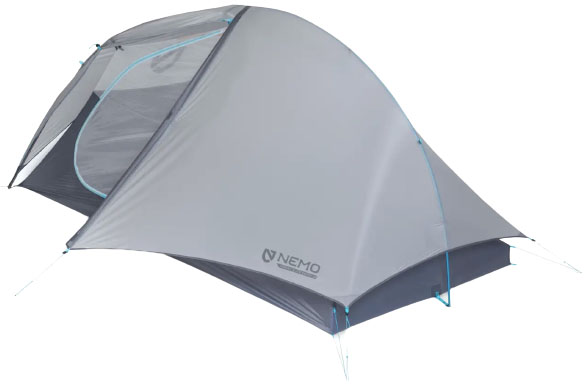 Category: Semi-freestanding tent
Packaged weight: 2 lb. 1.0 oz.
Floor dimensions: 85 x 50/42 in.
Capacities: 1P, 2P
What we like: All the performance and convenience of a traditional backpacking tent—for just 2 pounds.
What we don’t: Expensive, less durable than most alternatives, and not very spacious.
Gone are the days when you had to sleep under a tarp to be considered an ultralight enthusiast, and the Nemo Hornet Elite Osmo 2P is a case in point. For just over 2 pounds all in, the Hornet Elite combines the refined design and quality of a standard backpacking tent with a competitive UL weight. The hubbed-pole structure is simple to set up and stable in winds, and two doors and vestibules keep convenience high and offer ample storage space for two. What’s more, the finishes are what we’ve come to expect from Nemo’s premium offerings, including multiple interior pockets, a handy headlamp diffuser, equalized guy-out points, smooth-operating clips and buckles, and a Flybar pole clip that increases headroom with very little weight penalty.
The Nemo’s main downside is price, especially considering you can save a lot of cash with a tent like the Fly Creek UL2 (2 lb. 4 oz.). On the other hand, a trekking-pole shelter like the Gossamer Gear The Two (1 lb. 8 oz.; $320) is both lighter and more affordable, and many A-frame designs (both Dyneema and nylon/polyester) are considerably more durable, too. But there’s no denying the convenience of a traditional tent design, which features a better ventilated double-wall build, a user-friendly setup, and arguably more livable space overall—though the sleeping area of the Nemo Hornet Elite does feel pretty cramped for two compared to some competing models. Still, if you’re willing to make the investment, we think that the Hornet Elite is the best of both worlds in terms of weight and performance. It’s also worth mentioning Nemo’s Hornet Osmo 2P, which is 7 ounces heavier but will save you some considerable cash.
Read more: Nemo Hornet Elite Osmo 2P review
See the Nemo Hornet Elite Osmo 2P
.jpg)
 Category: Trekking-pole shelter
Packaged weight: 1 lb 15 oz.
Floor dimensions: 92 x 52 in.
Capacities: 1P, 2P
What we like: A highly engineered, double-wall trekking-pole shelter at a great price; latest version is considerably lighter.
What we don’t: Heavier and not as long-term waterproof as the Dyneema competition.
A lot goes into making a solid shelter at a low weight, so ultralight price tags can be fairly steep compared to standard backpacking tents. It’s for this reason that the Durston X-Mid 2 is such a surprising entry. Like many premium trekking-pole shelters, it is exceptionally well-built, roomy, and checks in at less than two pounds—but at $319, it offers massive savings over the Dyneema competition. During testing on high-route miles in Washington’s Alpine Lakes Wilderness and the Goat Rocks, we found the X-Mid to be truly stormproof; the 15D silpoly fly sheds heavy rain without the sagging typical of nylon, and the bathtub floor provides a reliable seal against splashback. The highly engineered geometry is full of thoughtful details, including magnetic door toggles for one-handed use, durable #3 YKK AquaGuard zippers, and a unique parallelogram shape that keeps trekking poles out of the way of the doorways. Plus, the double-wall design offers superior ventilation and the flexibility to pitch the fly first in a downpour to keep the interior dry.
How does Durston manage such a low price point? The compromises are minor for most but worth noting for the weight-obsessed. While impressively light at 1 pound 15 ounces, it is several ounces heavier than the Zpacks Duplex Pro, which might nudge dedicated thru-hikers toward more expensive Dyneema options. Additionally, the X-Mid’s footprint is quite large; while the expansive vestibules and interior headroom are "palatial" for two, finding a suitable pitch in tight alpine zones or cramped backcountry sites can be a challenge. Unlike some competitors, the X-Mid lacks collapsible vestibules to shrink its setup size. However, for hikers who want a top-tier, packable, and incredibly stable shelter without the $700+ price tag, the X-Mid 2 is a masterclass in design and value. If you're looking for an even lighter version with the same geometry, the X-Mid Pro 2 offers a premium Dyneema build for a significant jump in price.
Read more: Durston X-Mid 2 review (prior version)
See the Durston X-Mid 2
.jpg)

Category: Freestanding tent
Packaged weight: 3 lb. 6.3 oz.
Floor dimensions: 86.6 x 43.3 in.
Capacities: 2P, 2.5P, 3.5P
What we like: More weatherproof and breathable than most lightweight 4-season tents.
What we don’t: Expensive; Samaya’s Assaut2 Ultra is over a pound lighter.
Most backpackers are fair-weather creatures, but if you don’t let the elements hold you back, it’s worth considering a 4-season tent. With key design features that include a freestanding and aerodynamic structure, burly poles, strong fabrics (including very little mesh), and additional guy-out points, these shelters are built to handle anything Mother Nature might dish out. And while many 4-season tents are as heavy as 10 pounds, there are a number of ultralight options for weight-conscious climbers and mountaineers, and intrepid UL backpackers. Standing head and shoulders above the competition is the Samaya 2.0, which provides impressive protection against wind and precip for just 3 pounds 6.3 ounces all in.
The Samaya 2.0 Dyneema is undeniably expensive, but you won’t be thinking about your bank account when you’re braving heavy winds up high on a Cascades volcano or deep in a Patagonian valley. Compared to most lightweight 4-season tents, the 2.0 is actually waterproof (some popular models are merely water-resistant) with a Dyneema floor, roof, and door awning that won’t wet out or sag over time (note: you can save with the less weather-worthy ripstop nylon version). Samaya also opted for their 3-layer Nanovent fabric in the tent body, which increases breathability over Dyneema—great for when you’re tent-bound in a storm. All told, the 2.0 is an exquisitely designed tent that’s well worth the investment for serious users. For those looking for an even lighter option, Samaya also offers the all-Dyneema Assaut2 Ultra, which weighs just 2 pounds 5 ounces but is quite expensive.
Read more: Samaya 2.0 Dyneema review
See the Samaya 2.0 Dyneema
.jpg)
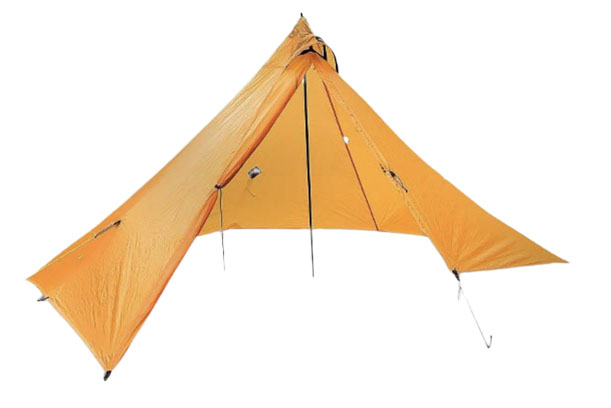 Category: Floorless shelter
Packaged weight: 1 lb. 2.0 oz.
Floor dimensions: 110 x 68 in.
Capacities: 1+P, 2P, 2+P, 4P
What we like: Versatile with multiple setup variations and all-season protection.
What we don’t: Barebones design isn’t geared toward new or tentative ULers.
Backpackers accustomed to the security of a freestanding tent might balk at the concept of a floorless pyramid shelter, but the Mountain Laurel DuoMid shouldn’t be overlooked. The first thing to like about the DuoMid is its versatility: It can be pitched alone, strung between trees, or paired with one of MLD’s InnerNets for a double-wall, bug-free haven. Second is weather protection: The pyramid is surprisingly stable in snow and high winds, and the floorless design is uber-functional, allowing you to dig out a seating area in snow or cook inside in inclement weather. A final benefit is its weight: At 1 pound 2 ounces, the DuoMid is incredibly lightweight considering its all-season credentials.
We really like the Mountain Laurel Designs (MLD) DuoMid for those who get out in a variety of seasons and want the ability to tweak their kit accordingly, especially if you tack on the SoloMid XL or DuoMid InnerNets. That said, the MLD is a very simplistic shelter that takes some attention to set up correctly. And, used on its own, the floorless concept doesn’t offer the same isolation from the elements as a full-fledged tent. In terms of durability, the version here uses durable silicone-treated nylon, a premium combination that offers a high degree of waterproofing and stretch resistance. The DuoMid and InnerNets are also available in 0.75 ounce-per-square-yard DCF versions, but things start to get pricey when you head in that direction.
See the Mountain Laurel Designs DuoMid

Category: Trekking-pole shelter
Packaged weight: 1 lb. 3.5 oz. (Blue w/ Lite Floor)
Floor dimensions: 84 x 50 in.
Capacities: 2P, 3P
What we like: Extraordinarily light yet roomy and durable; Dyneema doesn't sag and won't ever lose its waterproof properties.
What we don’t: Mesh-heavy design is vulnerable to high winds.
Take a good look at the tents along the PCT, AT, CDT, or any other long-distance trail in the US, and you’re bound to see the Zpacks Duplex more than almost any other. For one, the Duplex is incredibly lightweight and features a streamlined setup with just two trekking poles and six stakes (not included). Several leading ultralight tents use Dyneema Composite, a high-tech fabric prized for its waterproofing, sag resistance, and incredible strength for its weight. A standout in this category is the trekking-pole-supported Zpacks Duplex Pro (formerly the Duplex Zip), a time-tested design that remains the lightest option in our lineup. Weighing a mere 1 pound 3.5 ounces (in the Blue w/ Lite Floor version, excluding stakes), it provides a spacious interior for two and a full bathtub floor for reliable protection. The latest "Pro" iteration modernizes the classic Duplex with zippered storm doors, magnetic door keepers, and peak vents. While no ultralight shelter is without compromise, the Duplex Pro feels polished and weather-protective, performing on par with semi-freestanding tents that weigh a full pound more.
In the world of Dyneema shelters, the Hyperlite Unbound 2 is the most direct competitor, offering a more premium aesthetic. However, the Duplex Pro wins out on utility and specs: the Unbound 2 is heavier, uses a thinner floor fabric, and lacks the Duplex’s essential end cinches. These cinches are critical for closing the mesh gap between the canopy and the bathtub floor during heavy rain or high winds. Still, the Duplex requires a careful pitch (you’ll need secure stakes or large rocks), and its single-wall construction can grow swampy if you’re not careful with ventilation. The mesh-heavy design is also very vulnerable to winds, although this is par for the course with most ultralight tents. Ultimately, for those prioritizing the best balance of durability and weight savings, the Duplex Pro remains the superior choice.
See the Zpacks Duplex Pro
 Category: Semi-freestanding tent
Packaged weight: 2 lb. 8.0 oz.
Floor dimensions: 86 x 52/42 in.
Capacities: 1P, 2P, 3P
What we like: Roomier and more affordable than the top-ranked Nemo Hornet Elite.
What we don’t: Less durable than most trekking-pole shelters here.
If the Nemo Hornet Elite above caught your eye, it’s worth also taking a look at Big Agnes’ Tiger Wall UL2. The Tiger Wall UL2 is another one of our favorite ultralight tents, with a similar two-door-and-vestibule layout and semi-freestanding build (you have to guy out the corners at the foot). It can’t quite measure up to the Hornet Elite in terms of weight, but the Tiger Wall adds a few more inches to the floorplan and a large ridge pole across the top for noticeably more headroom. If you’d rather keep cash in your pocket than shave some weight from your pack, it’s a great runner-up from a well-respected tent manufacturer.
The Tiger Wall is not particularly durable, with a 15D floor and fly that require caution around sharp rocks and twigs. That said, it’s a bit more hardwearing than the ultra-thin Hornet Elite—especially with Big Agnes’ use of their more abrasion-resistant HyperBead Fabric—and we appreciate the added assurance of the full-length rainfly (the Nemo’s is truncated at the head for weight savings). All told, the Tiger Wall is a great value for those who like the traditional tent design—just expect it to be a tight squeeze for two. For more room, Big Agnes also makes the Copper Spur UL2, which is significantly heavier at 3 pounds.
Read more: Big Agnes Tiger Wall UL2 review (bikepack version)
See the Big Agnes Tiger Wall UL2
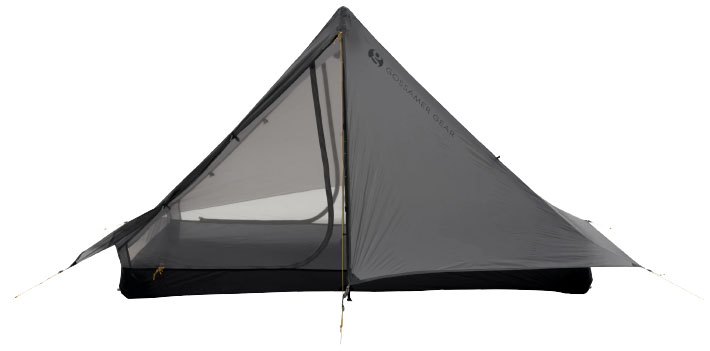 Category: Trekking-pole shelter
Packaged weight: 1 lb. 8 oz.
Floor dimensions: 84 x 48/42 in.
Capacities: 1P, 2P
What we like: Similar specs as the Zpacks but cheaper.
What we don’t: Not as durable, breathable, roomy, or versatile as the Durston X-Mid.
The Zpacks Duplex Pro is a favorite among thru-hikers for its hardwearing Dyneema build and low weight, but Gossamer Gear’s The Two isn’t far behind. For a staggering amount less, The Two features a very similar single-wall design (swapping out the Dyneema for a nylon floor and fly) that sets up with two trekking poles. What’s more, the two shelters are fairly close in weight if you consider the full package. Nylon can’t match Dyneema in terms of lightweight performance—it has a tendency to sag, is not naturally waterproof (the waterproof coating will degrade over time), and has less tear resistance—but it’s been used by tentmakers for decades and certainly gets the job done. All told, if you’re looking to go as light as possible but need to keep costs low, too, the Gossamer Gear is well worth a close look.
Many cost-minded backpackers will find themselves choosing between The Two and Durston's X-Mid 2. While the Gossamer Gear’s primary aim is to be as light as possible, the Durston offers a better balance of weight and performance. Compared to the X-Mid, The Two features less durable fabrics (10D sil/PU nylon compared to 15D sil/PE polyester), a smaller floor area, and a more complicated setup (six stakes rather than four). Even more importantly, the X-Mid’s full-fledged double-wall design boosts breathability (The Two has a reputation for collecting condensation) and allows you to use the inner separate from the fly (or vice versa). But for gram counters who don’t mind a few compromises, The Two is far and away the lighter option. We’ll wrap things up with this glowing review: One editor brought The One (The Two’s smaller sibling) on back-to-back thru hikers of the CDT and AT, with the only resulting damage being slightly degraded seam sealing and a failed zipper.
See the Gossamer Gear The Two
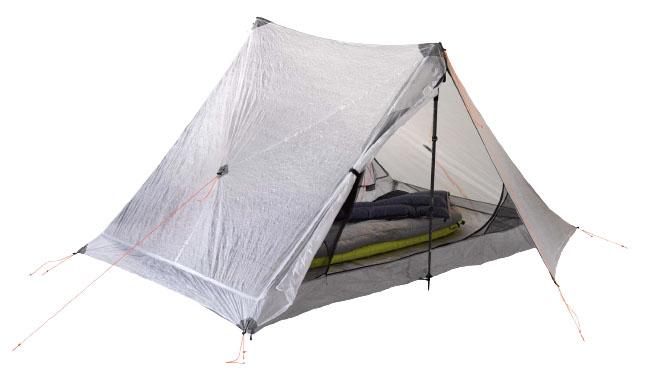 Category: Trekking-pole shelter
Packaged weight: 1 lb. 6 oz.
Floor dimensions: 90 x 48 in.
Capacity: 2P
What we like: More refined and storm-worthy than the Zpacks Duplex.
What we don’t: Thin floor is likely to gather punctures over time.
Hyperlite Mountain Gear knows a thing or two about Dyneema products, and their Unbound 2P takes direct aim at the Zpacks Duplex Pro. The shelters feature a very similar A-frame layout, but in testing the two, the Unbound really stood out with a refined build quality (especially compared to Zpacks’ more homegrown aesthetic). The components are a bit more user-friendly (including the buckle at the base of the door), and we can’t help but love the fun orange accents and contrasting colorways. Finally, Hyperlite designed the Unbound to ride a little lower to the ground than many of its competitors, which can help a great deal with wind and water protection. There’s no shortage of competition within the DCF trekking-pole shelter world, but the Unbound is a noteworthy offering from a well-respected brand.
But for the discerning buyer, there are a few ways the Unbound comes up short of the Duplex. For one, you don’t get the option between two canopy materials (the Unbound’s canopy is 0.55 oz./sq. yd. vs. the Duplex’s 0.55 or 0.75 oz./sq. yd offerings). And while the Hyperlite’s fly sits closer to the ground, the tent lacks the Duplex’s end cinch, which closes the mesh gap between the tent canopy and bathtub floor (a helpful feature in wind and rain). Finally, despite the thinner fabrics, the Hyperlite is still a bit heavier than the Zpacks, which will factor in for serious thru-hikers. But there’s nevertheless a whole lot to like about the Unbound, which feels just as premium as its price tag suggests.
Read more: Hyperlite Unbound 2 review
See the Hyperlite Mountain Gear Unbound 2
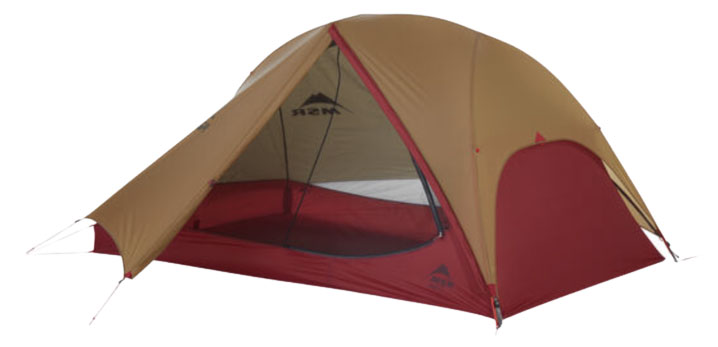 Category: Semi-freestanding tent
Packaged weight: 2 lb. 5 oz.
Floor dimensions: 84 x 50 in.
Capacities: 1P, 2P, 3P
What we like: Non-tapered footprint offers more versatility with sleeping arrangements.
What we don’t: Truncated fly; not as much headroom as the Tiger Wall.
The MSR FreeLite 2 takes aim at our top-ranked Nemo Hornet Elite and the Tiger Wall, with a similar two-door-and-vestibule layout that makes it much easier for two campers to enter/exit and stash gear than one-door alternatives like the Fly Creek below. One of the key strengths of the FreeLite’s design is its non-tapered floor area, which will feel a lot less cramped for two (and allow you to sleep head to toe with your tentmate). To save weight, MSR opted for a truncated fly at the head end but traded out the mesh underneath for a water-resistant fabric body fabric. We took the FreeLite 1 on a rowdy backpacking trip across the highlands of Kenya, East Africa, where it performed with flying colors (and kept curious elephants at bay late at night). It weathered some wild and windy tropical storms, but the truncated fly meant water eventually seeped in after hours of consistent rain. All told, we love its minimum weight, wind protection, and stability but wish it boasted a bit more water resistance.
The FreeLite 2 is on par with the Big Agnes’ Tiger Wall as far as price, while also checking in lighter by a few ounces—so why the lower ranking? As usual, the devil is in the details: The Big Agnes actually features a more livable interior, with a couple more inches at the head end (52 in.) and a larger ridge pole that stretches the walls up and away. And while we like that the MSR uses less mesh in the body—resulting in a more wind-worthy tent overall—most of the gains are offset by the shortened fly. It’s splitting hairs, but if we had to choose between the two, our vote would go with the Tiger Wall. But the overall quality of the two tents is very similar, including impressively strong, coated ripstop nylon and high-end workmanship from two of the best tent manufacturers in the business.
Read more: MSR FreeLite 2 review
See the MSR FreeLite 2

Category: Trekking-pole shelter
Packaged weight: 1 lb. 3.6 oz. (Blue w/ Lite Floor + pole)
Floor dimensions: 84 x 50 in.
Capacities: 1P, 2P, 3P
What we like: Incredibly lightweight for the sheer amount of internal volume.
What we don’t: Small zippers can be finicky; some durability concerns with stitching.
If you’ve spent any time on a thru-hiking trail, you’ve likely seen the ubiquitous blue glow of a Zpacks shelter. While the classic Duplex has been the gold standard for years, the new Zpacks Pivot Duo is a smarter, roomier evolution that significantly redefines the interior livability-to-weight ratio. By incorporating a one-ounce 32" carbon end-pole at the foot, Zpacks has created a "buttressed" design that boosts the peak height to a generous 52 inches and pulls the walls away from your head and feet. This solves the primary complaint of many single-wall shelters—brushing against condensation-prone walls. Weighing in at a remarkable 1 pound 3.6 ounces (Blue w/ Lite Floor + carbon pole), it offers a palatial 29.2 square feet of floor space that easily fits two 25-inch wide pads. During a full season of testing from the North Cascades to British Columbia, we found it to be surprisingly sturdy in 25-mph gusts and reliably waterproof thanks to the inherently hydrophobic Dyneema Composite Fabric (DCF).
However, the pursuit of such a feathery weight comes with undeniable compromises in refined durability and hardware. While the DCF canopy is incredibly strong for its weight, the construction can feel a bit "homemade" compared to sleeker rivals from Durston or Hyperlite; our test model even arrived with a repair patch on the floor and later developed a small tear near a guyline anchor. More concerning are the undersized vestibule zippers, which tend to separate under tension and require a delicate touch to operate. Additionally, the ventilation is limited to two small apex vents, and the six-inch gap between the fly and the ground makes the tent feel quite drafty in turbulent weather. We also found the stock guy-lines to be frustratingly short. For the ultralight purist who prioritizes maximum volume-to-weight ratios, the Pivot Duo is a top-tier accomplishment, but its high price tag and finicky zippers mean it requires a level of care that casual campers might find taxing.
See the Zpacks Pivot Duo
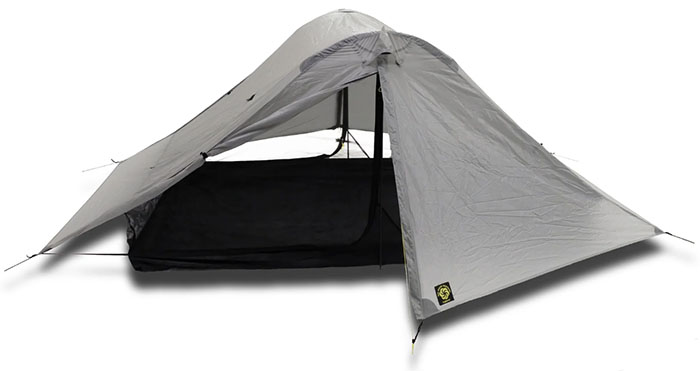 Category: Trekking-pole shelter
Packaged weight: 2 lb. 13 oz.
Floor dimensions: 90 x 54 in.
Capacities: 1P, 2P
What we like: Durable materials, roomy floor area, and spacious arched roof.
What we don’t: Heavier than the competition; can grow swampy when fully zipped up.
Like Durston, Gossamer Gear, and Zpacks, Six Moon Designs is a popular UL cottage brand built by the people, for the people. Their popular Lunar Duo is a non-Dyneema trekking-pole shelter similar to the likes of The Two above. The Lunar Duo features a massive floor area that easily accommodates two sleepers, and its 90-inch (7’6”) length is a particularly great pairing for taller hikers. The 45-inch peak height is also pretty generous, and curved poles above each door create an arched (rather than pointy) roof that leads to a bit more headroom overall. And while the Lunar Duo’s single-wall design can grow swampy, built-in vents at the top of each door do help to create a cross breeze.
The Gossamer Gear and Six Moon Designs differ most in terms of fabrics and weight. While The Two keeps weight low with thin, 10D nylon that’s silicone-treated on one side and PU-coated on the other, the Lunar Duo features a 30D, fully silicone-treated polyester (compared to PU, silicone strengthens the base material and makes it much more waterproof). As a result, the Lunar Duo is over a pound heavier than The Two but has less of a tendency to sag when wet, absorbs less moisture, and is more hardwearing over the long haul. For hikers more concerned with durability than ounces, it’s an excellent and highly livable pick. Note: For full waterproofing, the Lunar Duo will need to be seam-sealed, which you can do yourself or purchase for an additional $35.
See the Six Moon Designs Lunar Duo
 Category: Semi-freestanding tent
Packaged weight: 2 lb. 4.0 oz.
Floor dimensions: 86 x 52/42 in.
Capacities: 1P, 2P
What we like: A very lightweight semi-freestanding tent at an approachable price.
What we don’t: Not very storm-worthy; just one door and vestibule.
Throwing it back to semi-freestanding tents, our next pick is Big Agnes’ trimmed-down Fly Creek UL2. The Fly Creek is the most minimalist tent in Big Agnes’ lineup, featuring a simple one-door-one-vestibule design, all-mesh body, and single hubbed pole. In terms of semi-freestanding tents, it doesn’t get much simpler, and as a result, the Fly Creek checks in 4 ounces lighter than the Tiger Wall above. At just $450, it’s also one of the most affordable semi-freestanding UL tents available.
However, the Fly Creek gives up a lot of windy-weather performance with its simplified structure, all-mesh body, and very low bathtub floor. On a blustery night in Washington’s Enchantment Range, dirt flew in through the walls of our Fly Creek, covering our sleeping bags; the next morning, a pole broke and punctured the fly near the vestibule. While this is a bummer, another one of our testers has had a Fly Creek UL2 for nearly four years and has put it through some serious abuse, and it keeps on ticking. This shelter is definitely crafted for more mellow-weather objectives, though. But if weight is a priority and you plan to adventure in calmer conditions, we still see a lot of value in its affordable design. You do sacrifice a lot of gear storage with the one-door-and-vestibule layout and will have to crawl over your tentmate to get in and out. In the end, if you have reason to opt for such a minimalist structure, we think a more durable and storm-worthy trekking-pole design is the better option, such as the Durston X-Mid 2, but the semi-freestanding design is an attractive option for many just breaking into the ultralight realm.
Read more: Big Agnes Fly Creek UL2 review (previous version)
See the Big Agnes Fly Creek UL2
Beyond our top selections, we’ve rigorously field-tested a variety of other high-quality tents that ultimately didn’t secure a spot in our final lineup. Our goal is to highlight the true standouts—models that offer an exceptional balance of value, weather protection, and long-term durability. Every model we recommend has been vetted over multiple seasons, ensuring it can be fully trusted when real-world conditions turn for the worse.
The Durston X-Mid Pro 2 is one that we omitted this round. This is a unique Dyneema trekking-pole shelter with high-end ingredients that is rising in popularity in the ultralight community. That said, we think the Zpacks Duplex is the better Dyneema pick, and in light of its cheaper sibling, the regular X-Mid, we just don't feel like it needs to be in this guide. We also opted to leave the SlingFin SplitWing Shelter Bundle out. This is a fun, highly customizable shelter and is quite affordable for such a low weight, but it has a pretty complex design and isn't super competitive from a weight perspective, and is a tight fit for two campers.
Finally, we left the Tarptent Double Rainbow out this round. This is an affordable semi-freestanding tent that is well-built, but it just isn't that competitive weight-wise, and we've had issues with breathability—something we wish was better in a package this heavy.

| Tent/Shelter | Price | Category | Weight | Floor Dimensions | Fly Fabric | Capacities |
|---|---|---|---|---|---|---|
| Nemo Hornet Elite 2P | $700 | Semi freestanding | 2 lb. 1 oz. | 85 x 50/42 in. | Poly/nylon blend | 1P, 2P |
| Durston X-Mid 2 | $319 | Trekking pole | 1 lb 15 oz. | 92 x 52 in. | Silpoly (15D) | 1P, 2P |
| Samaya 2.0 Dyneema | $1,210 | Freestanding | 3 lb. 6.3 oz. | 86.6 x 43.3 in. | 3L nylon & DCF | 2, 2.5, 3.5P |
| MLD DuoMid | $290 | Floorless | 1 lb. 2 oz. | 110 x 68 in. | Silnylon (20D) | 1+, 2, 2+, 4P |
| Zpacks Duplex Pro | $799 | Trekking pole | 1 lb. 3.5 oz. | 84 x 50 in. | DCF (.55 & .75 oz.) | 2P, 3P |
| Big Agnes Tiger Wall UL2 | $500 | Semi freestanding | 2 lb. 8 oz. | 86 x 52/42 in. | Nylon (15D) | 1P, 2P, 3P |
| Gossamer Gear The Two | $320 | Trekking pole | 1 lb. 8 oz. | 84 x 48/42 in. | Nylon (10D) | 1P, 2P |
| Hyperlite Unbound 2 | $775 | Trekking pole | 1 lb. 6 oz. | 90 x 48 in. | DCF (.55 oz.) | 2P |
| MSR FreeLite 2 | $500 | Semi freestanding | 2 lb. 5 oz. | 84 x 50 in. | Silnylon (15D) | 1P, 2P, 3P |
| Zpacks Pivot Duo | $849 | Trekking pole | 1 lb. 3.6 oz. | 84 x 50 in. | DCF (.55 & .75 oz.) | 1P, 2P, 3P |
| Six Moon Lunar Duo | $395 | Trekking pole | 2 lb. 13 oz. | 90 x 54 in. | Silpoly (30D) | 1P, 2P |
| Big Agnes Fly Creek UL2 | $450 | Semi freestanding | 2 lb. 4 oz. | 86 x 52/42 in. | Silnylon (15D) | 1P, 2P |
From months-long grueling thru-hikes across the country to shiver-bivies on snow-draped peaks, the Switchback Travel team is no stranger to packing light and staying safe in the most extreme environments on earth. To hone in on our initial selection of 16 worthy models back in early 2023, former senior editor and veteran ultralight adventurer Jenny Abegg took countless UL tents all over the world to test their mettle and craft this guide. Current senior editor Chris Carter inherited the round-up in 2024. An alumnus of each of the Triple Crown trails in the United States (AT, PCT, and CDT), Chris has arguably spent more time under flimsy sheets of nylon than a real roof. He continues to backpack all over the world—including long treks through East Africa and the Himalayas—and is constantly seeking a lighter, more efficient base weight for his expeditions.
Key factors such as weight, materials and durability, weather protection, packability, and ventilation are considered when giving any tent real estate above. These shelters serve as a first line of defense against unpredictable elements in the backcountry, and we would be remiss to recommend anything that we wouldn't personally depend on during our trail-trotting exploits. Our round-up represents a broad spectrum of designs, weights, and purposes, but each will keep you cozy and safe while on the move. Finally, we recognize that the competition for the ultralight tent podium is fierce. We work hard to keep our finger on the pulse of the UL backpacking community, scoping out new products as they surface and adding standouts to our list along the way, ensuring that our existing reviews stay up-to-date in the process.
.jpg)
By our definition, tents and shelters must have a packaged weight of less than 3 pounds to be considered ultralight, which includes the body and fly along with stuff sacks, stakes, tent poles (if applicable), and guylines. The ultralight category is surprisingly large, ranging from semi-freestanding tents to trekking-pole shelters, floorless pyramids, and tarps. If you want to dip into freestanding tents (the traditional, tent pole-supported type that dominates the backpacking market), you’re looking at packaged weights over 3 pounds. For this reason, we only include one highly specialized freestanding model on our list: the 4-season Samaya 2.0 Dyneema. For a comprehensive look at the best traditional backpacking tents on the market, be sure to check out our guide on the best backpacking tents.
 2.jpg)
Opting for an ultralight tent is an excellent way to decrease your base weight (an ultralight term for all of your gear, minus consumables like food, water, and fuel). Many serious ultralighters will aim to have a base weight of 8 pounds or less, in which case a sub-2-pound tent becomes fairly important. More casual ULers can get away with a tent or shelter that's roughly 2.5 pounds. And as we’ll touch on more below, ultralight tents offer surprisingly decent livability, weather protection, and durability—although you should expect some compromises compared to traditional backpacking models, which check in anywhere from 3 to 6 pounds. If you are chasing that elusive 8-pound-or-lower base weight, you'll also want to choose a comparably ultralight sleeping bag or quilt and sleeping pad to round out your sleep system.
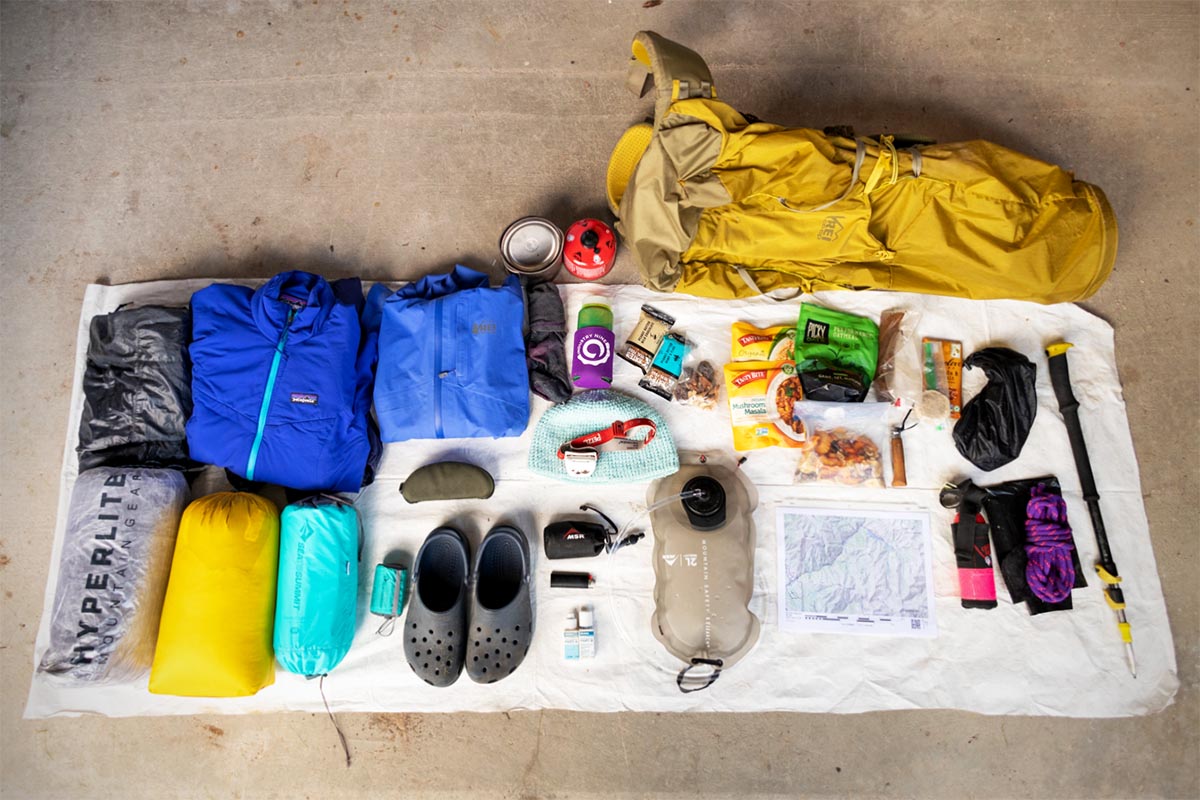
Freestanding and Semi-Freestanding Tents
On the heavier end of the ultralight spectrum are streamlined tents from traditional tent brands like Big Agnes, Nemo, and MSR. Like standard backpacking tents, they feature double-wall construction (including a separate tent body and rainfly) and pitch with included tent poles. But they often trim weight with semi-freestanding designs, which means they need to be guyed out at a few points to maintain their structure (usually at the foot). They also use thinner fabrics and zippers (including a lot of mesh in the tent body) and feature tapered floor areas, heavily sloped ceilings, and more simplified pole structures. Our favorite tents in this category include the chart-topping Nemo Hornet Elite Osmo 2P, Big Agnes Tiger Wall UL2, and MSR FreeLite 2.

Compared to the ultralight competition (trekking-pole shelters and floorless shelters), tents offer the easiest setup and are thus our recommendation for new backpackers or those who prefer a hassle-free camp experience. They also have a smaller footprint that fits well in cramped campsites; on the other hand, livable space is competitive due to their more generous headroom. Because of their well-ventilated double-wall design, tents are also a great match if you travel in particularly wet or humid climates or sleep with a tentmate (two people generate more condensation than one). However, ultralight tents don’t offer as much bang for your buck as trekking-pole shelters—most of the time, they’re heavier, more expensive, and not as durable. As a result, they're not on the radar for many serious ULers or thru-hikers who prioritize low base weights and gear that can withstand month after month of hard use.
.jpg)
Trekking-Pole Shelters
Trekking-pole shelters comprise the bulk of the dedicated ultralight market and are traditionally made by cottage brands like Zpacks, Gossamer Gear, Durston, and Mountain Laurel Designs. The standard trekking-pole design uses single-wall construction with solid fabric on the floor and fly and mesh on the doors and perimeter. Generally, two-person models feature two doors and vestibules and are set up with two trekking poles at the midline, although manufacturers can shave weight by employing a one-door-one-vestibule design. Depending on materials, trekking-pole shelters can range from just over a pound to over 2 pounds for the two-person model. For instance, the Zpacks Duplex Pro is 1 pound 3.5 ounces, while the budget-friendly Durston X-Mid 2 is 1 pound 15 ounces.

Compared to ultralight tents, trekking-pole shelters offer ultralighters a lot more value, with lower overall weights and price points. They’re also known for their larger footprints, which provide more floor area for two sleepers to spread out. If you do opt for an expensive Dyneema version, the payoff is better weather protection, sag resistance, and tear resistance in a lighter-weight package. For example, the Hyperlite Unbound 2 will withstand significantly more wet weather and abuse than the Nemo Hornet Elite Osmo 2P, and it’s also over a half-pound lighter. The downside is less ventilation (a casualty of the single-wall build), although shelters like the Durston X-Mid remedy this with double-wall designs. Finally, trekking-pole shelters do require a bit more tweaking to get a taut pitch. But if set up well, they offer just as much (or more) weather protection as a semi-freestanding tent.
.jpg)
Floorless Shelters
Last but not least are floorless shelters, the most minimalist form of ultralight shelter. These can range from simple tarps strung between trees to pyramid shelters like the Mountain Laurel Designs DuoMid featured above. They’re most ideal for those who prioritize a low base weight (floorless shelters can range from just a few ounces to a little over a pound) and camp in non-exposed, low-elevation (and low-bug) areas. That said, the pyramid design can be surprisingly stable when pitched correctly, and is also a great choice for snow camping (you can dig out the floor for a sheltered hang-out zone) or inclement weather when it’s nice to have the option of cooking inside.

By our definition, ultralight tents check in at less than 3 pounds for the packaged weight, which includes poles (if applicable), stakes, guylines, and stuff sacks. Generally speaking, semi-freestanding and freestanding tents are the heaviest in the category (on our list, they range from 2 lb. 1 oz. to 3 lb. 6.3 oz.), while floorless shelters are the lightest (the Mountain Laurel Designs DuoMid is 1 lb. 2 oz.). Trekking-pole shelters fill in the middle, with Dyneema models at the low end (the Zpacks Pivot Duo is 1 lb. 3.6 oz.) and durable nylon or polyester designs at the high end (the Six Moon Designs Lunar Duo is 2 lb. 13 oz.).

It’s worth noting that all ultralight tents and shelters are inherently compromised (some more than others), so you’d better have a fairly good reason to need to dip under 3 pounds. For reference, we consider a tent like the popular Big Agnes Copper Spur UL2 (3 lb.) to be an excellent fit for the majority of backpackers, with a near-ideal balance of weight, livability, and performance. But if you’re thru-hiking the PCT, fastpacking in the high country, or just love covering a lot of miles with a lightweight pack, an ultralight tent/shelter can go a long way in helping you keep your base weight low.
.jpg)
A lot hinges on a tent or shelter’s materials, including the final price and weight, along with its lifespan (and/or how much you’ll need to exercise caution during use). Cottage brands place an especially high emphasis on materials, mixing and matching Dyneema, nylon, and polyester, and often offering the consumer a number of options for each design. Importantly, Big Agnes also provides this level of customization with their Carbon and Platinum lineups. Along with the actual materials, it’s also important to consider the thickness of the fabric (i.e., denier or ounce-weight), in addition to the waterproof treatment (i.e., silicone, PU, or PE). Ultralight materials have come a long way as thru-hikers, mountaineers, and weekend warriors alike push the limits of where they pitch these thin shelters. A sub-one-pound tent must still be able to survive months of rough use, weathering driving rain, snow, and high winds—all while keeping bulk and weight to an absolute minimum. These are big asks, but the UL market has risen to the challenge. Several of the models above have accompanied our authors on months-long thru-hikes across the country, serving as their portable home and refuge from the elements.
.jpg)
Materials: Polyester, Nylon, and Dyneema
The majority of tents are built with nylon and polyester, and we also see a number of Dyneema models (such as the Zpacks Pivot Duo) in the ultralight category. At the time of writing, nylon is still the most popular material, prized for affordability alongside performance: It's relatively strong (even the thin varieties), tear and puncture-resistant, and has a fairly minimal weight and packed size. However, nylon's big flaw is that it’s hydrophilic, meaning it absorbs water. As a result, it both gets weaker and expands when wet (which explains why your tent fly sags after the rain) and is slow to dry.

Polyester has traditionally received a bad rap for being cheap, heavy, and not as strong as nylon. However, the last few years have seen a lot of advancements in lightweight polyester, and it’s now a solid contender in the ultralight realm. Unlike nylon, polyester is not hydrophilic, meaning it does not absorb water, dries quickly, and remains taut when wet. What’s more, it won’t degrade as quickly when exposed to sunlight for long periods of time. It’s true that its tear and puncture resistance isn’t quite as high as nylon in dry conditions, but this equation reverses in wet conditions, which is arguably when you need the most performance out of your tent. As a result, polyester has become much more prevalent in ultralight tents, including models like the Durston X-Mid 2 and Six Moon Designs Lunar Duo, as well as Nemo's Hornet Elite Osmo 2P, which features a polyester-nylon ripstop material.

Finally, there’s Dyneema Composite Fabric—often referred to as simply Dyneema, or DCF—the darling of ultralight gear and a fabric that’s known for its low weight, high tensile strength, and inherent water resistance. What’s more, Dyneema doesn’t require waterproof coatings (which we’ll touch on below), which goes a long way toward saving weight and bulk. But it isn’t all good—Dyneema is incredibly expensive and, despite its strength, has particularly low abrasion resistance. As a result, it tends to form punctures quite easily, especially when you’re camping around sharp objects like sticks and rocks. It’s hard to beat Dyneema as a fly fabric, but manufacturers often look for ways to get around it as a floor material.
.jpg)
Denier (Thickness)
You can’t talk about fabrics without also discussing their thickness. Nylon and polyester are measured in terms of denier (technically speaking, the weight of the yarn), while Dyneema is measured in terms of ounces per square yard (oz/sq yd). Traditional backpacking tents often feature 30D to 70D nylon or polyester (particularly on the floor), while most ultralight designs use 10D to 20D fabrics. Of course, the higher the denier, the more durable the tent, which is why it's important to exercise caution with ultralight models.

When it comes to Dyneema, a thicker material also translates to more performance (and particularly, abrasion resistance). The Zpacks Pivot Duo, for example, uses a 0.55-ounce fly and 0.75-ounce floor, translating to a boost in durability where it matters most. Interestingly, Mountain Laurel Designs only uses 0.8 oz./sq. yd. Dyneema in their shelters—it’s as thin as they’re willing to go without compromising too much on durability. In short, not all Dyneema shelters are created equal, and the weight of the DCF is a very key consideration.
.jpg)
Waterproof Coatings: Silicone, PE, and PU
Nylon and polyester aren’t inherently waterproof—for this reason, we need waterproof coatings. Traditionally, the most common treatment has been PU (polyester urethane, or polyurethane), which is gradually being replaced by PE (polyethylene). PU/PE are relatively inexpensive, highly waterproof, and aren’t slippery like silicone, meaning they can bond with fire retardant or seam tape (and offer a better next-to-skin feel when used in a tent floor). But both come with some major downsides. Because PE doesn’t stretch, it reduces the tear strength of the fabric to which it’s applied (for this reason, it’s rare to see PE used on fabrics thinner than 20D). On the other hand, PU actually absorbs water (leading to mold and mildew growth) and eventually degrades over time. Neither are even close to perfect, but PE is the better option of the two.

Without question, the best waterproof coating is silicone. Silicone is fully waterproof (when’s the last time you saw your silicone kitchen tool absorb water?), strengthens rather than weakens fabric, and doesn’t degrade over time. Silicone treatment also makes fabric less prone to stretching, meaning your fly will stay more taut in the rain. Because of its strengths, we see silicone used a lot in high-end ultralight tents (often referred to as silpoly or silnylon). Silicone treatment is more expensive than the alternatives, but we’d much rather see a premium treatment on a premium fabric (rather than have a premium fabric go to waste with PU).
.jpg)
But because of silicone’s slippery nature, it can’t adhere to seam tape or fire retardant, and it’s not the most comfortable application for a tent floor. For this reason, it’s common to see sil/PU or sil/PE combinations, which denote that the fabric has been treated on one side (usually the inside) with PU/PE, and the other side with silicone—the MSR FreeLite's fly, for example, is 15D nylon sil/PEU. Of course, these materials aren’t as strong, stretch-resistant, long-lasting, or mold-resistant as pure silicone (often referred to as sil/sil), but they’re nevertheless a good compromise.
.jpg)
Floor Dimensions
In parsing out how roomy an ultralight tent or shelter is, the first thing you’ll want to evaluate is the floor dimensions (L x W), which matter quite a bit when you’re trying to fit two backpackers with their sleeping pads side-by-side. In general, two-person ultralight tents have fairly streamlined floor areas (which often taper about 10 in. from head to foot), while trekking-pole and floorless shelters use more generous dimensions that provide a more practical sleeping area for two. However, while floor dimensions are a good place to start, you’ll also want to take the tent’s peak height and shape into consideration as well.

Peak Height and Slope
A tent’s “peak height” refers to its tallest point, and the models above vary from 37 inches for the Nemo Hornet Elite Osmo 2P up to 55 inches for the MLD DuoMid. Trekking-pole and floorless shelters have significantly taller peak heights than ultralight tents, but this number doesn’t tell the whole story: A-frames slope sharply from the apex (the top of the trekking poles) to the ground, while freestanding and semi-freestanding tents have a longer ridgeline across the top (this can be further extended with a ridge pole). Thus, whereas trekking-pole shelters and floorless shelters offer a better sleeping area for two, ultralight tents are roomier when you’re sitting up.
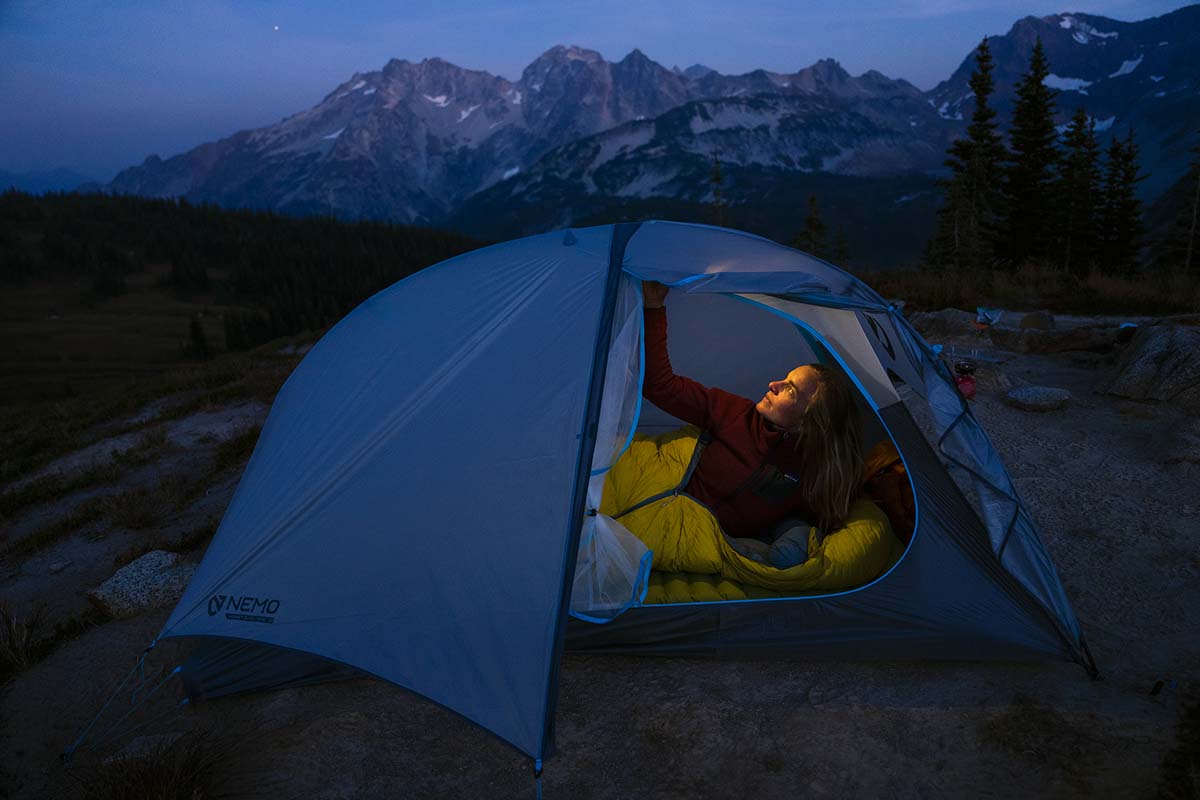
Tents are built to provide shelter in bad weather, including both rain and wind. All of the designs above use waterproof materials for their fly and floor (Dyneema is naturally waterproof, while nylon and polyester become watertight with waterproof coatings and seam tape/seal), which can withstand hours of downpour without leaking. The primary point of vulnerability on ultralight tents and shelters is their mesh-heavy interior—if wind or rain sneak under the fly, it’s easy to penetrate the mesh doors, walls, or perimeter. If you’re consistently headed out in inclement conditions, it’s a good idea to look for a design that offers a low pitch or minimal mesh, such as the Hyperlite Unbound 2 and Samaya 2.0 Dyneema, respectively.
.jpg)
Structure is another factor in weather resistance, especially when it comes to heavy winds. When pitched correctly (read: taut, guyed out well, and with the head or toe facing the wind), both semi-freestanding ultralight tents and trekking-pole shelters (and even floorless pyramid shelters) can fare decently in moderate winds. That said, we wouldn’t recommend pushing ultralight tents and shelters into high-altitude or exposed areas—the tent poles of ultralight designs can be a particular weak point, and no matter the design, it can be challenging to find decent anchors above treeline. On our list above, the 4-season-ready Samaya 2.0 Dyneema is the main exception, and the MLD DuoMid is also impressively stable in snow and high winds.
.jpg)
We’d be remiss not to also touch on hydrostatic head (HH) specifications here. Often provided by manufacturers, the HH is a measure of how much water pressure must be applied to a fabric (nylon or polyester) before passing through. In general, fabrics will start out very waterproof, but their coatings will decline over time (yes, your nylon/polyester tent won’t stay waterproof forever). Thus, opting for a higher HH at the beginning can be a nice setup for long-term success.
.jpg)
Ventilation is one area where we see a lot of variation among ultralight tents and shelters. The main thing to look for here is whether a design features single- or double-wall construction. A double-wall tent features a permeable layer of fabric (often mesh) that allows air to escape the interior before hitting the moisture-trapping fly, while single-wall construction offers no barrier between you and the fly. As a result, single-wall shelters’ big downside is ventilation, and they can grow very swampy throughout the night. Most semi-freestanding tents and a few shelters (including the Durston X-Mid 2) feature double-wall constructions, while the vast majority of trekking-pole shelters are single-wall.

A tent or shelter’s fabrics are also an important consideration. Dyneema in particular suffers in terms of breathability, while thin nylon or polyester are more air-permeable—for this reason, Samaya uses Dyneema only in key areas on the 2.0, swapping in their 3-layer Nanovent laminate throughout the rest of the tent body. Venting options also matter a great deal: Some shelters (like Gossamer Gear's The Two) feature very little in the way of vents, while others maximize airflow with perimeter mesh at the base and roof vents. Placing mesh on opposing sides (as we see with most two-door trekking-pole shelters) can also help to encourage a cross breeze.
.jpg)
We've accrued a few more tips for avoiding the condensation calamities of UL tents through trial and error on our own adventures. First and foremost, on clear nights, unzipping the vestibule doors—or even the main mesh doors themselves when bugs aren't an issue—and letting air flow freely can go a long way toward mitigating condensation buildup. It's also a good idea to orient your tent so that the vents are facing the direction of the wind. This facilitates easy circulation throughout your tent, boosting ventilation. Take some time to analyze your campsite before pitching your tent, and think about where the wind will blow from throughout the night.
.jpg)
Also, pitch your tent under a tree's canopy whenever possible. Camping under the open sky increases the possibility of condensation buildup. Avoid hanging wet clothes or shoes up to dry inside your tent if possible. Drying your gear inside your tent increases humidity, encouraging condensation. Plan to dry your gear the following day during a sunny break or hang it off your backpack while you hike. Next, don't pitch your tent in low valleys or depressions where cold air lingers at night. And finally, avoid setting up camp on the banks of streams, rivers, lakes, or marshy areas with greater humidity whenever possible. While some condensation is usually inevitable with UL tents—primarily single-wall shelters—these practices can help mitigate issues. In the end, we often plan to bring an extra bandanna to wipe off condensation buildup in the morning, and then take our tent out during a (hopefully) sunny lunch break the next day, turning it inside out to let it dry completely. Nobody likes setting up a wet tent.
.jpg)
Tent storage can be broken into two categories: vestibules for exterior gear storage and pockets inside the tent body for small items you need close at hand. A traditional vestibule—seen in most tent and trekking-pole shelters—covers the entry door to the tent with enough space for a backpacking pack and footwear. Without it, your options are bringing the wet and grimy gear inside the tent or letting it soak outside. Needless to say, we put a priority on some sort of outside gear storage. The amount of vestibule space is measured in square feet and can vary a fair amount. From our top picks above, the smallest vestibules are on designs with just one door, such as Big Agnes' Fly Creek UL2 (8 sq. ft.). On the other end of the spectrum is the Durston X-Mid 2’s 23 square feet divided between two vestibules. For those camping with a partner, the Durston’s added space makes staying organized (and sane) much easier.
.jpg)
A tent with excellent interior organization isn’t a top priority, that is, until you get into the tent for the first time and look for a spot to store your headlamp, handheld GPS, or other small items. We’ve found the most helpful area for a pocket is near the head, and a simple mesh drop-in pocket or two is sufficient. Some tents have pockets along the interior of the roof, which make for an easy place to squeeze in a headlamp to light up a game of cards (the top-ranked Nemo Hornet Elite even features a light-diffusing pocket specifically for this reason). Should the tent or shelter not include pockets along the roof, look to see if it has hang loops instead for securing a light. These extra little details can make your backcountry camping experience all the more enjoyable.
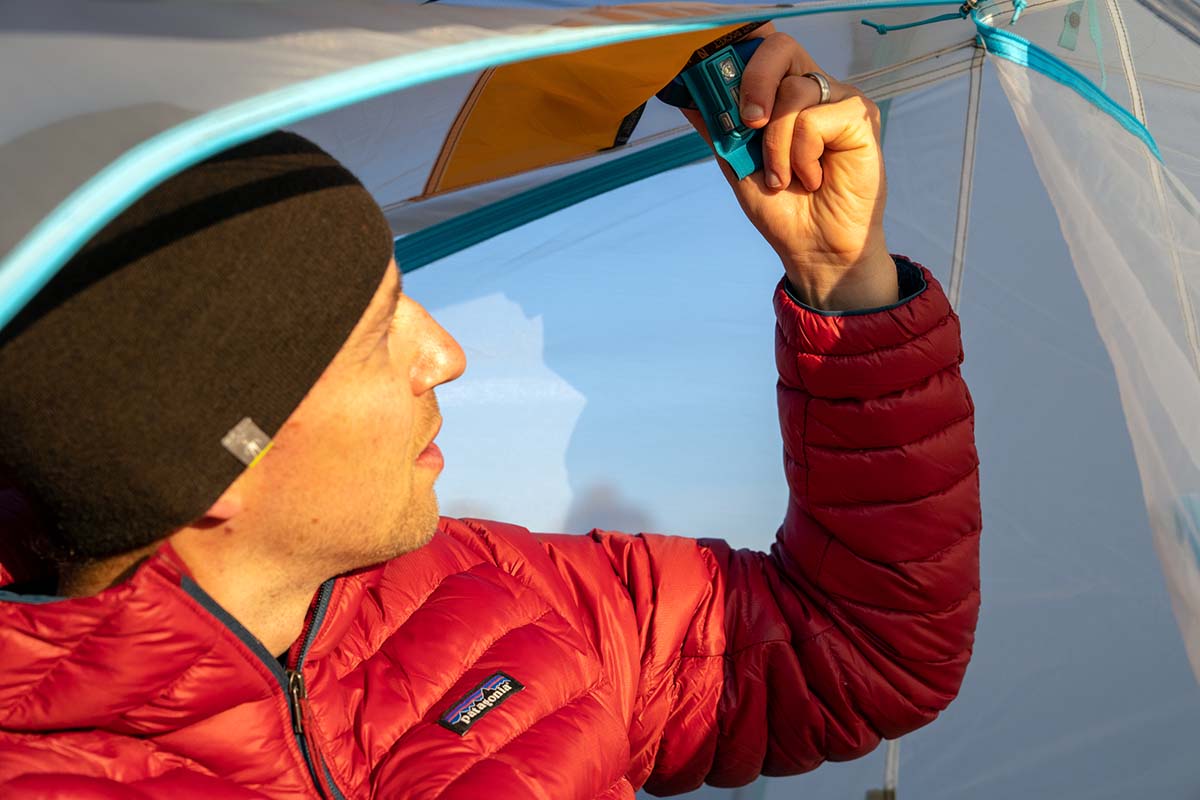
This article covers primarily two-person ultralight tents and shelters (the most common capacity), and a quick look at our picks above shows our clear preference for models with two doors. These designs are by far the most convenient if you consistently camp with a partner: Each person has their own door for getting in and out, including vestibule storage space. Some models use just one door to save weight—the Big Agnes Fly Creek, for example. If you’re sharing the tent with a partner, this can be a major downside—you’ll be crawling over your tentmate to get in and out and will be limited to one vestibule for exterior storage. In the end, unless you’re traveling alone or pulling out all the stops to save weight, we recommend a tent with two doors.
.jpg)
The setup process can differ widely between semi-freestanding tents and trekking-pole and floorless shelters. Semi-freestanding and freestanding tents are very intuitive, often featuring color-coded poles and corners, and can be set up very quickly with little practice. Because the ultralight tents here are not completely freestanding, you’ll want to make sure to choose a campsite with some form of anchor (especially at the foot of the tent), whether it’s hard-packed soil, rocks, tree trunks, or snow. But in general, it’s difficult to mess up when setting up a semi-freestanding tent, which is one of the key benefits of their design.
.jpg)
On the other hand, trekking-pole and floorless shelters can require a little more practice to pitch correctly. You’ll need to stake out the corners, adjust your trekking poles to the correct height (for many shelters, this is 48 in.), and insert them into the correct grommets or attachment points. Once standing, it’s very important to tweak your shelter so that all angles are taut—in heavy wind and rain, a taut tent is synonymous with a weather-resistant tent. This can be difficult to nail the first time around, and many manufacturers offer troubleshooting guides or videos to help you learn the ropes. Finally—even more so than with ultralight tents—it’s important that you find a campsite with strong anchors to set up your shelter, as the tension between the guy-out points and the trekking poles is vital to the structure.
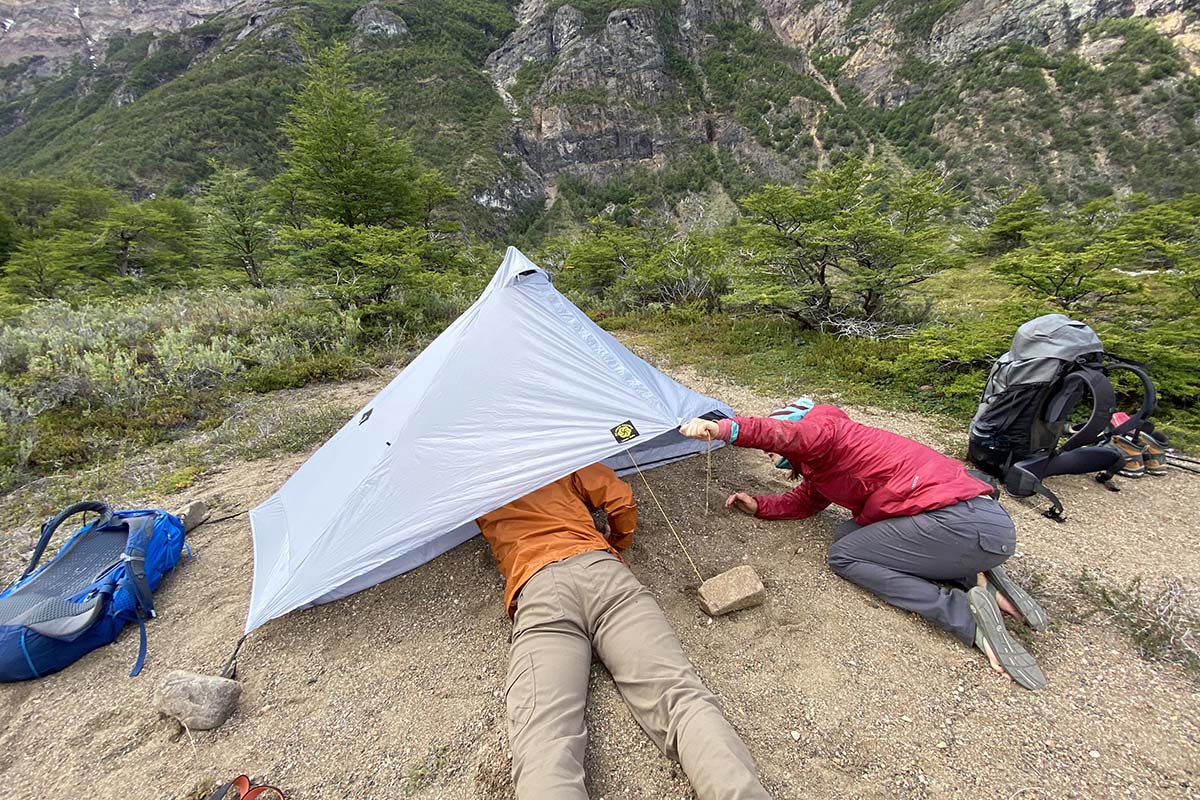
Most of the ultralight tents and shelters above are of the two-person variety, with floor plans that can accommodate two 20-inch sleeping pads side-by-side. However, because ULers place a high priority on weight savings, it’s just as common to see streamlined one-person designs for solo hikers. If you most commonly travel alone, opting for a one-person tent or shelter like Gossamer Gear’s The One will shave perceptible weight (and bulk) from your pack. Compared to the traditional backpacking tent market, there are far fewer three-person UL options, but those traveling with a furry friend or small child might want the extra room. In this case, it’s worth checking out models like the Zpacks Triplex Zip, Big Agnes Tiger Wall UL3, and Tarptent Triple Rainbow DW.
.jpg)
None of the tents and shelters above include a footprint with purchase, but it’s not a bad idea to consider adding one to your kit. Dyneema floors are particularly prone to punctures, but you’ll want to baby thin polyester and nylon, too. For ultralight enthusiasts trying to keep their pack weight low, our top recommendation is a Tyvek groundsheet, which is affordable, waterproof, abrasion-resistant, and easy to set up. Tyvek can be found at your local hardware store, or you can purchase it online from retailers like Zpacks or even Amazon. Tyvek is easy to cut despite being puncture-resistant, which makes it easy to create a custom shape to fit your tent. In addition to providing a durable, waterproof groundsheet, Tyvek makes for a great hitchhiking sign while on long treks. We always throw a Sharpie in our packs to write town-specific pleas for rides—or even fish for free food. Polycro is another popular option (also found at hardware stores or through online retailers like Gossamer Gear)—it’s even lighter and more packable than Tyvek, but isn’t quite as durable and doesn’t have the same ease of setup. You can't write on it, either. For more info, check out our full article on this topic.
.jpg)
There is no shortage of trekking poles to choose from, but you’ll want to take care to purchase a model that’s compatible with your trekking-pole shelter. The most important consideration here is length and adjustability—each shelter is different, but most require trekking poles in the 120- to 130-centimeter range (47 to 51 in.), and adjustable models are essential to tweaking your pitch depending on campsite features and anchors (lever locks offer a much more secure clamp than twist locks). Of course, trekking pole weight will be important to most ULers: Gossamer Gear makes some of our favorite lightweight and adjustable designs in their LT5 (9.8 oz. for the pair).
.jpg)
Our article above provides a survey of the ultralight tent and shelter market for the majority of ULers, but some thru-hikers and gram-counters are known to opt for even more minimalist designs. The Mountain Laurel Designs DuoMid hints at this market, which generally includes floorless tarps and shelters that set up with trekking poles or included poles or are suspended between trees. Within this category, there’s a vast array of options, most of which come from cottage brands like Gossamer Gear, Six Moon Designs, Mountain Laurel Designs, Zpacks, Seek Outside, and Hyperlite Mountain Gear. If you’re looking to shave even more ounces from your pack, check out floorless shelters like the Hyperlite UltaMid, Gossamer Gear Solo Tarp, Six Moon Designs Deschutes Tarp, and Zpacks 7' x 9' Flat Tarp.

If you're looking to pare down your backpacking kit, opting for an ultralight tent or shelter can shave pounds off the weight of your pack. But the other components of "The Big Three" are arguably just as vital to an ultralight load, including a sleeping bag or quilt, a sleeping pad, and a backpack. Within each of these categories, there are fairly mainstream models that are particularly popular among the ultralight crowd, well-loved cottage-brand designs, and seriously streamlined gear used only by the most devoted ULers (similar to what we see in the picks above). To help guide your purchase, see our articles on the best ultralight backpacks, best ultralight sleeping bags and quilts, and best ultralight sleeping pads.

.jpg?h=d1272f3a&itok=pIiUisJh)


.jpg?h=fbc67360&itok=alJCQBk9)

.jpg?h=fbc67360&itok=uauKvPVn)
