.jpg)
 (m).jpg)
Photo Credit
With rapidly changing technology and an ever-growing number of options, it can be hard to nail down the best ride for your needs. The most important thing to consider when shopping for a trail bike is the type of riding you'll be doing. Whether it's a daily commute on the single track you found through town, a multi-night bikepacking trip, or a group trip to that fabled two-wheeled mecca to hit every trail on the map, the type of bike you're on can mean the difference between a successful day and a sufferfest. Our top recommendation is the Santa Cruz Hightower S for its impressive performance, whether it's ascending a rocky tech section or hauling down a flow trail. If you're unsure how much to invest, our team also has advice on how much to spend on a mountain bike and what to expect at lower prices, including the trade-offs when shopping for the best budget mountain bikes under $1,500.

Frame: Carbon
Suspension: 150mm (front) 145mm (rear)
Tires: 29 x 2.4 in.
What we like: A hard-charging workhorse that excels on almost all terrain.
What we don’t: A bit heavy and expensive; not as strong a climber as a shorter-travel bike.
With high-end bikes growing increasingly expensive each year—four on this list alone are $5,000 or more—it’s no wonder that lots of folks are looking for one bike to do it all. Santa Cruz’s Hightower is exactly that: a well-rounded and highly capable rig that can handle almost any terrain you throw its way. Highlights include a light carbon build, a fantastic SRAM GX Eagle drivetrain, 29-inch tires that smoothly roll over rocks and roots, and a just-right amount of suspension (150mm up front and 145mm in the back) to balance long stints of uphill pedaling and steep, technical descents. In short, the Hightower is a point-and-shoot downhill machine that doesn’t skimp on climbing performance, striking a hard-to-beat balance for many riders.
Santa Cruz has a reputation for high prices, and the Hightower is no exception. That said, the brand’s lifetime warranty on its frames is one of the best in the business, and the bike is built to last with high-quality components throughout. It’s not the strongest climber out there, but the Hightower puts it all together better than most at a much lower price than many bikes, earning it our top spot this year.
See the Santa Cruz Hightower S
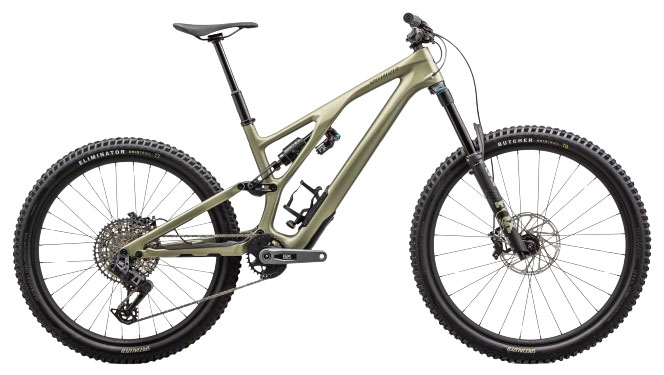 Frame: Carbon
Suspension: 160mm (front) 150mm (rear)
Tires: 29 x 2.3 in. (front), 27.5 x 2.3 in. (rear)
What we like: A playful and capable downhill companion; uniquely adjustable build for nearly any riding style.
What we don’t: Downhill prowess comes with drawbacks in weight, price, and versatility; mullet setup is polarizing.
The Stumpjumper has a storied history in the world of cycling: It was the first mountain bike made for the masses and helped popularize the sport, and Specialized has had decades to dial in overall performance and refinement. The mid-range Evo Expert T-Type model is a real winner, particularly for those who put a premium on downhill prowess. Compared to the Hightower, the Stumpjumper offers more squish, along with a mullet setup—a 29-inch tire up front and 27.5-inch tire in the back—for added playfulness on the descent. And we’d be remiss not to mention the adjustable geometry, which lets you fine-tune the head tube angle (by 2 degrees) and bottom bracket height (by 10mm) to suit your needs and riding preferences.
What’s not to like with the Specialized Stumpjumper Evo Expert T-Type? In addition to the steep price, the bike is no featherweight at nearly 33 pounds and not a strong climber—if gnarly downhills aren’t at the top of your priority list, there are plenty of more well-rounded options to consider, many of which are cheaper. The mullet setup is also polarizing and takes some getting used to, although we’ve come to love the best-of-both-worlds compromise.
See the Specialized Stumpjumper Evo Expert T-Type
.jpeg) Frame: Aluminum
Frame: Aluminum
Suspension: 120mm (front)
Tires: 29 x 2.6 in.
What we like: A capable option for mellow terrain and gravel; decent components for the price.
What we don’t: Still a lot to spend for those new to the sport; not suitable for rocky and rooty descents.
Entering the world of mountain biking can be daunting. Dropping thousands of dollars on a new bike isn’t feasible for many, especially when you’re still dialing in your riding style and preferences. Not to mention, the world of budget bikes is full of true clunkers that lack the durability and rideability of more premium (read: pricier) designs. Enter the Salsa Rangefinder, a solid all-rounder that lets you progress without breaking the bank. The 120 millimeters of front travel offers ample squish for mellow singletrack, long gravel rides, and even easy bikepacking missions, and the 11-speed drivetrain is realistically almost all most beginning riders need. It even includes a dropper post, which isn’t always the case at this price. Lastly, the Rangefinder is available through REI, offering a host of benefits that are enticing to new riders.
What do you sacrifice by saving with the Salsa Rangefinder? As expected at this price, you’re not getting the most modern geometry or the highest-quality components. Combined with the short travel on the front fork, this limits the terrain on which you can ride—those looking to push their limits and tackle steep, aggressive lines will want to upgrade to a more capable rig, ideally one with rear suspension. And while we consider the Rangefinder to be a great value for a capable starter bike, there are plenty of cheaper options available—Co-op Cycles’ DRT lineup is a great place to start, with options from around $600. We consider these bikes too limited and dated to recommend for extensive trail riding, but they’re nevertheless compelling for easy-going riders on a tight budget.
See the Salsa Rangefinder Deore 11-Speed 29

Frame: Aluminum
Suspension: 130mm (front)
Tires: 29 x 2.5/2.4 in.
What we like: Everything you need for a sporty hardtail with upgradeable components.
What we don’t: Dropper post design could be better.
For more than forty years, Cannondale has been at the forefront of mountain bike innovation, and the Habit HT 2 is an exemplary case of their time spent in the knobby two-tire game. It has geometry that climbs well but is capable of steep descents, an ample 130 mm of front suspension travel, a Shimano 1x10-speed drivetrain, hydraulic disc brakes, and a dropper seatpost. Unlike many budget-oriented bikes, the Habit HT 2 doesn't use proprietary components from a mystery factory, so you're able to swap out or upgrade just about any part that you want.
A bike at this price point comes with some tradeoffs. For one, nearly every other bike on this list is full suspension. The added design considerations, along with added moving parts, almost always mean added cost. It's not quite as light, nimble, or versatile as higher-end carbon bikes on the cutting edge of what's new and hot–it's meant to be an affordable model that can still hang on intermediate rides. Our only other small gripe is that the seatpost doesn't have quite the range that we'd like to see, but for what this bike is designed to do, it likely won't be a problem. At the end of the day, the Habit HT 2 is a great choice for those who are ready to get off the beginner rig and get dirty on some real single track.
See the Cannondale Habit HT 2
.jpg) Frame: Aluminum
Frame: Aluminum
Suspension: 140mm (front) 135mm (rear)
Tires: 29 x 2.5 in.
What we like: An excellent all-rounder at a hard-to-beat price.
What we don’t: You can get similar performance for less in the consumer-direct space (if you're willing to deal with some downsides).
There’s no way around it: Full-suspension bikes are an expensive breed. Fortunately, we’ve started to see high-end tech trickle down into the cheaper end of the market, and there are currently several competitive options for under $3,000. The Ari Cascade Peak Pro is a case in point. At $2,999 full MSRP and $2,799 on sale at the time of publication, the Cascade is by no means cheap but offers a stellar build for the price: The rugged aluminum alloy frame, combined with a SRAM GX Eagle drivetrain and nice balance of suspension for both the up and down, makes for a fun and sturdy ride even on rough and rowdy singletrack. In short, unless you’re looking for a lightweight racing rig, the Cascade Peak Pro will save you serious cash without sacrificing too much in terms of geometry, quality, and components for most recreational riders.
While we consider the Ari Cascade Peak Pro to be a stellar all-around value, you can go cheaper. But with the Cascade, you get a lifetime frame warranty (Polygon covers full-suspension frames for 5 years), and you can return the bike no questions asked within 30 days of purchase. These benefits—along with Ari’s detailed fit guide—help offset the biggest pitfall of buying consumer-direct: the wholly subjective battle of dialing in the right fit sight unseen. For value-focused riders looking for a capable aluminum build, YT’s Jeffsy Core lineup is also worth considering.
Read more: Ari Cascade Peak Pro review
See the Ari Cascade Peak Pro
.jpeg) Frame: Carbon
Frame: Carbon
Suspension: 130mm (front) 120mm (rear)
Tires: 29 x 2.4 in (front), 29 x 2.35 in. (rear)
What we like: Wildly light and fast—great for long, pedal-heavy days in the saddle.
What we don’t: Pricey and not the best downhill companion.
One of the latest buzzwords in mountain biking, “downcountry” bikes are purpose-built for efficiency, with lightweight carbon frames, trail-friendly geometry, and shorter travel than all-rounders like the top-ranked Santa Cruz Hightower (they're essentially more downhill-friendly XC rigs, hence their name). In other words, whereas the options above emphasize downhill performance, these bikes are all about the up. The Epic 8 Evo Comp from Specialized is our current favorite in this growing category. Listed at around 28 pounds (for a medium frame), it’s a competitively light and fast build that nicely blends the agility and speed of a cross-country rig with the capability of a trail bike. In sum, it’s an ideal companion for big days in the alpine, snagging local singletrack KOMs on Strava, or if your local terrain involves a lot of long, pedal-intensive climbs.
Other than sacrificing some downhill performance for climbability, the biggest downside here is cost: Specialized bikes don’t come cheap. But we think of downcountry bikes as the MTB equivalent to skimo skis: You can put some serious uphill miles on them, and they’re decently capable descenders, too. But for those looking for the best-of-both-worlds performance, we’d opt for a heavier, beefier option like the Hightower or Specialized’s own Stumpjumper above.
See the Specialized Epic 8 Evo Comp
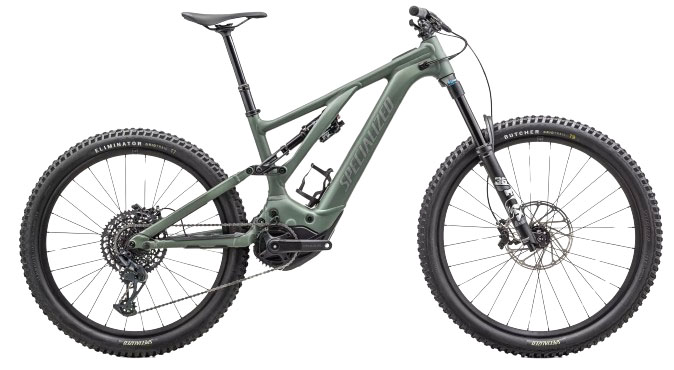 Frame: Aluminum
Suspension: 160mm (front) 150mm (rear)
Tires: 29 x 2.6 in. (front) 27.5 x 2.6 in. (rear)
What we like: A well-rounded e-bike with a strong, long-lasting battery and refined downhill performance.
What we don’t: Heavy, expensive, and many trail systems don’t allow e-bikes (yet).
Specialized has been at the forefront of electric mountain bikes in North America, and their Turbo Levo is a leading all-mountain design. The latest bike is a real grin-maker—trust us on this one—and received a host of improvements that set it apart. Its mullet setup (a 29-in. wheel at the front and a 27.5-in. wheel at the back) gives it a balanced, easy-to-control feel while still smashing through technical terrain, and its electronics have seen nice upgrades in durability and refinement over the years. Plus, like Specialized’s Stumpjumper Evo, the Turbo Levo Comp lets you tweak the head tube angle and bottom bracket height to dial in the geometry to your preferences. Overall, among a fast-growing and competitive field of e-mountain bikes, we think the latest Turbo Levo is at the top of the list.
Currently, the biggest barrier to an e-mountain bike of any kind is price. Despite packing an aluminum frame, the Turbo Levo Comp here costs a steep $7,000, and carbon models start at a whopping $9,000. Additionally, the extra drive system adds significant weight—it’s not uncommon for e-bikes to weigh upwards of 50 pounds (for reference, the Turbo Levo Comp is around 52.5 lb.). This added heft also has performance drawbacks, and we’ve found the Turbo Levo is less flickable and more reluctant to get off the ground than the brand’s analog Stumpjumper Evo (or the lighter but less powerful Levo SL e-bike). Finally, land managers and lawmakers are still trying to figure out where e-bikes fit into outdoor recreation. Regulations vary by state and riding area, but often they're technically not legal to ride on singletrack trails (although we’re seeing increased access each year).
See the Specialized Turbo Levo Comp Alloy

Frame: Aluminum
Suspension: n/a
Tires: 700c x 38mm
What we like: Great price, versatile, high-quality components
What we don’t: Not the lightest option for gram counters
It may come as a surprise that our first choice of a gravel bike is aluminum, but the Cannondale Toptstone 1's competitive price, quality build, and versatility won us over. It has hydraulic disc brakes, wide wheels for absorbing bumps, and a Shimano GRX drivetrain, which was designed specifically for gravel. Aluminum is far more durable than carbon, and the frame's geometry makes for responsive climbs and a body position more conducive to descents than much of the competition. Whether you're commuting in the city or headed out for a multi-night bikepacking adventure, the Cannondale Topstone 1 is a solid option.
This model isn't without its flaws. At 22.5 pounds, it's not the heaviest gravel bike, but we've tested builds that are much ligher, closer to 19 pounds. That said, the lightest bikes are all carbon and will cost you significantly more. The Topstone 1 also uses a few proprietary parts, so if customization is your thing, you may want to go with a different bike. Small gripes aside, it's still the best gravel bike we've seen in terms of price vs performance.
See the Cannondale Topstone 1
Overall, aluminum-framed bikes still dominate the trail category, but carbon fiber is becoming increasingly common. What’s driving its growing popularity? The main advantages are less weight—approximately 1 pound, depending on the frame—and increased stiffness. The material's greater rigidity compared with aluminum results in better power transfer and higher efficiency. For committed cyclists, those are convincing performance advantages.
.jpeg)
Carbon comes with its fair share of downsides, however. Right off the bat, you can expect to pay about a $1,000 premium for upgrading from an aluminum to a carbon frame. Additionally, aluminum does a better job absorbing impacts from trail debris and surviving a high-speed crash (carbon can crack from hard hits). Finally, aluminum is easier to recycle once a bike reaches the end of its life, though that’s still a hotly debated topic. In the end, it often comes down to budget: Carbon has plenty of advantages, but it’s a hard sell if you’re only dabbling in the sport. And we can’t help but think that the extra cash may be better spent on a visit to Whistler instead.
| Bike | Price | Frame | Suspension (F/R) | Tires | Drivetrain |
|---|---|---|---|---|---|
| Santa Cruz Hightower S | $5,899 | Carbon | 150mm / 145mm | 29 x 2.4 in. | SRAM GX |
| Specialized Stumpjumper Evo | $6,299 | Carbon | 160mm / 150mm | 29 x 2.3 / 27.5 x 2.3 in. | SRAM GX |
| Salsa Rangefinder Deore 11 29 | $1,099 | Aluminum | 120mm | 29 x 2.6 in. | Shimano Deore |
| Cannondale Habit HT 2 | $1,299 | Aluminum | 130mm | 29 x 2.5/2.4 in. | Shimano CUES |
| Ari Cascade Peak Pro | $3,299 | Aluminum | 140mm / 135mm | 29 x 2.5 in. | SRAM GX |
| Specialized Epic 8 Evo Comp | $4,999 | Carbon | 130mm / 120mm | 29 x 2.4 / 29 x 2.35 in. | SRAM GX |
| Specialized Turbo Levo Comp | $6,999 | Aluminum | 160mm / 150mm | 29 x 2.6 / 27.5 x 2.6 in. | SRAM GX |
| Cannondale Topstone 1 | $2699 | Aluminum | n/a | 700c x 38mm | Shimano GRX |
Finding the right mountain bike can be tough. The market is loaded with options, prices are sky-high, and riders need to pin down key priorities and preferences before buying—including but not limited to riding style and terrain, fit, purchasing convenience, and cost. Fortunately, the Switchback team is well versed in two-wheeled adventures. The original editing team put together our initial list of seven top trail mountain bikes back in 2021, drawing on decades of experience charging down the rocky, rooty trails of the Pacific Northwest. Editor Ross Patton took the guide over in 2026. Based in Ogden, Utah, Ross has been riding mountain bikes for most of his life, with his first trip to Moab at ten years old. He has extensive foothill trail networks, alpine single tracks, and chairlift-accessed bike parks in his backyard, with the mountain bike hubs of Moab, St. George, and Richfield only a few hours away.
It wasn’t easy dialing in the streamlined list of seven top trail mountain bikes that you see. To earn a spot, each bike had to stand out in some way, and many of the options excel in several areas. Strong on-trail performance is an obvious way to win us over, and we try to get our hands on as many designs as we can to put them through their paces on techy singletrack, long slogs on forest service roads, and everything in between. Overall quality is another important factor, encompassing everything from the frame to the drivetrain, fork, brakes, tires, and other key components. Finally, we’re acutely aware that mountain bikes can cost an arm and a leg, so we make sure to balance each bike’s performance with its price. If you’re on a tighter budget, we’ve also put together lists of the best trail mountain bikes under $1,500 and the best trail mountain bikes under $2,500.
.jpeg)
When buying a new trail bike, one of the most commonly asked questions is: Should I buy a hardtail (front suspension only) or a full-suspension (front and rear suspension)? There are several factors to consider when making this choice. Are you on a tight budget? Are you just starting out? Are your local trails smooth and with few obstacles? If so, a hardtail is probably the best choice for you. However, if your local terrain is rooty and rocky, or if you just like going downhill fast, a full-suspension rig is probably the better option.
.jpeg)
Performance
In terms of overall riding performance, hardtail and full-suspension mountain bikes each has its pros and cons. Starting with hardtails, their lower weight and lack of suspension travel make them fast and easy to pedal quickly. As a result, they excel on long rides and climbs. But should the going get rough—especially on the downhill—a full-suspension bike quickly takes the lead. The added rear suspension helps soak up bumps and provides a much more comfortable ride overall. FS bikes are the weapon of choice for most intermediate to advanced riders. Having said that, full-suspension designs like our top-rated Santa Cruz Hightower typically weigh more, are significantly more expensive, and are less efficient at climbing or on non-technical trails.
.jpg)
Maintenance
If you’re looking for a simple and low-maintenance bike, then hardtails take the cake. Their lack of rear suspension means they forgo bushings, bearings, and pivots that require extra care and attention. This becomes especially true if you live in a wet, muddy climate, which can wreak havoc on full-suspension bikes if they go unmaintained. Because of these characteristics, it’s not uncommon for dedicated mountain bikers to own a full-suspension bike for summer use and a hardtail for when the trails turn to slop. Bikes like the Cannondale Habit HT 2 can hold their own against short-travel full-suspension rigs while being much easier to keep fresh if you often ride in the rain.
.jpeg)
Price
Once again, if a low price is your top priority, then hardtails are the clear choice. Quality full-suspension trail bikes, with their added rear shock and linkage, are too complex to design and build on the cheap. From out list, the Ari Cascade Peak Comp is about as low as we’d advise going with a full-suspension design. Sure, you could spend less than that on a bike from a big-box store, but in reality, it’s going to ride terribly. The parts won’t last, the suspension will be overwhelmed, and you’ll quickly wish you had bought a lighter and more comfortable hardtail instead.
.jpg)
In this day and age, the old 26-inch wheel standard is essentially gone, and most trail mountain bikes are equipped with either 27.5- or 29-inch wheels (occasionally you'll come across “plus” variations of the two sizes, which indicate wider tires). In general, riders who prefer a lighter, nimbler style will opt for 27.5s, while 29ers are more popular among speed-focused cyclists tackling rougher trails. And there are other considerations—including your height and local terrain—to consider.
27.5
Those looking for a playful ride that is easy to maneuver on tight and twisty trails will likely want to choose a 27.5-inch-wheeled bike. This smaller wheel size is lighter, accelerates more quickly, and responds more quickly to rider inputs—something you’ll notice when starting from a slow speed or coming out of corners. Downsides of 27.5-inch trail bikes are that they’re more fidgety when you’re riding hard and can get hung up easier than a 29er in rough terrain, but the differences aren’t too drastic. Finally, compared to 29ers, 27.5s are typically a better choice for smaller riders (especially those 5’2” and under): They're less cumbersome, provide a better overall fit, and offer greater control.
.jpg)
29er
29-inch-wheeled mountain bikes, often referred to as “29ers”, are known for their ability to carry momentum down the trail and roll over obstacles with relative ease. While these favorable characteristics were previously sought primarily by XC riders, this wheel size has slowly spread across all disciplines of the sport. 29ers are also known to be more stable than 27.5-inch-wheeled bikes at speed and to have a larger tire contact patch with the ground, which translates into increased traction. And it's worth noting that in the past, 29-inch-wheeled bikes were marketed to taller riders. However, in recent years, bike companies have made significant progress in trail bike designs, and it’s not uncommon to find riders in the 5’3” range sporting this wheel size. Of course, if you happen to be over 6 feet tall, we can’t help but think you’ll be best-served by a 29er in most cases. For a more detailed breakdown, see our article: 27.5 vs. 29er Mountain Bikes.
.jpg)
Mullet
There's a fad sweeping the bike world: riding with a 29-inch front tire and a 27.5-inch rear tire. Aptly dubbed a “mullet,” it’s as polarizing a design as the ‘70s hairstyle. But in theory, you’re getting the best of both worlds, including the workhorse capability of a 29er combined with the playfulness of a 27.5-inch setup. Climbing can take some getting used to, but fast, downhill cornering is a blast. Many bikers prefer the predictability of a more traditional setup, but the added playfulness and versatility can be a boon for the right rider. From the options above, the Specialized Stumpjumper Evo T-Type and Specialized Turbo Levo Comp are standouts in this category.
There are a number of drivetrain and gearing options, and the quality of a given setup often directly correlates with the bike's cost. On some budget-oriented rides, you’ll find 3 x 7 or 3 x 8 gearing (for a total of 21 or 24 speeds). The “3” indicates the gearing at the front (where you’re pedaling), while the “7” is for the rear cassette. The upside to the design is that you have a wide range of gears at your disposal for anything from steep uphills to fast-paced gravel paths. But it comes with a significant weight penalty, and it can be a real pain to quickly swap gears at either end of the ratio. As such, every year we see more and more 1X drivetrains that ditch the front derailleur.
.jpeg)
For 2024, most quality hardtails and full-suspension rigs—including all of those on our list above—utilize a 1X setup. What you get by only having the gearing at the back is improved ergonomics and efficiency—there’s only one shifter to manage—and less weight. In addition, with budget-friendly designs like the 1 x 12 Shimano Deore, you can still get a very wide gear range without breaking the bank. For riders committed to the sport and planning to tackle steeper terrain, we consider a 1X setup a worthy upgrade. And a final note here: SRAM and Shimano dominate the 1X market, and in general, as price goes up, weight goes down, and shifting smoothness and reliability improve.
.jpg)
Mountain bike weight is one of the more sought-after numbers for potential buyers, but it can be difficult to nail down (not all manufacturers advertise it). The good news is that weight doesn't vary too widely within the trail category, plus it’s typically easy to get a good estimate based on the design. In general, pounds drop as the quality of the materials and price go up. For the most part, the weight decreases are due to nicer components like the drivetrain, suspension fork, and wheels. You’ll also see a drop in weight on high-end bikes when manufacturers utilize carbon fiber frames rather than aluminum. Serious riders will often be willing to spend up for the lighter model, while casual riders or those not planning to cover significant ground can save with a heavier build. Finally, e-mountain bikes are on the extreme heavy end of the spectrum—their batteries and complex motors can push them to around 50 pounds.
.jpg)
Electric mountain bikes (also known as e-mountain bikes) are a rapidly growing category. As the name suggests, they feature an electric motor to help propel the bicycle. Currently, there are three popular classifications of e-bikes: Class 1, known as pedal-assist (AKA pedelec), requires rider input to engage the motor. This is the most popular form of e-mountain bikes. Class 2 features a throttle and does not require rider input to engage the motor. Class 3 is considered a speed pedelec (it still needs rider input) but features a higher assisted top speed of 28 miles per hour (Class 1 bikes stop assisting at 20 mph).
While electric mountain bikes are fun to ride, they do have several downsides. They are typically very heavy (averaging around 50 lb.) and can be cumbersome to transport. And although e-bikes have been very popular in Europe for some time, they continue to receive pushback in the United States. There are a number of laws and trail restrictions regarding the use of E-MTBs, so it’s important to check your local rules before heading out on a ride.
.jpg)
Many trail bikes are made in a unisex style and a range of sizes (typically from “S” to “XL”). This can work well for both men and women, though riders on the shorter end of the spectrum may have some challenges finding an ideal fit. Some brands, like Specialized, address this by offering a wider range of sizes within their unisex line. Taking their Stumpjumper Evo as an example, the bike is made in six frame sizes with varying geometry to accommodate different heights. For many women, having a range of sizes is all they need to get a great fit.
In addition, several brands offer dedicated women’s mountain bikes. In the past, these mostly have been shrunken-down versions of the unisex models in different colors. And while that’s still true in some cases—especially on the budget end of the spectrum—many quality brands make women’s-specific trail designs with retuned suspensions, handlebars that are narrower with smaller-diameter grips, and reshaped frames. There are also women ’s-only bike brands, including Juliana (Santa Cruz’s sister brand) and Liv (Giant). Liv Cycling, in particular, stands out as a leader with a growing collection of XC, trail, and e-mountain bikes for women. In the end, a unisex design like the aforementioned Stumpjumper can be a great pairing for many lady riders, but there are a number of potential benefits in opting for a women’s-specific model.
.jpg)
One of the first questions you should ask yourself when purchasing a trail bike is how much you’re willing to spend. Having an approximate number in mind helps narrow the search and will put you into a general category. It’s a complex topic overall, and we take a deeper dive in our article on how much you should spend on a mountain bike.
$400-$1,000
This is the bargain-basement price range, reserved for beginners and those who plan to get out infrequently. Bikes here are almost exclusively hardtails that are suitable for mellow gravel rides and easy, smooth singletrack. However, they’re decidedly heavy, clunky, and less trail-worthy and upgradable than pricier options. If you intend to stay in the sport long-term, we’d highly recommend spending more on better components and overall performance. For example, the Salsa Rangefinder Deore 11 29 costs a very palatable $1,099 and will far outperform the true clunkers that dominate the sub-$1,000 price range.
.jpg)
$1,000-$3,000
Stepping up into this price range gets you a significantly more singletrack-worthy design. Overall, expect to see three main areas of improvement: Drivetrains will become much more modern, suspension components will offer greater refinement and more adjustments, and the bike's overall weight will greatly decrease. At the lower end of this price spectrum, we advise a hardtail, which will have much better components and weigh significantly less—both important characteristics for having fun. On these bikes, you should expect to see name-brand drivetrains from Shimano and SRAM, as well as quality disc brakes (many also come with a dropper post). However, as you approach $2,500, switching to a full-suspension bike can be worthwhile. Overall, we consider this a great price for finding quality and trail-worthy bikes.
$3,000-$6,000
Now we’re into the holy grail of price categories among trail bikes. At the lower end, you’ll find full-suspension aluminum bikes with modern parts and geometry. Smooth-operating 1x12 drivetrains, quality suspension components from Fox or RockShox, and mostly name-brand parts should be the norm. Close to $5,000, you’ll start to find aluminum bikes with top-of-the-line components, as well as the introduction of carbon fiber-framed bikes. Although $5,000 is unquestionably a lot of money to spend, if you’re set on carbon, be aware that you’ll still be only getting mid-range components in most cases.
.jpg)
$6,000 and Above
Breaking the $6k barrier puts you in the “fully committed” category. Your bike might cost more than your car (we’ve been there), but it’s a dream machine. There’s carbon everywhere—frame, wheels, cranks, handlebars—all in the name of shaving weight. And if money is no object, many top manufacturers offer a super-high-end model or two. Their top-of-the-line version has carbon everything, and then adds in wireless shifting for good measure. These bikes generally cost between $10,000 and $ 15,000. While outlandish, we can’t help but appreciate the crème de la crème of trail bikes. And the final piece of good news is that the technology that goes into these high-end beasts eventually trickles down into the lower price points.
The majority of us do a lot of online shopping, so why not do the same when purchasing a mountain bike? There’s been a lot of recent movement toward online sales from consumer-direct brands, major retailers like REI Co-op and Competitive Cyclist, and even manufacturers like Diamondback. If you’re considering going this route, it’s important to ask yourself a few questions before clicking that buy button. Are you comfortable doing basic assembly and mechanical projects? Will someone be at home to take delivery and sign for your new ride? And, perhaps most importantly, are you comfortable choosing the right size and style of bike without taking a test spin? Like shopping for a great bike helmet, fit matters.
Consumer-direct brands like Ari, YT Industries, Polygon, Canyon, and Commencal have gained a solid foothold in the U.S. in recent years. The appeal is obvious: By selling straight to you from an online shop, they cut out the middleman (bike shops) and save you a bunch of money. For instance, Ari’s carbon Delano Peak Elite comes in $1,000 less than a similarly equipped Santa Cruz Hightower S ($5,899). What’s the catch? There are plenty of horror stories out there of poor customer service, long lead times for receiving bikes due to stock issues, and the pain of having to ship bikes back for warranty (instead of being able to just bring them into a shop). That said, we also know of plenty of happy buyers who are riding their dream bikes at a significant discount.
Buying a used bike can be a fantastic way to get your perfect ride at a screaming deal, but it can also easily turn into a can of worms. Keep in mind that mountain bike technology has been rapidly evolving over the past few years, so we recommend picking up a new model. It’s a good idea to closely inspect the bike in person to make sure you’re not buying an unmaintained money pit. With the drivetrain, verify that the chainring teeth are shaped like triangles rather than shark fins. If they look like the latter, the chainring will likely need to be replaced. The frame, brake pads, and chain should also be inspected for undue or heavy wear. Finally, see if the rubber seals around the suspension components are cracking or if oil is running on the outside of the fork—both are signs that service is required. If you don't feel comfortable conducting these inspections yourself, it would be a good idea to bring a friend along to check the bike out, or call a local shop to see if they have time to give the bike a once-over.


 (s).jpg?h=fbc67360&itok=PjmAGExw)
.jpg?h=fbc67360&itok=4wZ-aQlt)

.jpg?h=fbc67360&itok=U4Wwpw_Z)
 (s).jpg?h=fbc67360&itok=R0OjvHVZ)
.jpg?h=fbc67360&itok=gW1vW3vf)
.jpg?h=fbc67360&itok=ZpPytoj2)
.jpg?h=fbc67360&itok=liEFX6oW)
.jpg?h=fbc67360&itok=-mji7GBI)