.jpg)
Photo Credit
Price: $1,385
Category: Treeline/basecamp
Trail weight: 6 lbs. 2 oz.
Floor area: 31.2 sq. ft.
Wall(s): Double
What we like: Impressive weather protection and livability in a lightweight, 6-pound build.
What we don’t: It’s one of the most expensive 4-season tents available.
See the Hilleberg Allak 2
Hilleberg makes famously fine-tuned and well-built tents, so we were excited to test the Allak, a two-person freestanding tent in Hilleberg’s “Red Label” category. This means that it’s designed to withstand four-season weather but weighs less than their expedition-grade “Black Label” tents. We took the Allak on several adventures in British Columbia, including backcountry skiing and coastal hiking in a range of conditions. After subjecting it to some nasty weather, we found it to be an excellent choice for nearly all winter conditions. Below we break down the Allak’s weather protection, interior space and comfort, ventilation, and more. To see how the Allak stacks up, see our article on the best four-season tents.
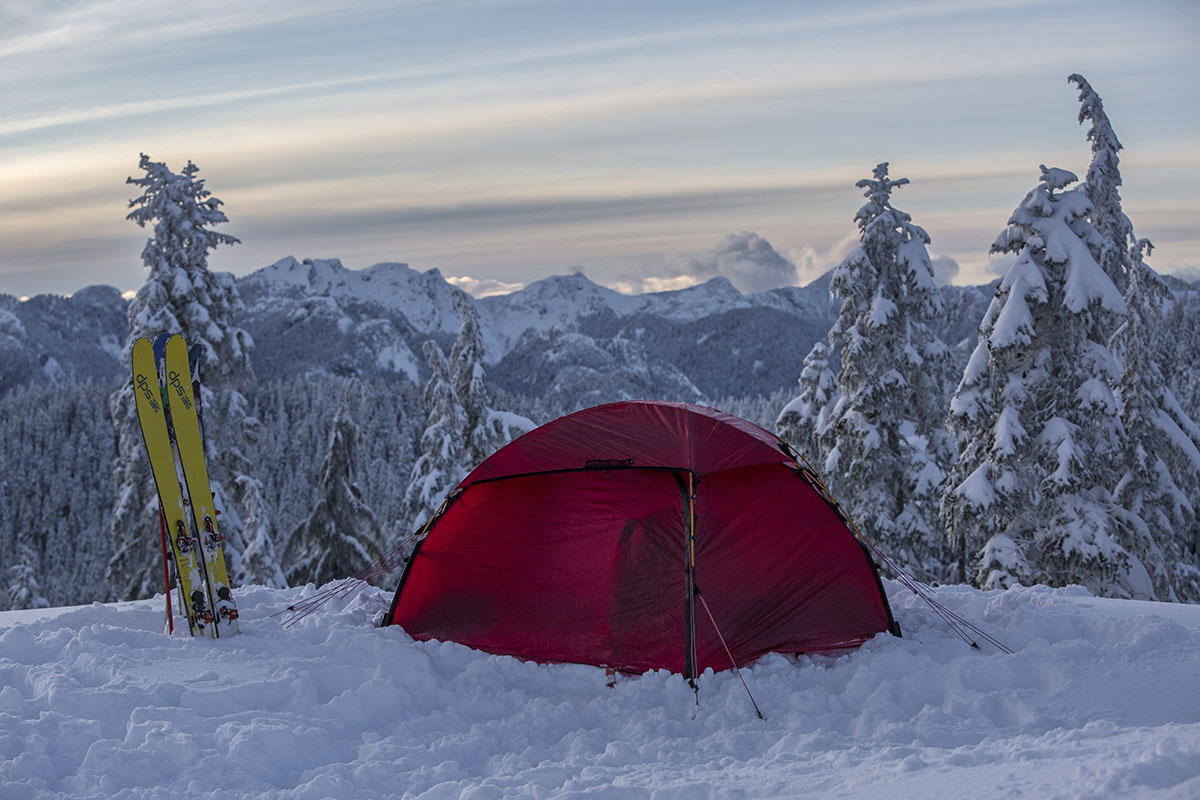
Typically, the first time out with a new tent in stormy conditions is cause for concern, but not so with the Hilleberg Allak. Hilleberg’s stellar reputation, the Allak's fabric, and our observations while pitching had us feeling confident even on our first night. The peace of mind that comes with knowing your shelter is waterproof, tear-resistant, and strong enough to withstand heavy winds and snow cannot be overestimated. It allowed us to hunker in and sleep through a heavy snowfall.
.jpg)
Hilleberg's own Kerlon fabric is a nylon with three layers of silicone coating. In addition to being “ear-proof and waterproof, this coating allows the tent to be much lighter than one would expect for the strength and protection provided. For the Allak and other Red Label tents, including Hilleberg's Nallo 2, they use Kerlon 1200, a 30-denier material for the outer material, as well as a DWR-coated 30-denier ripstop nylon for the tent body, along with a 70-denier nylon floor.
This combination creates a strong, waterproof shelter that withstands sustained winter winds and precipitation. The Allak was originally built for kayaking expeditions in Northern Sweden, an area known for its brutal Arctic conditions. We would happily trust the Allak in the harshest of conditions, but depending on one’s tolerance for weight, one of Hilleberg’s Black Label tents might be even better for basecamp settings.
.jpg)
In addition to the Kerlon fabric, the Hilleberg Allak is packed with features that contribute to its overall weather protection. The outer tent walls extend all the way to the ground, providing exceptional coverage from drifting snow and rain and helping keep the wind out. There are two doors and two large vestibules, and the high bathtub-style floor is a triple-coated polyurethane that has not wetted out on any of our snowy adventures. For further protection and peace of mind, a 14-ounce nylon footprint can be purchased separately.
If you know you’re going somewhere windy or more extreme, you can opt to double Hilleberg’s DAC Featherlite poles. All Red Label tents have pole sleeves designed to accommodate two sets of poles, but the second set must be purchased separately. Additional details, such as sturdy zipper flaps, two solid guylines per pole (the top one can be wrapped around the pole for extra stability), and a built-in fabric flap covering the vents, add to the feeling of security and shelter from the elements.
.jpg)
The Allak offers 30.1 square feet of floor space and a 41-inch dome-style ceiling. On paper, the floor area is slightly smaller than the competition: MSR’s Remote 2 has 33 square feet, and Hilleberg’s own Red Label Jannu has 33.4 square feet. The Allak's configuration is enough for a few pieces of gear and two large sleeping mats, with the option for tent mates to sleep in either direction. The gently sloped dome of the tent also allows two people to sit up comfortably together.
.jpg)
The Allak also features doors on both sides rather than at the head and foot, allowing each camper to have their own entrance and exit. In addition, the two vestibules add almost 20 square feet of gear storage, easily accommodating two backpacks and other gear. Adding the footprint extends to cover the area under the vestibules, creating additional dry, livable space.
Two interior mesh pockets are handy for headlamps, books, and maps, but seem sparse after being spoiled by The North Face Mountain 25’s almost ridiculous number of mesh pockets. There are also several interior tabs that you can use to hang a light or lantern.
.jpg)
The best way to reduce condensation is to increase ventilation, but in cold weather, balancing staying warm and maximizing airflow is tricky. The more control occupants of the tent have over ventilation, the better, and the Hilleberg Allak offers flexible ventilation options. Both doors can be zipped open from the inside to reveal mesh fabric. The outer tent also has vents covered with a fabric flap to keep the elements out, allowing humid tent air to escape and fresh air to enter. If the temperature warms enough, the doors can be fully unzipped, and the vestibules can be left open to allow maximum airflow (and views), while the mesh protects against insects.
.jpg)
The outer and inner tents are connected, maintaining a fixed, taut distance. This creates consistent airspace that insulates without concern that the fly will sag and flop onto the inner tent, even with a significant snow load. Despite use in inclement weather, we have had absolutely no condensation on the Allak’s inner walls. Other than “dew” on our sleeping bags around our heads, we remained entirely dry.
.jpg)
The Allak is perhaps the single easiest tent we’ve ever set up. The tent was originally designed for kayakers who often have only sand or rock slabs to pitch their tents on, so the Allak can be completely freestanding (including the vestibule) and is ideal for tough pitching conditions. We are accustomed to hunting for large rocks when the ground cannot be staked, often a frustrating task at the end of a long day. That’s not to say we don't recommend staking this tent (we do), and Hilleberg provides 12 hardened aluminum V pegs to secure the guy lines.
.jpg)
Along with three identical poles, the fly and tent body are connected, so they are pitched simultaneously. To ease setup, Hilleberg uses a short-pole sleeve-and-clip system on its Red Label tents. The partial sleeve adds stability and support, while the clips are simple and efficient. To avoid confusion, the pole sleeves are color-coded to ensure each pole is connected to the proper ends of the tent, and the integrated approach is welcome after long days of exertion when blood sugar is dipping. Another major advantage is that the tent body stays dry even when pitching in the rain. For such a serious four-season tent, setting it up and taking it down is a cinch.
.jpg)
Hilleberg’s Kerlon is coated with three layers of silicone rather than polyurethane, so even if the material were to be punctured, it would not keep tearing. To demonstrate this, Hilleberg included a sample of the materials so that we could try to destroy them. It was an exercise in futility—they seem to be completely indestructible. Even when the Kerlon was cut, it was not possible to continue the tear. The silicone coating also makes the fabric waterproof and abrasion-resistant without adding significant weight. Further, the seams are stitched using a flat-fell seam, so the stitches pass through four layers of fabric. This creates a tighter seam that reduces water entry points and increases strength.
.jpg)
The Hilleberg Allak comes with 9mm DAC Featherlite poles, which offer the best balance between strength and weight, and every tent comes complete with an extra repair section and aluminum sleeve. Features like guylines are often overlooked, but Hilleberg's 3mm cord is made of interwoven Vectran and polyester with negligible stretch and minimal water absorption. Finally, the dome construction consists of multiple poles that cross at the top of the tent to provide strength and help combat snowfall, rain, and wind. The dome shape also reduces the build-up of snow as it tends to naturally run off the tent due to its convex shape.
.jpg)
With a minimum weight of 6 pounds 2 ounces, the Allak is light enough to pack on most winter or alpine adventures. You can save weight with a single-wall tent like the Black Diamond Eldorado, but you compromise on ventilation, interior space, and convenience, as it has only one door and one vestibule. A better reference point is the much heavier The North Face Mountain 25, which shares the dome-style construction, two-door and vestibule design, and roomy interior. Considering Allak’s construction quality and full feature set, its weight is downright impressive.
.jpg)
For this review, we tested the two-person Allak, and Hilleberg also makes the tent in a three-person model. The Allak 3 weighs 7 pounds 1 ounce for a trail weight and 8 pounds 3 ounces for a packed weight, but otherwise has nearly identical construction. The three-person Allak has 40.9 square feet of interior space compared to 30.1 square feet in the two-person, and you get an additional two inches of headroom. For two winter campers with a lot of gear to store inside the tent, the three-person version makes a lot of sense.
.jpg)
.jpg)
| Tent | Price | Type | Packed Weight | Height | Floor | Doors |
|---|---|---|---|---|---|---|
| Hilleberg Allak | $1,385 | Double wall | 7 lb. 4 oz. | 41.3 in. | 30.1 sq. ft. | 2 |
| The North Face Mountain 25 | $760 | Double wall | 9 lb. 13 oz. | 41 in. | 29.3 sq. ft. | 2 |
| Mountain Hardwear Trango 2 | $1,050 | Double wall | 9 lb. 7 oz. | 38 in. | 40 sq. ft. | 2 |
| MSR Remote 2 | $860 | Double wall | 7 lb. 13 oz. | 44 in. | 33 sq. ft. | 2 |
The Allak does a great job bridging four-season categories with a lightweight design that sacrifices very little in weatherworthiness, and The North Face Mountain 25 is another trusty basecamp option. It has a similar peak height (though less interior space), and is comparable to the Allak in terms of comfort and livability. But whereas the Allak is versatile for lightweight endeavors, the Mountain 25 won’t be coming with you for the summit push. You get more options with the Allak, but the Mountain 25 is just as good when weight is not an issue.
.jpg)
The Mountain Hardwear Trango 2 is another alternative to both the Allak and the Mountain 25. With 40 square feet of interior space, the Trango offers more room, though the Allak adds three inches of height and slightly larger vestibules. The Trango 2 is also more than a pound heavier than the Allak, though the Trango comes at a more palatable price. For terrible weather in a basecamp setting, we prefer the roomier Trango 2, but the Allak’s lightweight build makes it the more versatile tent.
.jpg)
Finally, MSR’s Remote 2 is another valid option. The tent is designed for mountaineers and prioritizes strength and comfort. Its minimum weight is also competitive with the Allak, but from our test of the Remote, we found it to fall short in a few key areas: the rainfly doesn't provide full coverage when pulled taut, the bathtub floor sits low and is vulnerable to moisture, and setting it up in the wind can be difficult. It's a solid option at a reasonable price, but lacks the refinement of a Hilleberg product.


.jpg?h=fbc67360&itok=hkHyY7EI)
.jpg?h=fbc67360&itok=wmPMXiEZ)
.jpg?h=fbc67360&itok=3rw7mw4a)


.jpg?h=fbc67360&itok=_ShKcz91)
-t.jpg?h=fbc67360&itok=tQQ0SQx9)
.jpg?h=fbc67360&itok=sfPIFCqH)