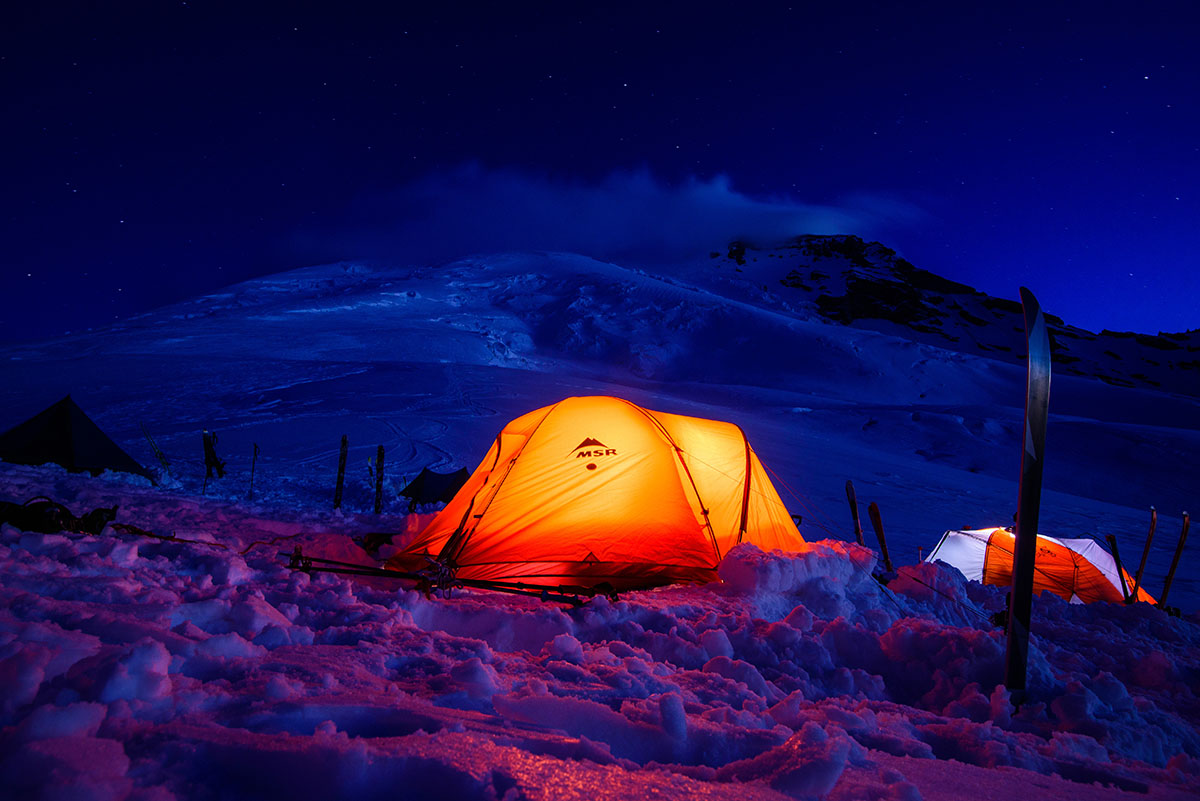
.jpg)
Photo Credit
Price: $860
Category: Basecamp/mountaineering
Packaged weight: 7 lbs. 13 oz.
Floor area: 33 sq. ft.
Wall(s): Double
What we like: Vertical walls increase livable space, and the front vestibule is generously sized.
What we don’t: No snow flaps, limited ventilation, expensive.
See the MSR Remote 2
The ideal four-season tent is a delicate balance of roominess and comfort, ventilation, and durable stormproof construction, all in a package that doesn’t weigh you down too much. With a short weekend on Mount Rainier and a longer basecamp-style expedition to the Columbia Icefield on the docket, I was hoping to find a four-season tent suitable for anything from lightweight mountaineering to a multi-day home away from home on a glacier. For the most part, MSR’s Remote 2 delivered. Below we break down the Remote 2’s weather protection, ventilation, interior space and storage, durability, and more. To see how it stacks up, see our article on the best four-season tents.
Camping on the Columbia Icefield was a perfect opportunity to test the MSR Remote 2 in a variety of conditions. Initially, I was nervous about taking a new tent on such an expedition, but I quickly gained confidence in the quality of the Remote. We weathered clear and cold conditions with moderate winds, some light snow, and hot sunshine and warm rain. At the end of each day, it was comforting to ski back to our reliable shelter, spotting the bright orange tent standing strong from a mile away.
.jpg)
Wind: The Remote 2 is designed to withstand high winds, and it hasn't disappointed. At Camp Sherman on Mount Rainier, we pitched the Remote 2 beside Mountain Hardwear's Trango 2, and both tents held up similarly well. The three-pole construction of the Remote 2 delivers the stability of a dome tent, with even more strength (and height) thanks to the addition of the door-to-door pole. The Easton Syclone poles are designed to flex under high loads, and the 14 guy-out points help secure the tent in every direction. One downside is the lack of multi-point guylines, which can help reduce the number of anchoring pegs. This is helpful when using a limited number of poles and skis to anchor a tent in the snow.
.jpg)
Snow: The Remote is built to withstand snow from above and below, with steep walls for sluffing flakes and snow flaps on the vestibules designed to seal out spindrift. It has most of the features I want in a winter tent. That said, there are no snow flaps on the sides of the tent, where our heads and feet rest inside. To make matters worse, the bottom edge of the rainfly can float up to five inches above the ground. While this might help with air flow, it also allows more cold air and wind-driven snow to pile up at the head and foot of the tent. I wish that MSR had extended the fly lower or included snow flaps around the entire perimeter.
.jpg)
Rain: We experienced precipitation even on the glacier in the Canadian Rockies, and the MSR Remote 2 kept us well protected. The tent comes with a beefy 68D ripstop polyester rainfly with a 1,500mm polyurethane and DWR coating, offering more reliable protection than others we tested. The large vestibule also allowed us to remove our wet layers before getting inside the tent. The bottom of the tent is equally reliable thanks to the quality seam taping and 10,000mm polyurethane and PFAS-free DWR. We had some issues with moisture forming along the bathtub floor overnight, but this isn't a knock against the waterproofing.
.jpg)
The Remote is a warm tent thanks to its thick rainfly, which has pros and cons. In the mornings, the spring sun brought the inside up to a sauna-like 85°F, and moisture collected along the walls. On the flipside, during our coldest night when temperatures dropped to 5°F, we closed the mesh ventilation panels at the top of each door and awoke in the morning to frost lining the inside ceiling. On future nights, we opened both the mesh panels and unzipped the doors at the top and had no issues with condensation. We made it work, but dome tents like the MSR Remote 2 would benefit from ceiling ventilation options and a more breathable canopy material, as we've seen in the Hilleberg Jannu.
.jpg)
The Remote 2 is designed for expeditions where teams might spend multiple days inside. It has a spacious floor plan with 33 square feet of interior floor space and a peak height of 44 inches, which extends throughout much of the interior. This is plenty of room for two full-length sleeping pads, two full-sized men, and all of our bulky winter gear. Two large pockets next to each door provide additional organization, with tabs at the top for hanging gear. The relatively high ceiling also means you can sit upright in the tent without worrying about touching the sides.
.jpg)
The 22 square feet of vestibule space is twice that of other four-season tents like The North Face Mountain 25. In poor winter weather, I appreciate having a large vestibule to protect all my gear without having it inside the tent, and the primary vestibule is big enough that I felt comfortable using a stove on cold mornings. The secondary vestibule is 5.5 square feet, with a large door and enough space for boots, helmets, and crampons.
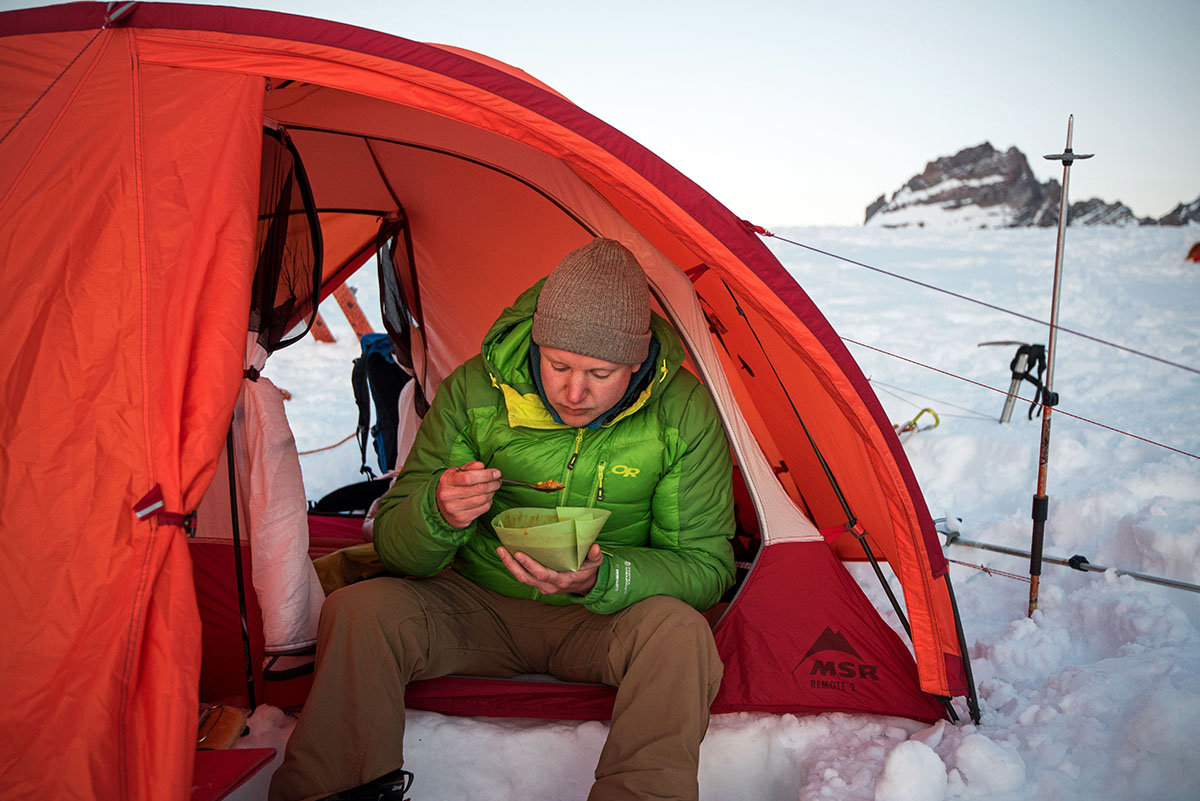
MSR lists the minimum weight of the MSR Remote 2 at 7 pounds 4 ounces, placing it roughly in the middle of the field for double-wall, four-season tents. You could save multiple pounds with a single-wall, four-season tent like the Black Diamond Eldorado, but you will compromise comfort in colder temperatures, and you'll have less interior and vestibule space.
.jpg)
Learning to set up the Remote 2 took me a few attempts, especially in windy conditions. The body of the tent goes up easily by securing the four corners and matching the color-coordinated pole clips to the three main poles. A fourth pole is then used to create the large vestibule. But setting up the fly and vestibules becomes a two-person job in the wind—they do not stay in position without tension from guylines. Eight anchor points are required for a bare minimum setup, but I recommend being prepared to use more.
.jpg)
One letdown of the design was the Velcro straps that connect the guyline attachment points to the poles. In theory, having a direct connection to the tent pole is a great way to increase strength, but I found these to be flimsy, and the straps were too long to cinch tightly. I had difficulty aligning the rainfly seams with the poles, so I relied on the guylines to achieve proper tension and alignment. On the bright side, the 17 plastic clips that attach poles to the tent were easy to handle with gloves on. The MSR Remote 2 comes with nine MSR Groundhog stakes, which are only suitable for soft soil. If you plan to take this tent into the snow, consider purchasing the MSR Blizzard stakes.
.jpg)
I've taken the MSR Remote 2 for five days on the Columbia Icefield, two days on Mount Rainier, and another five days on a summer camping trip with no signs of wear. Unlike the more expensive sil-nylon coating used on Hilleberg tents, the polyurethane coating is less resilient to prolonged exposure to moisture and may require renewal treatments every few seasons. Because of this, it is also important to dry the tent completely before packing it away for long stretches.
.jpg)
We tested the MSR Remote 2, and MSR also makes the same tent in a three-person capacity. The Remote 3 features a four-pole design, adds 13 square feet of interior space, and weighs 9 pounds 8 ounces. Both capacities are made with the same materials and have similar weather protection and durability. They have the same peak height, and both have two doors and two vestibules. For two winter campers with a lot of gear to store inside the tent, the three-person version makes a lot of sense.
.jpg)
.jpg)
| Tent | Price | Category | Weight | Area | Height | Wall(s) |
|---|---|---|---|---|---|---|
| MSR Remote 2 | $860 | Basecamp/mountaineering | 7 lb. 13 oz. | 33 sq. ft. | 44 in. | Double |
| Hilleberg Jannu | $1,325 | Mountaineering | 7 lb. 1 oz. | 34.4 sq. ft. | 39 in. | Double |
| The North Face Mountain 25 | $760 | Basecamp | 9 lb. 13 oz. | 29.3 sq. ft. | 41 in. | Double |
| MSR Access 2 | $800 | Treeline | 4 lb. 1 oz. | 29 sq. ft. | 42 in. | Double |
The MSR Remote 2 balances its priorities better than most tents, but is not without stiff competition. First, Hilleberg’s Jannu sets the standard for the ideal, durable, lightweight two-person double-wall tent. Its minimum weight is 6 pounds 3 ounces, more than a pound lighter than the Remote 2's minimum weight. The Jannu is also made with a more durable silicone-coated fly rather than a polyurethane/DWR coating. Hilleberg tents are regarded as top-of-the-line, and it's the most expensive comparison tent by a long shot. If you're looking for the strongest tent and willing to pay the price while sacrificing some room, the Hilleberg Jannu is likely your tent of choice.
.jpg)
For greater strength (and more weight), the The North Face Mountain 25 is worth considering. You'll get less interior space, but the North Face tent sports a beefier, overlapping pole structure, a tougher floor, and more ventilation options for a sturdier, more comfortable design. Tack on the more affordable price, and the Mountain 25 is tough to beat for basecamping needs.
.jpg)
Finally, if you're not planning to camp in severe mountain conditions, the MSR Access is a less hefty option. The Access 2 has a minimum weight of only 3 pounds 10 ounces, but also has less interior space and a thinner fly. We’ve been impressed with the weight and performance of the Access, but it’s in a different class for weather protection than the Remote. If you’ll be high in the alpine, need strong snow load performance, or a bombproof tent that you can trust, the Remote is the better choice.


.jpg?h=fbc67360&itok=3rw7mw4a)
.jpg?h=fbc67360&itok=wmPMXiEZ)

.jpg?h=fbc67360&itok=Vl5UZCfa)
.jpg?h=fbc67360&itok=ulxnS6MK)
.jpg?h=fbc67360&itok=vcIod759)

.jpg?h=fbc67360&itok=BIxITVRK)