.jpg)
.jpg)
Photo Credit
Hiking footwear is shifting away from bulky boots toward lightweight shoes and even trail runners, which are faster and more comfortable. While you do lose some support when carrying a heavy pack or traversing rocky trails, many modern hiking shoes are stable and supportive underfoot, and are much more nimble than traditional hiking boots. Our team of avid hikers and backpackers has worn hundreds of pairs of shoes over the years to narrow down the streamlined selection of 13 models you see below, ranging from ultralight options for fast-and-light trips to more supportive models for carrying a full pack. The Salomon X Ultra 5 GTX currently leads the charge, with the Merrell Moab Speed 2 a close runner-up. While this article includes both men's and women's styles, we've also put together a dedicated list of the best women's hiking shoes. And if you're often hiking on muddy trails with stream crossings, we have a guide dedicated to the best waterproof hiking shoes.
 Category: Hiking shoe
Weight per pair: 1 lb. 10 oz. (men's), 1 lb. 6 oz. (women's)
Waterproof: Yes (non-waterproof available)
What we like: Great balance of weight and on-trail performance.
What we don’t: Love-it-or-hate-it fit and comfort.
Salomon’s X Ultra has been one of our favorite hiking shoes for years, offering an exceptional combination of comfort, on-trail performance, and durability for everything from casual day hikes to ambitious overnight missions. While version 4 was a flop for many, version 5 seems to be on a slow path back to redemption. Beyond its sleeker, more modern look, the X Ultra 5 features a roomier toe box, a better lacing system, and a hard-wearing Kevlar upper, which we have yet to wear through. Importantly, the shoe retains its fantastic mix of agility, support, and protection, along with a grippy, trustworthy outsole.
The X Ultra 5 snags our top spot because of its versatility. It can keep up on high-mileage days, low-grade scrambling, and it doesn’t look too sporty for casual jaunts on day hikes close to home. But it’s not without faults. While we think the 5 boasts an overall fit improvement over the last version, the forefoot still feels narrow, which won’t work for everyone’s foot. We also have mixed feelings on the cinch-style lace system, which makes it tough to dial in a perfect fit. And while we didn’t have any hotspots or blisters during testing this shoe out of the box, there isn’t much underfoot cushion. We replaced the insole with a cushier one, which improved comfort over long distances. Long story short, if you can try this one on before you buy and it fits your foot shape, the X Ultra 5 is an undeniably high-performance, high-quality option for technical hikes and lighter backpacking adventures.
Read more: Salomon X Ultra 5 review (women's version)
See the Men's Salomon X Ultra 5 Gore-Tex See the Women's Salomon X Ultra 5 Gore-Tex
/A woman stepping down onto a rock while hiking in a rocky and glaciated landscape in hiking shoes.jpg)

Category: Hiking shoe
Weight per pair: 1 lb. 8.7 oz. (men's), 1 lb. 3.4 oz. (women's)
Waterproof: No (available)
What we like: This shoe checks all the right boxes for most hikers.
What we don’t: Roomy toe box and insecure heel make this less secure on technical terrain.
Merrell has been a staple in the hiking footwear world for ages, and their Moab Speed 2 stands out as a well-rounded shoe at a price you can't beat. Unlike the brand's classic offerings, which are more dated-looking, the Speed 2 is a modern, trail-ready shoe with a lightweight yet well-cushioned design. It’s a great shoe for everything from mellow day hikes to fast-and-light backpacking missions. The Speed 2 offers solid protection and support, featuring a firm midsole, reinforced toe and heel caps, and a grippy Vibram outsole. The latest version of this shoe features 30% more midsole foam, making for a softer, more forgiving feel underfoot. The result is a durable and comfortable shoe that strikes one of the best balances we’ve seen between weight savings, all-around performance, and price.
That said, the Moab Speed 2 isn’t without compromise. The roomy toe box and somewhat loose heel lead to an imprecise fit, which may frustrate hikers tackling steep, rocky terrain or carrying heavier loads. We prefer a stiffer, more planted shoe for security and underfoot stability on technical terrain, albeit at the cost of some plushness. Still, for most hikers seeking a versatile, comfortable, and lightweight shoe that can handle many miles on established trails, the Moab Speed 2 strikes a near-perfect sweet spot.
Read more: Merrell Moab Speed 2 GTX review (women's version)
See the Men's Merrell Moab Speed 2 See the Women's Merrell Moab Speed 2
.jpg)
.jpg) Category: Hiking shoe
Category: Hiking shoe
Weight per pair: 1 lb. 9.1 oz. (men's and women's)
Waterproof: No (available)
What we like: Great value for a very comfortable and well-built hiking shoe.
What we don’t: Not built for technical terrain.
These may not be your long-distance or fast-and-light hiking shoes, but there is a lot to like about Merrell’s flagship Moab 3. What has made this shoe so popular over the years? Most notably, it's the lightweight yet planted feel, comfortable, well-padded fit, excellent durability, and attractive price. In fact, these shoes are among the comfiest we've tested out of the box. Merrell updated the Moab a few seasons ago, incorporating recycled materials, a revamped insole, and subtle updates to cushioning and traction, but the formula remains mostly the same and is a crowd-pleaser for a reason. For day hikers sticking to established trails, the Moab 3 is comfy and a great value.
In terms of downsides, on rocky and muddy trails, we’ve found that Moab’s traction and stability fall short of those of a performance shoe. Despite the burly leather upper, they don't have great ankle support, especially on off-camber trails. They also feel slow and cumbersome compared to some of the lighter, nimbler alternatives on our list. While Merrell claims both the men's and women's versions weigh just over a pound and a half, they feel heavier on foot (and on our scales). But these are reasonable trade-offs for casual hikers, and it’s hard to deny the price. Keep in mind that we included the non-waterproof version here, but Merrell also makes a waterproof model with their in-house membrane, along with an upgraded Gore-Tex version.
Read more: Merrell Moab 3 review (men's version)
See the Men's Merrell Moab 3 See the Women's Merrell Moab 3
.jpg)

Category: Hiking shoe
Weight per pair: 1 lb. 15 oz. (men's), 1 lb. 10.2 oz. (women's)
Waterproof: Yes
What we like: A backpacking-ready shoe that is tough, comfortable, and well-made.
What we don’t: Pricey and heavy.
Many of the designs on our list are lightweight or almost trail-runner-like (or are actual trail-running shoes), but La Sportiva’s burly Spire GTX is designed for those who prefer a heftier shoe for more aggressive backpacking adventures. It feels sturdy and substantial, with good stiffness and a thick midsole that effectively isolates you from rough, rocky trails (La Sportiva even goes so far as to call it a low-cut hiking boot). Throw in excellent protection and grip over a variety of terrain, ankle support, and a quality build that we’ve come to expect from this Italian climbing brand, and you have one of the more capable hiking shoes you can find.
The Spire GTX is heavy for a low-top hiking shoe, which makes it a poor choice for fast missions. And we also found that it runs large, which can lead to sloppy footwork on the trail (we recommend trying it on in person and sizing down by at least half a size). And there’s also no denying the price, which is among the highest on this list. Casual hikers will likely find the shoe overkill, and can save a lot of money by opting for one of the simpler designs on this list. But these gripes aside, it’s hard to knock the performance chops or quality of the Spire if it feels good on your foot.
Read more: La Sportiva Spire GTX review (men's version)
See the Men's La Sportiva Spire GTX See the Women's La Sportiva Spire GTX


Category: Trail runner
Weight per pair: 1 lb. 3.4 oz. (men's), 1 lb. 0.6 oz. (women's)
Waterproof: No
What we like: Lightweight feel, grippy outsole, thick but supportive cushioning.
What we don’t: Not as durable as a dedicated hiking shoe, and not the most stable on technical terrain.
As trail running becomes more popular in the hiking space, niche brands like Hoka are becoming more mainstream. There are plenty of benefits in opting for a trail runner over a stiff hiking shoe or burly hiking boot, including underfoot comfort and weight- and cost-savings. One of our favorites in this space is the Speedgoat 7, which retains Hoka’s iconic plushy midsole for comfort over high-mileage days. The outsole is grippy over a range of trail types, and the rocker keeps momentum flowing. The latest version of this shoe has a more planted feel than the last, while still offering a springy, energetic ride. We’ve tested several iterations of this shoe on iconic treks such as the Continental Divide Trail and the Appalachian Trail, and it remains one of our go-to choices for backpacking and hiking.
Of course, there are also downsides to going the trail-runner route. Not only do you sacrifice some durability with the lightweight, flexible materials in a running shoe, but you also lose some stability and support. The Hoka, above all other trail runners on this list, can feel tippy and unstable on tricky trails due to its generous midsole. We also can’t help but feel like the latest version of this shoe is overbuilt. It has a flashy aesthetic, reflective materials, a stiffer heel base, and additional overlays, all of which go over the heads of casual hikers. Plus, we aren’t the biggest fans of the color options, which are certainly eye-catching (not in the best way). But if you’re logging lots of miles of established trails and want to prevent foot fatigue as long as possible, the Speedgoat is worth checking out.
Read more: Hoka Speedgoat 6 review (women's version)
See the Men's Hoka Speedgoat 7 See the Women's Hoka Speedgoat 7

 Category: Trail runner
Weight per pair: 1 lb. 6.3 oz. (men's), 1 lb. 2.6 oz. (women's)
Waterproof: No (available)
What we like: A thru-hiker favorite thanks to its low weight and comfort-first design.
What we don’t: Roomy fit and flexible build aren’t ideal for difficult terrain; not as durable as other options here.
Altra’s Lone Peak is another running shoe that’s become a favorite among thru-hikers. But the Lone Peak has a very different design from that of cushioned models like the Hoka Speedgoat. It has a roomy toe box, a zero-drop shape that encourages a natural stride, and a great ground feel with just 25 millimeters of stack height compared to the Speedgoat’s 40 millimeters (at the heel). It all adds up to a very comfortable shoe that’s ideal for hikers with wide or hard-to-please feet. In fact, an older version of the Lone Peak was one of our editor's shoes of choice for a thru-hike of the Pacific Crest Trail, keeping him cozy and injury-free the entire way.
The latest Lone Peak 9 is arguably our favorite iteration yet: Altra reinforced the upper with a tougher, more abrasion-resistant ripstop mesh, upgraded the traction with a grippier and longer-lasting outsole, and refined the midsole for better comfort and ground feel. Staying true to its trail-focused design, the Lone Peak still includes a rock plate and gaiter attachments. That said, its zero-drop platform isn’t for everyone. Those used to more traditional shoes and trail runners may find it flat, under-cushioned (the 25mm stack isn’t plush), and short on arch support. And while durability has improved in this version, the outsole is still prone to wearing down, and the shoes lose structure more quickly than burlier trail runners. Still, there’s a reason this shoe has earned cult status, particularly among fast-and-light backpackers.
Read more: Altra Lone Peak 9 review (women's version)
See the Men's Altra Lone Peak 9 See the Women's Altra Lone Peak 9


Category: Hiking shoe
Weight per pair: 1 lb. 8 oz. (men's), 1 lb. 4.2 oz. (women's)
Waterproof: Yes (non-waterproof available)
What we like: A wide toe box shoe with underfoot support and protection.
What we don’t: Fits small and stiffer underfoot than lightweight trail runners.
If you like a little more room in the forefoot, but like more underfoot support than a true barefoot shoe, Topo Athletic’s Terraventure 4 offers a great balance of comfort and support. This shoe feels stiffer than the Altra Lone Peak with a rock plate in the forefoot and more arch support, but with plenty of room in the toe box and decent cushioning, it's comfortable on long hikes. We also like the slight heel-toe drop, which keeps these shoes from feeling flat and sluggish on the trail. The Vibram outsole is very grippy on most terrain, and the upper material is very durable and holds up well to buswhacking, unlike traditional lightweight running shoes. This version is also waterproof (and reliably so), but Topo Athletic also offers a non-waterproof version called the Terraventure 5.
While we like the underfoot support on rocky and off-camber trails (where the Lone Peak felt unsupportive), some might find the shoe too stiff. It’s not our first choice for missions that involve running, but it can keep up with a light jog. It’s also worth noting that this shoe (along with all Topo Athletic shoes we’ve tested) fits small, and we recommend sizing up by half a size. The waterproof version also might be too warm for mid-summer hikes, but we haven’t experienced any overheating to date. Overall, the Terraventure remains one of our go-to shoes. Our editor, who struggled with bunions, believes it’s one of the most comfortable shoes she’s tested yet.
See the Men's Terraventure 4 WP See the Women's Terraventure 4 WP


Category: Trail runner
Weight per pair: 1 lb. 5.4 oz. (men's), 1 lb. 3.6 oz. (women's)
Waterproof: No (available)
What we like: A trail runner with good stability.
What we don’t: Heavier than most running shoes.
The Brooks Cascadia strikes a nice balance between comfort and stability, bridging the gap for speed-focused hikers who need something they can trust on rugged trails. It has a decent amount of cushion that doesn’t sacrifice too much ground feel, but it won’t weigh you down like a clunky hiking shoe. We tested the latest Cascadia on hikes in the Rockies, and continue to be impressed by the balanced design: This shoe feels stable and precise while traversing off-camber terrain with a full pack, but remains quick and responsive when you want to pick up the pace. The latest 19 features a more abrasion-resistant mesh upper and additional recycled content, and it's lighter than the outgoing 18.
The Cascadia has a very different feel from the Altra Lone Peak and Hoka Speedgoat. In terms of fit, it has a roomy toe box that can accommodate swollen toes, but it locks things down in the midfoot and heel. It’s more technically capable than either of the aforementioned designs, with better overall stability and underfoot protection. It’s a nice, do-it-all shoe, but it doesn’t specialize in anything specific. We’d still turn to a stiffer shoe for scrambling, though the Cascadia is nice for rocky alpine trails. Still, it’s a very versatile shoe that can handle most terrain, making it a great quiver-of-one shoe for mountain athletes.
See the Men's Brooks Cascadia 19 See the Women's Brooks Cascadia 19

Category: Hiking shoe
Weight per pair: 1 lb. 11.9 oz. (men's), 1 lb. 7.6 oz. (women's)
Waterproof: Yes (non-waterproof available)
What we like: A reliable shoe for most trail hiking.
What we don’t: Not lightweight or our first choice for technical trails.
Keen’s Hightrail Waterproof is a newer addition to our quiver and has impressed us with its well-rounded design. Though not a specialized shoe for technical pursuits, it offers a nice balance of underfoot cushion and stability, durability, and grip on a range of established trails. Its stiff build secures it in the hiking shoe category, but they’re far from clunky. The slight rocker encourages momentum, and the arch support cradles the foot nicely. It also has a sleek, uncharacteristic aesthetic for the brand, known for its burly hiking boots. It can crossover nicely into casual use, and isn’t a sore sight at after-hike lunches.
The Hightrail has been an outstanding design for trail use, but we wouldn’t push it too far off the beaten path. While the outsole is reliable and provides a good barrier between the foot and the ground, protection elsewhere is limited. It doesn’t have a sturdy toe bumper, so you’ll want to be careful not to kick rocks or roots. The shoe is also on the heavy side, and not our first choice for fast missions. The collar is also stiff and takes some time to break in. But our impressions are overall positive, and we think the Hightrail has a lot to offer for those getting into hiking or planning to stick to established routes. And it doesn’t come in at a bad price, either.
See the Men's Hightrail Waterproof See the Women's Hightrail Waterproof

Category: Running shoe
Weight per pair: 1 lb. 3.1 oz. (men's), 1 lb. 0.9 oz. (women's)
Waterproof: No (available)
What we like: Lightweight shoe that’s still supportive.
What we don’t: Fits narrow, and lacing isn’t our favorite.
If moving fast is your objective, Saucony’s Peregine 16 is worth checking out. This lightweight shoe is built for moving fast on tricky terrain, offering more stability than ultra-cushioned designs like the Hoka Speedgoat, while still providing a good amount of cushion and underfoot protection. What’s more, deep lugs on the outsole provide excellent grip on a range of terrain, including loose dirt and rock. It can keep up on low-grade scrambles as well. Importantly, it doesn’t feel flat when loaded down by a pack, and it has its place on longer backpacking trips where the trail is easy to follow. In the end, it’s a capable shoe packaged in a sleek, lightweight design.
The Peregrine isn’t the most comfortable shoe we’ve ever worn, however. It took some time to break this shoe in, and it felt narrow and stiff out of the box. The tight fit is helpful for technical trails where precision matters, but you’ll want to spend some time breaking it in before taking it out on long hikes. We also had some trouble getting the laces secure over the top of the foot, and it took some finessing to get them comfortable. But these aren’t dealbreakers for us, and the shoe remains one of our favorites for mountain treks or fastpacking missions.
See the Men's Saucony Peregrine 16 See the Women's Saucony Peregrine 16

Category: Running shoe
Weight per pair: 1 lb. 3.8 oz. (men's), 1 lb. 1.3 oz. (women's)
Waterproof: No (available)
What we like: A very capable shoe on technical terrain.
What we don’t: Stiffer than most trail runners, and more expensive, too.
We often turn to Scarpa for high-quality technical gear, and the Ribelle Run 2 has impressed us with its performance on scrambles and precarious terrain. It has a similar stiffness to an approach shoe, but a nice dose of underfoot cushion that makes it far more comfortable when hiking over long distances. The very grippy outsole is another highlight, as well as the precise toe, which makes it easy to balance on small features. The shoe also isn’t out of place on soft or muddy trails. Durability is high across the board, making the high price worth the investment, especially for those who push their gear beyond the trail.
Though the Ribelle Run is designated as a running shoe, it doesn’t have the underfoot cushion that trail runners might expect. We run in it often on the soft forested trails in western Washington state, but it’s far from cushioned designs like the Hoka Speedgoat. The narrow shape and thick upper materials offer a sock-like fit, which is great for precision, but they might not be comfortable on all foot shapes (our editor with bunions didn’t find them too restrictive in the forefoot, however). We also aren’t the biggest fans of the cinch-lace system, which is hard to get just right, and the lace catch doesn’t do the best job at keeping them out of the way. Still, the Ribelle Run has proven itself as a very capable shoe in mountain terrain, and is a great choice for those who like to scramble to the tops of obscure peaks.
See the Men's Scarpa Ribelle Run 2 See the Women's Scarpa Ribelle Run 2
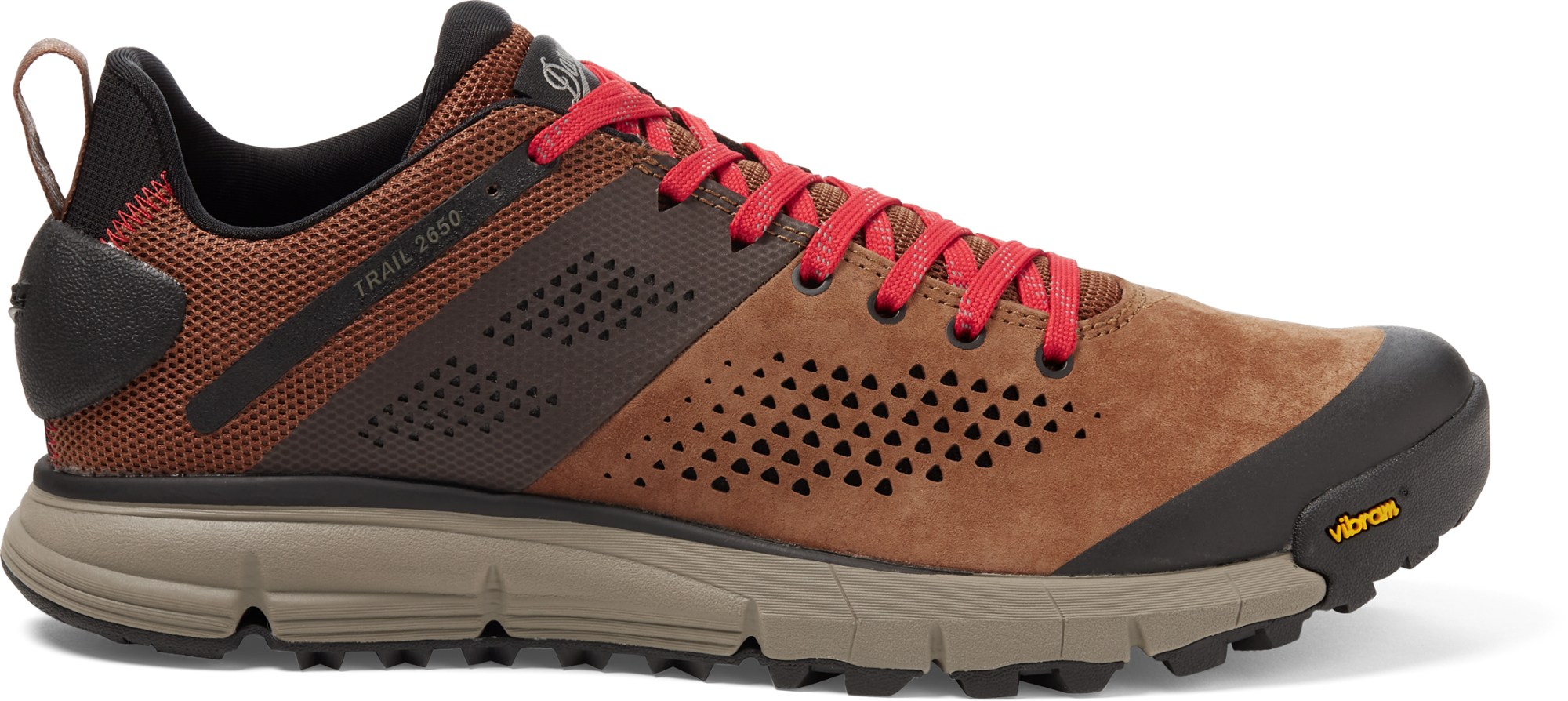 Category: Hiking shoe
Weight per pair: 1 lb. 8 oz. (men's), 1 lb. 2 oz. (women's)
Waterproof: No (available)
What we like: Comfortable, grippy, and looks good for use around town.
What we don’t: Pricey and not the most stable.
Danner is best known for their work boots, but the longtime footwear brand has made a notable transition to hikers in recent years. The Trail 2650—named after the length of the Pacific Crest Trail—has a lot going for it: It’s comfortable right out of the box, grippy with a Vibram outsole, and on the lightweight side. But this shoe manages to pull off versatility into casual use with a stylish leather upper and classy, blocked color options. There’s no need to bring along another pair of shoes for an after-hike trip to the brewery. All in all, we’re impressed with the direction that Danner is headed, and the Trail 2650 is one of the more versatile options on this list.
Despite its lightweight build, the Danner offers a step up in protection compared to the trail running shoes on this list, with generous heel and toe protection and a stiff rubber sole. On the other hand, it’s far from the most stable design here, with a low collar and a less locked-down feel than shoes like the Salomon X Ultra. It will show its weakness on tricky terrain or while hauling a heavy load. What’s more, we’re not sure what to make of the rather massive piece of rubber on the heel, which seems to go above and beyond the necessary levels of protection. But these are small complaints about an otherwise comfortable, capable, and stylish lightweight hiking shoe.
Read more: Danner Trail 2650 review (men's version)
See the Men's Danner Trail 2650 See the Women's Danner Trail 2650

Category: Hiking shoe
Weight per pair: 1 lb. 2.4 oz. (men's), 14.8 oz. (women's)
Waterproof: No
What we like: Wide but secure fit, great traction, and a broad toe box.
What we don’t: Barefoot shoes aren’t for everyone.
While the slim design, light weight, and sleek aesthetics may draw you to the "barefoot" world of hiking shoes, we feel it's worth starting the review with a word of caution. You shouldn't jump into hiking (especially backpacking) with minimalist shoes until your feet have properly adjusted to the stripped-down design. If you don't, you could risk serious injury. But there’s a reason “barefoot” running, hiking, and backpacking are becoming increasingly popular. The thin midsole and flexible design allow your feet to bend, move, and flex naturally, adapting to the contours of the trail. In this realm, Xero's Scrambler Low EV is one of our favorite picks. It features rugged Michelin rubber outsoles with 3 mm lugs for solid traction without sacrificing connection to the earth. On top of that, the Scrambler has an incredibly cozy, natural fit, with a wide toe box that allows your feet to splay naturally. In testing, we've found these hold up better to the rigors of tough trails than similar models in our arsenal.
The cons to these types of shoes are obvious, and most have nothing to do with the brand: They offer little support and cushion, and less durability than many other hiking shoes. Women should be especially cautious here, as in most cases they have higher arches that require more support than barefoot shoes provide. Specific to the Scrambler Low EV, though, the price is steep for what you get; the included laces aren't our favorites (some folks we know choose to swap them out); and it's heavier than other barefoot shoes. This aside, Xero makes some great shoes for those looking for more connection to the trails they are trotting on.
See the Men's Xero Shoes Scrambler Low EV See the Women's Xero Shoes Scrambler Low EV
Even after finding a properly fitting shoe, blisters can still form on the trail as you break them in. When trying on a shoe for the first time, be sure to note any hotspots that might lead to blisters. We've had luck taping these areas with a sports tape (we like Leuko tape) to keep the discomfort to a minimum. Your socks play a very important role in blister prevention, too, so opt for hiking socks that are moisture-wicking and quick-drying. Pre-treating a sock with a moisture-absorbing powder, such as Gold Bond, can also help. If blisters are still occurring after breaking in the shoe, it's possible the shoe isn't the right one for your foot or your intended use. For example, a shoe that fits too big or too small can cause friction that leads to blisters, or using a pair of waterproof hiking shoes in dry, hot climates can make feet sweat and make them more prone to blistering.
We removed the La Sportiva TX4 Evo from the guide in this update because it isn't a very comfortable hiking shoe. We like approach shoes for low-grade climbing, but a hiking shoe with more cushion is a better choice for hiking longer distances. Read our in-depth review of the TX4 Evo (previous version).
The Hoka Anacapa 2 Low also didn't make the cut. We retested this shoe recently and found it imprecise and heavy. It's also not as cushioned as other Hoka shoes. We're also concerned with the durability of the blown rubber on the outside of the shoe. For more information, see our in-depth review of the Hoka Anacapa 2 Low GTX.
We dismissed the On Cloudrock Waterproof Low because we weren't impressed with the outsole in testing, and it fell behind grippier shoes. The lacing system wasn't secure either. In our opinion, the performance isn't worth the price ($200).
There are a few models that simply didn't stand out from the other shoes in this list, including the Keen Targhee IV Vent and Oboz Sawtooth X Low.

| Hiking Shoe (men's/women's) | Price | Weight (m/w) | Waterproof? | Upper | Outsole |
|---|---|---|---|---|---|
| Men's Salomon X Ultra 5 GTX Women's X Ultra 5 GTX | $175 | 1 lb. 10 oz. 1 lb. 6 oz. | Yes (Gore-Tex) | Synthetic | All Terrain Contagrip |
| Men's Merrell Moab Speed 2 Women's Merrell Moab Speed 2 | $145 | 1 lb. 8.7 oz. 1 lb. 3.4 oz. | No (available) | Synthetic/TPU | Vibram TC5+ |
| Men's Merrell Moab 3 Women's Merrell Moab 3 | $140 | 1 lb. 9.1 oz. | No (available) | Leather/mesh | Vibram TC5+ |
| Men's Hoka Speedgoat 7 Women's Hoka Speedgoat 7 | $165 | 1 lb. 3.4 oz. 1 lb. 0.6 oz. | No | Mesh | Vibram Megagrip |
| Men's La Sportiva Spire GTX Women's La Sportiva Spire | $219 | 1 lb. 15 oz. 1 lb. 10.2 oz. | Yes (Gore-Tex) | Mesh | Vibram XS Trek |
| Men's Altra Lone Peak 9 Women's Altra Lone Peak 9 | $145 | 1 lb. 6.4 oz. 1 lb. 2.6 oz. | No (available) | Synthetic/mesh | MaxTrac |
| Men's TA Terraventure 4 WP Women's Terraventure 4 WP | $155 | 1 lb. 8 oz. 1 lb. 4.2 oz. | Yes (eVent) | Synthetic | Vibram Megagrip |
| Men's Brooks Cascadia 19 Women's Brooks Cascadia 19 | $150 | 1 lb. 5.4 oz. 1 lb. 3.6 oz. | No (available) | Mesh | TrailTack Green |
| Men's Keen Hightrail WP Women's Keen Hightrail WP | $150 | 1 lb. 11.9 oz. 1 lb. 7.6 oz. | Yes (Keen.Dry) | Mesh/leather | Keen All Terrain |
| Men's Saucony Peregrine 16 Women's Peregrine 16 | $150 | 1 lb. 3.1 oz. 1 lb. 0.9 oz. | No (available) | Mesh | Vibram Megagrip |
| Men's Scarpa Ribelle Run 2 Women's Ribelle Run 2 | $199 | 1 lb. 3.8 oz. 1 lb. 1.3 oz. | No (available) | Mesh | Presa/Supergum |
| Men's Danner Trail 2650 Women's Danner Trail 2650 | $190 | 1 lb. 8 oz. 1 lb. 2 oz. | No (available) | Leather | Vibram 460 |
| Men's Xero Shoes Scrambler Women's Xero Scrambler | $160 | 1 lb. 2.4 oz. 14.8 oz. | No | Mesh | Michelin rubber |
The Switchback Travel team is no stranger to long days on the trail. From epic high routes traversing striking peaks to months-long thru-hikes across the country, we clock serious miles each year on all sorts of terrain. Senior editor Chris Carter took over the guide in 2024, with input from the entire team. A seasoned thru-hiker, Chris has completed the Triple Crown of U.S. long trails (AT, PCT, and CDT) and continues to backpack and explore around the world. Senior editor Maddie Downie now manages the guide, drawing on her years of hiking and backpacking in the Pacific Northwest and the Rockies to determine the best hiking shoes for a range of hikers. Both have worn well-earned holes in more hiking shoes than they can count, and know the importance of solid kicks for tackling any trail.
We meticulously tested dozens of highly rated hiking shoes to narrow the selection to 13 models above, drawing on personal experience as well as feedback from seasoned contributors and the broader hiking community. Weight, durability, breathability, and cushioning are all key factors we consider when evaluating a hiking shoe's performance, and each design had to prove itself over grueling miles to earn a spot in this roundup. Finally, we recognize that the hiking shoe market is continually evolving. As a result, we stay informed about new products as they emerge, adding standouts to our list along the way and ensuring our existing reviews remain up to date. And if you're looking for a different style of hiking footwear, we took a similar approach in putting together our lists of the best hiking boots and best trail running shoes.
.jpeg)
Hiking Shoes
For the vast majority of day hikers, and even many backpackers and thru-hikers, a hiking shoe that falls just below the ankle is the perfect choice. Shoes like the Salomon X Ultra 5 GTX and Keen Hightrail Waterproof are stiffer and more substantial than a trail runner for carrying a light load over mixed terrain, but don't feel draggingly heavy like a full-on boot. Furthermore, hiking shoes often have a tougher construction than trail runners, with greater use of leather and durable nylon rather than mesh. Protection from obstacles like rocks and roots comes courtesy of rubber toe caps and medium-stiff midsoles. Hiking shoes are also great options for folks who need a substantial shoe for daily wear; just be mindful that the outsoles will wear faster on pavement.
.jpg)
Trail Running Shoes
If speed is paramount, consider a trail runner. Shoes like the Altra Lone Peak and Hoka Speedgoat have gained significant popularity over the past few years as the ultimate lightweight options and are a common sight on thru-hikes. That said, keep in mind that these types of shoes are not traditional off-trail or backpacking footwear. Trail runners are flexible and super comfortable, but they don’t provide much in the way of ankle support when you’re carrying a heavy load and have minimal toe and underfoot protection. For hikes on established trails or for experienced minimalist trekkers, however, a trail runner remains an excellent option. We’ve included a couple of great hybrid trail running and hiking options in this article, but for a complete breakdown, see our round-up of the best trail running shoes. And for a deeper dive into the differences, check out our article on Hiking Shoes vs. Trail Runners.
.jpg)
Approach Shoes
The third option has a narrow focus: climbers or hikers who need a grippy shoe to tackle steep, rocky terrain. Many rock climbers will use an approach shoe on the hike in (hence the “approach” in the name) and switch to a true climbing shoe when the terrain becomes vertical. Approach shoes are easy to spot: They have a large toe rand and a sticky, low-profile rubber compound underfoot for maximum grip on rock. That said, we don't recommend approach shoes for most hikers because they're too stiff for long-distance hiking, and the tread isn't as secure on soft surfaces like mud. We have included a few hiking shoes that toe the line, including the Scarpa Ribelle Run 2 and the La Sportiva Spire GTX. Both have a stiff base, very grippy outsoles, and enough cushioning to remain comfortable in the long haul.

Arguably, the most significant development in modern hiking shoe technology is the shift toward lightweight designs. Tough but thin fabrics and a shift from over-the-ankle boots to low-top shoes have made putting on major miles a lot easier. It’s no surprise that most hikers now choose a hiking shoe over a traditional leather boot. Most of the shoes on our list weigh 2 pounds or less for a pair. By comparison, a backpacking boot like the Asolo TPS 520 GV Evo weighs around 4 pounds. And on your feet, the weight is even more apparent. True, the drop in ounces can sometimes impact long-term durability, but there are still a number of compelling hiking boots available for traditionalists and those who need extra support. For most, a lightweight shoe is a much better companion for day hikes, peak bagging, and minimalist overnight trips. As long as the rest of your gear is equally light, there are very few sacrifices. For those hoping to shave weight, something like the minimalist Xero Shoes Scrambler offers an unprecedented "barefoot" like connection with the trail in a light, packable design.
.jpg)
Reflecting the push for lighter gear across all facets, hiking shoes are shifting away from the traditional, stiff construction of hiking boots toward greater flexibility and a nimble feel. All hiking footwear (except some minimalist trail runners) retains some stiffness due to built-in shanks or internal supports. These features are part of what separates a hiking shoe (and approach shoe) from a super-flexible cross-trainer or road-running shoe.

For day hikes on flatter or less technical terrain, we can’t recommend a lightweight and semi-flexible hiking shoe enough. Shoes like the Merrell Moab 3 and Danner Trail 2650 are standouts for these uses. As your trips get longer and your pack gets heavier, a more substantial shoe still wins out for us. Look to the Salomon X Ultra 5 as a great all-around option that is equally adept at conquering summit peaks and on multi-day backpacking trips.

Once you narrow your hiking footwear search, you may be wondering: Do you really need waterproofing? In theory, a waterproof design is a nice security blanket if you’ll be hiking in the mountains. The extra protection provided by a waterproof, breathable membrane in the shoe is great for creek crossings, unexpected rainfall, or if you hit snow on an early-season trek. However, the extra layer adds weight and significantly impacts breathability, and the designs aren’t always perfect. We’ve found Gore-Tex (also often referred to as 'GTX') models to work consistently well, and many in-house designs perform similarly at keeping water out (breathability is a different story), including the eVent used on Topo Athletic's Terraventure 4 WP.
.jpg)
Whether or not you need waterproofing often comes down to a personal choice. Are you a summer-only hiker or live in a warm and dry area? We’d recommend a non-waterproof shoe in most cases, and some of the best-ventilating shoes are the Altra Lone Peak 9 and Merrell Moab 3. But if you get into the alpine regions or would benefit from the added protection and modest insulation waterproofing provides, we’d lean the other way. The great news is that most shoes on our list are offered in both varieties. But expect to pay about $20-$30 more for the waterproof version. To dive deeper, check out our roundup of the best waterproof hiking shoes.

The truth about waterproof liners, even expensive Gore-Tex booties, is that they don’t breathe well. Just as a waterproof jacket won’t be as breathable as a comparable non-waterproof version. Waterproof and breathable membranes restrict a shoe’s ability to pull moisture away from your sweaty feet as efficiently as a non-waterproof upper. Not all non-waterproof shoes should be treated equally, however. Footwear featuring thinner fabrics and a lot of mesh will increase moisture transfer and airflow, keeping feet less sweaty in hot weather and drying soggy hiking socks out much more quickly.
.jpg)
Gore-Tex Surround, which is designed to bring 360 degrees of breathability by venting out the insole of the shoe, is an intriguing concept. It’s been well received in a few models, including the La Sportiva Spire, but performance will always fall short of a shoe made mostly of mesh (for more, see our in-depth Spire review). Regardless of your final decision, we encourage you to consider non-waterproof footwear before selecting your next pair of hiking shoes.
Easily overlooked, laces—as well as the system of hooks and eyelets—play an essential role in fit and comfort. If a shoe has a poor lacing system that is prone to loosening, you’ll find yourself having to readjust constantly on the trail. If the system itself doesn’t secure your heel very well, the up-and-down walking motion will create hot spots and blisters. If the culprit is just the laces themselves, it’s an easy fix: There are a number of quality replacement laces available. But if the system doesn’t hold your foot very well, we recommend looking elsewhere.

Some models, including the Salomon X Ultra 5, have a single-pull lacing system. The design is highly convenient, and we’ve had no durability issues beyond those we've experienced with traditional laces. One thing to keep in mind, however, is that you aren’t able to adjust the fit between eyelets, so the shoe will be equally tight across the entire foot. Those with finicky feet who need to fine-tune their laces for comfort may be best served by avoiding quick-lace designs.
.jpg)
Hiking shoe upper material is not the most exciting topic, but examining its construction can provide helpful insights into a shoe's performance. The type of material used will directly correlate with a shoe's durability, water resistance, and breathability. Most often, hiking and trail shoes are made from a combination of nylon, mesh, and leather to strike a balance between cost and longevity. Below, we outline the pros and cons of the most common materials used in hiking footwear.
Synthetic Nylon and Mesh
Woven synthetic (often nylon) and open synthetic mesh panels are commonly used to enhance breathability. These materials are not as well known for their durability, but they do a great job of cutting weight. Some of our favorite models with durable but lightweight synthetic mesh for standout breathability include Hoka's Speedgoat 7 and Saucony's Peregrine 16.
.jpg)
Nubuck Leather
Made of full-grain leather, but given a brushed finish that has a suede-like feel, nubuck leather is a common sight on heavier-duty hiking shoes. The softer-touch leather is lighter and more flexible than traditional, glossy full-leather options and more durable than most nylons. It does fall short in breathability, however. As a result, it’s common to find a mix of leather and nylon mesh for abrasion resistance and breathability, as seen on shoes like the Merrell Moab and Keen Hightrail Waterproof.

Digging deeper into the shoe's construction, we'll look at midsole construction next. Its importance lies in cushioning your feet, acting as a shock absorber against impacts, and providing an additional layer of protection against sharp rocks. Depending on the design, midsoles vary from very thin (minimalist trail runner) to stiff and substantial (burly hiking shoe). Most include EVA, TPU, or both in their construction.
EVA
Foam EVA midsoles are a common sight on running and hiking footwear. The cushy soft material takes some of the sting out of your heel or midfoot impacts and is also lightweight. While nearly all shoes on this list utilize some form of EVA, the proprietary versions can vary from soft to mildly stiff. For logging serious miles on tougher terrain, we prefer a firm and supportive midsole over excessive cushioning. Those overly soft midsoles also tend to break down over time, much like a road-running shoe. Generally, you pay more for an enhanced midsole design and a higher-quality EVA compound.
.jpg)
TPU
Thermoplastic polyurethane (mercifully shortened to TPU) is a durable plastic commonly found in performance-oriented light hikers. Shoes with TPU underfoot are often less cushy than those with only EVA, but they last longer and better handle a heavier load. They’ll also retain their shape longer and are less prone to compressing compared to EVA. Because both midsole types have valid applications and TPU is more expensive, it’s common for a manufacturer to use a TPU frame or shank for stability and toughness, and to add EVA underfoot for increased comfort.
.jpg)
One of the primary reasons to upgrade from a flimsy cross-trainer to a true hiking shoe is for improved traction. In a way that casual footwear can never match, hiking and trail-running footwear is leaps and bounds better when the going gets rocky, slippery, and steep. In much the same way that Gore-Tex dominates the market for mid- to high-end waterproofing, Vibram occupies a similar niche for outsoles. Their name is synonymous with solid grip and traction on a variety of terrain, and Vibram rubber is incredibly durable compared to other compounds we've tested. Not all Vibram models should be treated as equals, however, as the rubber manufacturer tailors its designs for specific footwear and brands. Some have much larger lugs underfoot for serious grip in mud, and others prioritize sticky rubber for scrambling over rocks. There are also more entry-level options that just do well on easier trails, like the lugs you’ll find on the bottom of the Merrell Moab 3 boots and shoes.

You don't need Vibram to succeed on the trail, however. Some in-house rubbers perform on par, such as Salomon's Contragrip, as seen on the X Ultra 5. Scarpa's Presa outsole is very grippy, and we've even had luck with some of the outsoles on more budget-oriented shoes, such as the Keen All Terrain outsole on the Hightrail Waterproof.
/Stepping down onto a boulder in hiking shoes while hiking in a rocky and glaciated landscape.jpg)
Hiking trails, even well-maintained ones, are full of rocks, roots, and other potential hazards, so we almost always recommend a hiking shoe with a toe cap. Lacking any protection on the front of your shoes can lead to a trip-ruining impact when you inevitably look up from the trail to enjoy the scenery. Hiking shoes typically have a full rubber toe cap, but trail runners sometimes have a trimmed-down version or none at all (one of the compromises in opting for a minimalist shoe). Approach shoes, on the other hand, offer exceptional toe protection thanks to their wraparound rubber rand at the front.
.jpeg)
Just like with running shoes, the stock insoles that come with nearly every hiking shoe are generally cheap. For some, this might not make a difference, but for others, it’s what separates comfort from misery. Thankfully, removing your insoles is easy, and replacing them with an aftermarket model that’s specifically designed for your foot size and shape can remedy most shoe maladies. New insoles can provide more or less volume to fill out the shoe, improve fit under the arch, and increase or decrease cushion and shock absorption. We recommend checking out Superfeet insoles for their wide selection and trusted reputation in daily shoes, ski boots, and hiking footwear.
Perhaps the biggest point of differentiation between hiking shoes and boots is height: Shoes have a low-top fit, while boots sit above the ankle. Hiking shoes excel on smooth trails, where rolled ankles are less likely to occur (if you keep your pack weight down), and for those who want to move quickly with less on their feet. Tradition suggests that hiking boots are the better choice for carrying heavy packs and navigating rough trails, and in most cases, that remains true today. The tall height, along with laces that hold the boot snugly around your ankle, offers a more secure fit, greater stability, and added protection. That said, with enough practice and trail time, hikers can build ankle strength in low-top shoes and remain safe while traversing the same terrain they would in boots. Given the choice, we most often select a hiking shoe for its lightweight and agile feel; however, both are viable options for day hiking, backpacking, and non-alpine peak bagging.
.jpg)
Nowadays, we see the lines between hiking shoes and boot categories continuing to blur. They still will be separated by height—although some modern boots only cover part of the ankle—but fewer and fewer boots resemble the heavyweight leather clunkers of old. One example is the over-the-ankle version of the Salomon X Ultra 5. It’s the same basic shoe with the same defining characteristics, but the “Mid” sits higher on the ankle, weighs a few ounces more, and provides a boost in protection and support (it also offers a traditional lacing system instead of the Quicklace system). Since most folks stick to defined trails, the push for this type of fast-and-light footwear will continue to dominate the market.
When trying on a shoe in a store, we recommend spending some time in it to ensure it fits well. While it's hard to mimic the way they'll perform on the trail, you can get a pretty good idea of how they fit just by walking around in them. Be sure to bring your hiking socks so that you can dial in the most accurate fit (as well as custom insoles, if you have them). And it's not a bad idea to try on a half size above your normal size to account for how your feet will swell on the trail. Still, you'll want to make sure the shoe isn't too big. Wearing a shoe that's too big can lead to sloppy footwork and blisters. Your heel should be snug in the back of the shoe and not lift much as you walk. The toe should feel precise, but you'll still want some room for your toes to swell at the front of the shoe. Pay attention to any hotspots or discomfort; those are signs that a shoe doesn't fit right. There will be some discomfort when breaking in a shoe, but the goal is to minimize it.
Hiking shoes aren't cheap, and it's tough to find a good balance between price and performance when shopping for the right pair. If your budget is tight, you can get away with a less expensive shoe, but you'll likely be sacrificing performance. Cheaper shoes usually use cheaper materials throughout, which can limit grip on the outsole, midsole protection and stability, and upper durability. Starting with the outsole, we recommend choosing a shoe with deeper lugs than a traditional sneaker, so the shoe can bite into dirt and rock. The midsole should feel comfortable underfoot, but not tippy or unsupportive. Take a close look at the quality of the stitching and materials in the upper, and make sure there's toe protection at the front of the shoe. If you're planning to stick to casual, non-technical terrain, you can get away with a cheap shoe, but for more technical outings or long hikes, we recommend spending up for your safety and comfort. Also, a more expensive shoe is generally more durable, which can save you money down the line.

While a tall, supportive collar does help protect your ankles on the trail, you don't necessarily need to choose a hiking boot to do so. A stable midsole does a lot to keep the foot supported on the trail. We recommend that those prone to twisting their ankles when hiking avoid tall, cushy midsoles and instead opt for a stiffer midsole with arch support. Swapping the factory insole out for a more supportive insole can also help keep your feet safe. Hiking shoes are also generally lighter weight than boots, which makes it easier to be precise and nimble on the trail. That said, there are plenty of lightweight hiking boots to choose from if you'd still prefer the assurance of a tall collar.
Stack height refers to the amount of cushion between your foot and the ground, and drop refers to the difference in height between the heel and the front of the foot. A shoe with either a high stack height or a high drop can affect its stability on the trail. With more cushioning underfoot, a shoe can feel tippy and imprecise on technical or off-camber trails. And although a shoe might have a low stack height, a high drop can also affect heel stability. If you're planning to cover long distances on non-technical trails, a highly cushioned shoe can help reduce foot fatigue. But for off-trail wandering and scrambling, a stabler, less-cushioned shoe will provide better "ground feel" and greater precision. In the end, finding a comfortable balance is essential, and all of the shoes in the list above provide some underfoot cushion, but we're sure to point out those with extra cushion that may feel tippy or insecure on tricky trails.

_0.jpg?h=fbc67360&itok=9jCMZqJc)


.jpg?h=fbc67360&itok=3lNBbzz3)
.jpg?h=fbc67360&itok=n3cjxsVc)

.jpg?h=fbc67360&itok=ziUGHfa6)
