.jpg)
.jpg)
Photo Credit
There are numerous factors to consider when choosing a camping stove. How many people are you cooking for? Do you like to make intricate meals? How far will you have to shuttle your gear from the car to the campground? To help you decide, we break down the main considerations for choosing the best camping stove, including the differences between freestanding and tabletop models, selecting the right BTU rating, and choosing the right fuel type. For a look at our top picks, see our article on the best camping stoves. If you prefer venturing farther into the backcountry, we've also put together a round-up of the best backpacking stoves.
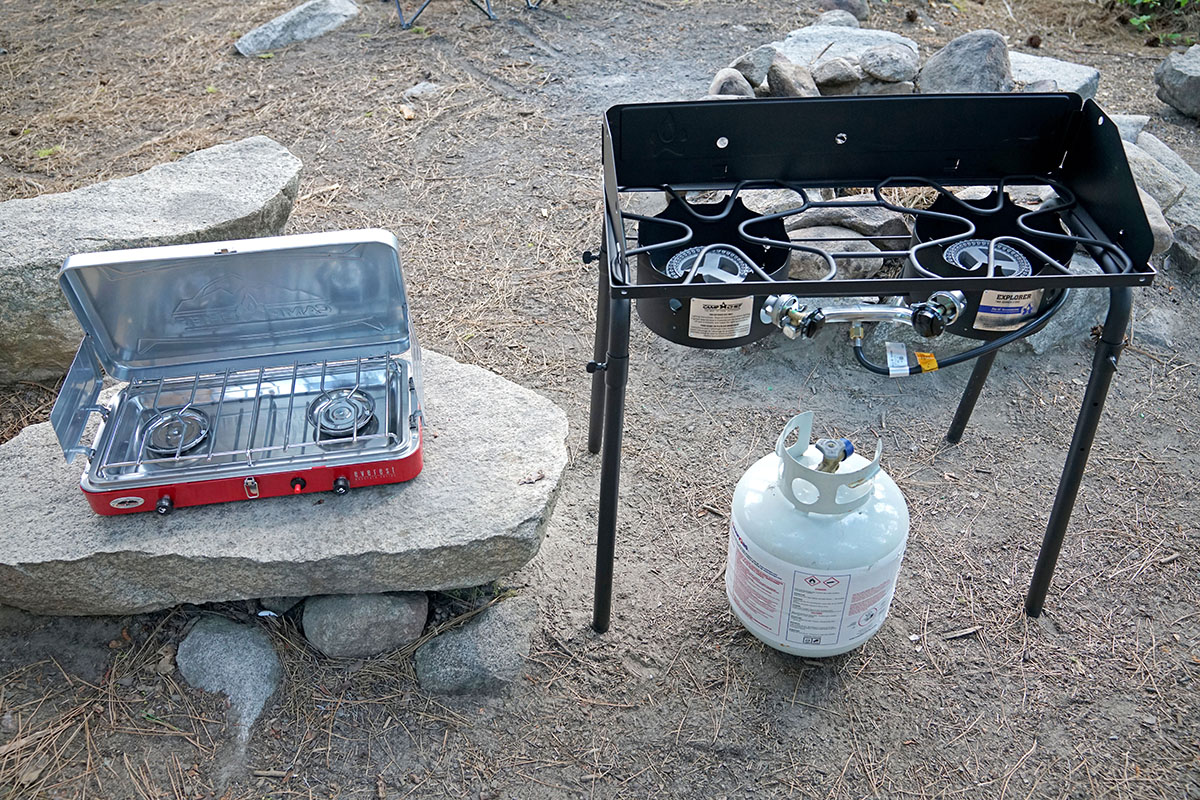
The two main types of stoves are freestanding models with legs and tabletop designs. Freestanding stoves are larger, heavier, and generally have more BTUs than tabletop units, making them well-suited for large groups or those who need more power and cooking space. Another benefit of freestanding models is that they can be set up just about anywhere—no need to hunt for a flat surface at camp or to take up food-prep space.
Tabletop designs, on the other hand, function just as their name implies: Prop them up on a picnic table or bench, and you’re ready to start cooking. Given the lack of legs, tabletop stoves are smaller, more compact, and more portable than freestanding models. With these units, you’ll need to make sure you have a sturdy surface for cooking—if not, consider bringing along a separate camping table. The differences in performance can be minimal between high-end tabletop designs and larger freestanding stoves, but you can expect tabletop models to have fewer burners, lower output (fewer BTUs), and less cooking space.
.jpg)
Next up is choosing how many burners you need. Two burners are the standard among both freestanding and tabletop camping stoves. Popular models like the Coleman Triton and Camp Chef Everest 2X excel at everything from weekend trips for couples to week-long family campouts. In most cases, a two-burner stove is your Swiss Army Knife solution.
.jpg)
Single-burner designs like the Coleman Xcursion 1-Burner Butane Stove and MSR WindBurner Combo System work well for one-pot or dehydrated meals on quick trips with one to three people. In addition, they take up less space and are significantly lighter than the two-burner competition. Cooking space is very limited, and you won’t be whipping up five-course meals, but one-burner stoves are more portable, and some options like the MSR WindBurner kit can cross over for backpacking.
.jpg)
If you're planning to take the camp chef role seriously and anticipate consistently cooking for large groups, it’s worth looking into three-burner stoves like Camp Chef’s Tahoe or the brand's large Pro 60. Their generous footprints and powerful burners put them almost in a class of their own. Alternatively, you can choose a stove system that can be linked together to increase cooking space. For instance, the Jetboil Genesis Basecamp System can be daisy-chained to other Jetboil stoves and connected to a single propane bottle. For those concerned about portability, these add-on setups can make a lot of sense. In the end, the number of burners you need comes down to a combination of personal preference, the complexity of your meals, and how many campers you need to feed.
.jpg)
A final and often overlooked consideration is space. A generous cooking footprint allows you to place two large-diameter items side by side—such as a 12-inch cast-iron skillet and a cookpot. Compact models can still fit two 10-inch pans, but you may run out of real estate when cooking a large meal. Before buying, we recommend reviewing each stove’s specifications to ensure you have enough room for your cookware.
Short for British Thermal Unit, BTUs measure the amount of energy required to heat one pound of water by one degree Fahrenheit. This number is essential for understanding how much power a given stove can produce. In other words, a burner with more BTUs can produce more heat than one with fewer. There are other factors that can impact a stove's performance potential—including overall design, burner size, wind resistance, etc.—but you can think of BTUs as an accurate indicator of power and a good point of comparison between different models.
The number of BTUs you need depends on what you’ll be cooking and how many people you'll be cooking for. For large groups or more involved meals, we recommend a BTU output of at least 20,000 per burner. Smaller groups or those who don’t need the added power can get away with 10,000 BTUs per burner or less, although the time required to boil water or cook will increase. Extra output also means you’ll burn through fuel faster, which will require planning ahead and bringing along an extra canister or two in case you run out.
.jpg)
The vast majority of camping stoves run on propane: It performs well in a range of temperatures, lights instantly, and those ubiquitous little green bottles are available at outdoor stores, gas stations, and many campgrounds. For most weekend outings, one 16-ounce bottle should suffice, but we recommend bringing backup in case you run out of fuel. For even more convenience without frequent restocking, the classic five-gallon propane tank (also called a 20-pound tank) is a tried-and-true choice. They’re more cost-effective than small bottles in the long run, refillable in just about every town, and will last many meals. To accommodate these, you’ll likely need to purchase an adapter and hose (like this one) that connect to your stove, but they’re a good investment if you do a lot of camping. Propane performance does suffer in temperatures below freezing, so take that into consideration for a cold-weather destination.
If you plan to camp in winter or in the high mountains, a liquid-fuel stove is the best option. Liquid fuel can come in the form of unleaded gasoline from any gas station, clean white gas from camping stores, kerosene, jet fuel, or even diesel. White gas is one of the best choices for camping in extreme conditions, but there aren’t many full-size camping stove options (one exception is a multi-fuel stove like the Coleman Dual Fuel, which runs on either white gas or unleaded gasoline). Liquid-fuel stoves tend to cost more than propane systems and don’t offer any performance benefits in mild conditions, but they're our top pick for winter.
.jpg)
A final type of fuel is one you might already have at camp: wood. Wood-burning stoves have gained popularity in recent years due to their convenience—simply collect twigs and sticks at camp, and you’re ready to start cooking. However, these systems have more limited flame and heat control than other models, are restricted during fire bans, and rely on a resource that may not be readily available depending on terrain and weather. We recommend propane for the vast majority of campers, but liquid-fuel and wood alternatives can be viable depending on factors like the temperature and campsite location.
.jpg)
Regardless of where you’re camping, wind can be a major meal-killer. If your stove isn’t protected on even a moderately gusty day, it’ll be difficult to get consistent power to cook your food evenly and efficiently. Look for stoves equipped with windshields on three sides to protect the burner. That said, if your ideal stove doesn’t come with built-in protection, you can improvise a makeshift barrier or purchase one separately. Windscreens aren’t a cure-all, but combined with a decent camp set up in a protected area, you should be able to get a stable flame.
Another important feature to consider is simmering ability. For foods that require more finesse, like sauces or soups, you’ll want to make sure your stove has effective simmer control or the ability to provide even heat and precise flame control at a low setting. Good simmer performance isn’t something found on a spec sheet, but high-end models will typically perform better in these conditions. The Camp Chef Everest 2X, has excellent simmer control, while budget stoves like the Coleman Triton tend to struggle. Having a good windscreen will also help keep the flame lit if you’re running the heat on low.
.jpg)
The majority of entry-level models have manual ignition, which requires you to turn on the gas and hold a match or lighter close to the burner until the flame catches. Piezo igniters, on the other hand, use pressure-based ignition, allowing you to light your stove with the push of a button (or twist of a knob) and keep your hands out of harm’s way. It all sounds great on paper, but piezo igniters do come at an extra cost and can fail over time. If you’re weighing both options, consider whether you’re willing to spend up for the added convenience, and always bring a backup lighter in case the ignitor fails.
.jpg)
When car camping or even basecamping, weight and bulk matter a lot less than when you’re hauling gear miles into the backcountry. That said, you should look for a unit that is manageable to cart to and from camp, and that also suits your cooking preferences. The Camp Chef Everest 2X weighs a reasonable 12 pounds and folds down easily, yet still performs on par with many larger, heavier freestanding units. The freestanding Camp Chef Explorer, on the other hand, features impressive cooking power with two 30,000-BTU burners and is great for large groups, but it weighs 31 pounds and is a pain to lug around. And at the low-profile end of the spectrum is GSI’s Pinnacle Pro, which weighs 11 pounds and packs down to 1.4 inches tall compared to the Everest's four inches.
.jpg)
Most campers will go with a traditional camping stove cook surface: two burners with a grate over the top. However, for those who want to cook meals like bacon and eggs, pizza, or barbecued meat, there are plenty of specialty cooktops. Versatile hybrids like the Coleman Cascade 3-in-1 include two burners and a cast-iron grill and griddle. Alternatively, models like the Camp Chef Explorer allow you to swap out or add accessories, such as a pizza oven or a griddle. Our preference is to use a separate griddle plate so that we still have access to two burners when needed, but the ability to switch cooking surfaces is a nice perk.
While those classic green bottles are highly convenient, many people don't know how to properly dispose of them, so they end up in landfills or scattered in the wild. This isn't ideal because they pose a fire hazard, as some propane remains inside even when "empty." To recycle these canisters safely, you'll need to take them to a solid waste authority in your area.
Another option is to invest in a refillable system such as this one from Flame King, though this works best only if you buy their branded canisters along with the kit. If you don't want to deal with refilling your own smaller bottles and have enough space, you can also purchase a hose and adapter, which will allow you to use a 20-pound propane tank. A final consideration, if you prefer to avoid disposable canisters, is a liquid-fuel model like the Coleman Dual Fuel. These can be messier to use, but the benefit is that you won't be restricted to just one fuel type.
.jpg)
Compared to camping-specific models, backpacking stoves are less stable, much smaller with only a single burner, don’t simmer as well, and are designed primarily for boiling water in a small pot. Camping stoves are heavier, larger, and often awkward to carry, but are similar to your cooktop at home. Backpacking stoves are suitable for quick car camping trips with one to two people, but they don’t offer the same versatility and severely limit the types of foods you can cook.
.jpg)
Here are our top selections for various categories. For even more details and picks, check out our in-depth article on the best camping stoves.
Best Overall Camping Stove: Camp Chef Everest 2X
Best Budget Camping Stove: Coleman Cascade Classic
Best Compact Camp Stove System: Jetboil Genesis Basecamp System
Best Single-Burner Camping Stove: Coleman Xcursion 1-Burner Butane Stove
Best Freestanding Stove for Large Groups: Camp Chef Explorer
Best Grill and Griddle Combo: Coleman Cascade 3-in-1
Best Crossover Camping/Backpacking Stove: MSR WindBurner Combo

.jpg?h=fbc67360&itok=B6ziq9P3)
 (s) (1).jpg?h=fbc67360&itok=bePLlSbY)
_0.jpg?h=fbc67360&itok=yvtPx5SW)
.jpg?h=fbc67360&itok=h3QnKmby)
.jpg?h=fbc67360&itok=O2zTM0-t)
.jpg?h=fbc67360&itok=y7o1xQoi)

.jpg?h=fbc67360&itok=eTQwNuw-)
.jpg?h=fbc67360&itok=CIvsDUvx)